Articles
Observational instruments for technique and efficacy of volleyball (TEVOL) and of beach volleyball (TEBEVOL), and material for observer training in their usage
Instrumentos de observación de la técnica y la eficacia en voleibol (TEVOL) y voley-playa (TEBEVOL), y material de apoyo para la formación de observadores en su uso
Jose M. Palao Andres1*
Policarpo Manzanares2
Elena Hernández-Hernández3
Carlos Echeverria2
David Valades4
Ana B. López-Martínez5
Alexandre Medeiros6
Silvia Perez-Piñero2
Ruth Alvarado-Ruano2
Enrique Ortega-Toro2
1 Univerity of Wisconsin – Parkside, United States.
2 Universidad de Murcia, Spain.
3 Universidad Pablo de Olavide, Spain.
4 Universidad de Alcala, Spain.
5 Universidad Católica San Antonio de Murcia, Spain.
6 Federal University of Ceara, Brasil.
Abstract
The aim of this paper is to present the tools available for the training process of observers in the use of the instrument of observation of technique and efficiency in volleyball (TEVOL) and beach volleyball (TEBEVOL). This paper describes the characteristics of the observational instruments and the support material available on their respective web pages of the instruments: observers’ manual (full and reduced versions), description of the variables, presentations, self-evaluation videos, data collection forms, and training videos. This document describes strategies used for the observation and observer training processes of the TEVOL and TEBEVOL instruments.
Keywords: Sport, performance, evaluation, competition, training.
Resumen
El objetivo de este artículo es presentar las herramientas disponibles para el proceso de formación de los observadores en el uso del instrumento de observación de la técnica y la eficiencia en el voleibol (TEVOL) y el voleibol de playa (TEBEVOL). En este artículo se describen las características de los instrumentos de observación y el material de apoyo disponible en las respectivas páginas web de los instrumentos: manual del observador (versiones completa y resumida), descripción de las variables, presentaciones, vídeos de autoevaluación, formularios de recogida de datos y vídeos de formación. Este documento describe las estrategias utilizadas para los procesos de observación y formación de observadores de los instrumentos TEVOL y TEBEVOL.
Palabras clave: Deporte, rendimiento, evaluación, competición, entrenamiento.
Performance control in volleyball
The study of the factors that affects performance is a critical aspect in the analysis of training and competition. In team sports, the technical-tactical analysis of the game actions allows us to know the importance of the different game actions, evaluate the improvement of the athletes, and prepare them for the demands of the competition. In volleyball, the study of game actions in training and competition is common by coaches (Palao & Hernandez-Hernandez, 2014) and researchers (Silva et al., 2016). Game analysis focuses on the evaluation of the effectiveness of game actions through the categorization of the effects of the game actions. Examples of analysis systems used by coaches are the FIVB system, Kill-Error system, VIS systems, or systems used by Data Volley or Volley Metrics software.
Most of these game action analysis tools were developed using the Statistical System developed by Rod Schall. This statistical system became popular because it was used by the United States national team during the 1968 Olympic Games under the direction of Jim Coleman. This statistical system was described by Coleman, Neville, and Gordon in 1969, in an article published in the International Volleyball Review (Coleman et al., 1969). This system evaluates the effectiveness of actions in terms of the effect of each action on the possibilities for the next action and on the effect on the play. For terminal actions (serve, attack, and block), a scale of five values was used, with the extremes being the error and the point. For the continuity actions, a scale of four values was used, with the extremes being the error and the execution that allows the team to perform the next action without any type of conditioning. For both terminal and continuity actions, the intermediate values progress on a scale depending on the game construction options in which the action allows the team to have the ball. From this efficiency evaluation system, numerous adaptations have been developed (Díaz, 1997) by A) teams, such as the Kill-Error system used by the United States team at the 1984 Olympic Games, B) federations, such as the FIVB and VIS system developed by the International Volleyball Federation, or C) software companies, such as Data volleyball or Volley Metrics.
Based on the analysis of statistical systems used by coaches and researchers, and as part of a research project conducted by researchers from the HUMSE research group of the University of Murcia (Human Movement and Sport Science), they designed and validated the TEVOL observation instrument or observational instrument for the analysis of the “Technique and Effectiveness in VOLleyball” (Palao & Manzanares, 2009a). This instrument was developed within the training support program of the Consejo Superior de Deporte and the Ministerio de Educación y Ciencia del Gobierno de España [“Control técnico-táctico y físico-biológico en entrenamiento y competición en jugadoras de alto rendimiento en volleibol” (05/UPR10/06)]. In this project, a scientific support for a female volleyball team and a male volleyball team in the first division of Spain was carried out in the 2006/2007 season. This instrument allows the study of the form of execution and the effectiveness of game actions in training and competition. This observation instrument integrates and adapts different coding categories of observational analysis instruments used in volleyball (e.g., FIVB system, system of coding the attacks, system of coding the game complexes, etc.). Coaches and researchers were involved in the design and validation of the instrument (Palao & Manzanares, 2009a; Palao et al., 2015a).
The design process of the TEVOL instrument followed seven stages (Palao et al., 2015a):
a) Review of literature and consultation of experts: A preliminary list of variables was established after analyses of the sport’s characteristics, the variables studied in other research papers, and volleyball statistical systems. The search of the research papers was carried out in Web of Knowledge (WOK) of ISI (Thomson), Sport Discus, Google Scholar, Sponet, Scielo, and Dialnet using the key descriptor volleyball and performance. The first draft of the categorical system and its possible application was analysed and reviewed by three experts and two researchers. The category system was tested by one researcher using a set of a match of the highest Spanish volleyball competition. Thirty-three variables were included to analyze the technical and tactical actions (ten were from the literature review, 15 were from the experts; 10 were modified either by the experts and researchers or after the pilot test).
b) Pilot observation and data analysis: Two men’s and two women’s matches from the highest Spanish volleyball competition were observed by one of the researchers to establish the variables to include in the list of variables and their category definitions. In this stage, the observation manual of the instrument was developed. A descriptive analysis of the values obtained in the observation was done. When the frequency of a variable’s category was less than 10%, the category was reviewed by the researchers and the expert group in the first stage. The researchers analysed the data and compiled a report in order to ensure the applicability of the data. The analysis and report were reviewed by the researchers and coaches and consider in the design of the instrument. In this stage, the possibility of automating or indirectly calculating part of the observation was reviewed. This allowed to reduce the variables registered by the observers. At the end of this step, a second list of behaviours was made, including the modifications of the behaviors and their variations. Five percent of occurrences was set as the limit to regroup cateogrias and variables.
c) Expert qualitative and quantitative review of instrument: the operationalisation, relevant content, and description of the instrument were reviewed by six experts (coaches or former coaches of higher Spanish divisions with at least 10 years of coaching experience in indoor volleyball; four were university professors with their doctorates) through a qualitative and quantitative evaluation of the instrument. No variable was eliminated by the experts after the evaluation of comprehension and pertinence (all variables had an average score > 7.0 / 10). After this feedback, a revised list of behaviours was established.
d) Observer training test: a third pilot study of observer training and an observation test was carried out. Three observers were trained in the use of the observation instrument during four two-hour sessions (a 10-minute break was given after 55 minutes). The observation training followed the criteria established by Anguera (2003) and Behar (1993), and it was directed by one of the researchers. An observation manual (both on paper and video) was used in the training. Two men’s and two women’s matches from the Spanish first division were used for training with posterior views of the court (different matches from those used in previous stages). The observers had an inter-observer agreement coefficient > 0.82 and an intra-observer agreement coefficient > 0.98 for all the studied variables (Cohen’s Kappa). After this stage, a new list of behaviours was established.
e) Expert review of instrument to establish content validity: the review of the operationalisation, relevant content, and description was repeated by the six experts from the third stage. After this feedback, the list of behaviours was established. To calculate the content validity, Aiken’s V was utilised (Merino & Livia, 2009; Penfield & Giacobbi, 2004). All variables had an Aiken’s V > 0.87; they were determined to be pertinent.
f) Measurement of the predictive ability of the instrument regarding the set’s result: the ability of the instrument to discriminate different competition age groups was measured (Trochim & Donnelly, 2007). Twenty-eight sets from the U-14 Spanish women’s National Championship (2007-2008 season) and 31 sets from the first Spanish division’s club championship (2007-2008 season) were analysed. The observation was done by an observer who had a degree in sport science, had the highest volleyball coaching certifications in Spain (level III), and was a volleyball coach. A discriminant inferential analysis of the data was done to find those statistical variables that are associated with the studied behaviors (Ntoumanis, 2001). Structural Coefficients (SC) greater than or equal to |.30| (Tabachnick & Fidell, 2001) were considered relevant for the interpretation of the linear vectors. All of the statistical analyses were done with a level of significance of p ≤ 0.05. The discriminant analysis showed that the instrument included variables that allow us to discriminate between competition age groups, taking into consideration efficacy variables (e.g., set efficacy, block efficacy, attack tempo, etc.).
g) Measurement of the differences between practice and competition situations: the ability of the instrument to differentiate between different practice and competition was analyzed (Trochim & Donnelly, 2007). Two weeks of practice and two matches from a male professional team’s competitive season were analysed (2006-2007 season). The observation was done by an observer who had a degree in sport science, had the highest volleyball coaching certifications in Spain (level III), was a volleyball coach, and had experience as an observer (research and scouting). An inferential analysis of the data was done using the SPSS 20.0 software (Mann-Whitney U for the continuous variables and Chi-Square Test and likelihood ratios for the categorical variables) with a level of statistical significance set at p<0.05. Significant differences were found in all variables related to the way actions were executed temporally, spatially, and with regard to technique and efficacy between the practice and competition.
Based on the TEVOL observation instrument, an adaptation of the instrument to beach volleyball was made: the instrument for the observation of Technique and Effectiveness in “BEach” VOLleyball or beach volleyball (TEBEVOL). This adaptation of the TEVOL instrument was carried out within another collaborative work between researchers and coaches within the training support program of the Consejo Superior de Deporte and the Ministry of Education and Science of the Government of Spain [“Technical-tactical and physical control in competition in high performance beach volleyball players” (03/UPR3/10)]. In this collaboration, we did a scientific support for the male national beach volleyball team in the process of classification and participation in the Beijing 2008 Olympic Games (Spanish Volleyball Federation, and his national beach volleyball coach, Sixto Jiménez). This instrument allowed the study of the form of execution of the actions and the effectiveness of the rival teams of the Spanish national team in the preparation and during the Olympic Games. The instrument was then validated. Coaches and researchers participated in the design and validation of the instrument (Palao & Manzanares, 2009c; Palao et al., 2015b). The design of the instrument and the process to establish its validity and reliability were similar to the process followed for the TEVOL. This process involved seven stages (Palao et al., 2015b):
a) Literature review and expert consultation: The starting point was the list of variables in the TEVOL instrument. These variables were adapted after analyzing the differences in the characteristics of the two sports (indoor and beach volleyball) and the variables studied in beach volleyball research. The search for research papers was conducted in the following databases: ISI (Thomson) Web of Knowledge (WOK), SportDiscus, Google Scholar, Sponet, Scielo, and Dialnet, using the key descriptors “beach volleyball” and “performance” The first draft of the category system and its possible application was analyzed and reviewed by three experts and one researcher.
b) Pilot observation and data analysis: One of the researchers observed six sets of three men’s World Tour matches. If the frequency of occurrence of the variable categories was less than 10%, the researchers and the expert group from the first stage reviewed the variable category in order to reorganize the categories. The researchers analyzed the data and prepared a report to ensure the applicability of the data. The analysis and report were reviewed by the researchers and coaches, and their criteria were taken into consideration in the design of the instrument. The same automation criteria used in the indoor volleyball instrument were employed for the TEBEVOL. A threshold of 5% occurrences was established for regrouping categories and variables.
c) Review of the instrument by experts: qualitative and quantitative assessment of the comprehensibility and relevance of the variables and categories on a scale of 0 to 10. The review was carried out by eight experts (coaches or former coaches with at least 10 years of experience in indoor or beach volleyball; four of them were university professors with PhDs). All variables and categories had an average score above seven out of 10.
d) Observer training test. Four observers were trained in the use of the observation instrument during three two-hour sessions. Two sets of the World Tour competition were analyzed to assess the observer skills after the training. The observers achieved an inter-observer agreement coefficient of greater than 0.82 and an intra-observer agreement coefficient of greater than 0.99 for all variables studied (Cohen’s Kappa).
e) Expert review of the instrument to establish its content validity. Three experts from the third stage repeated the review of the instrument’s operability, relevant content, and description (scale 0 to 10). Aiken’s V was used to assess the criteria of the experts. All variables had an Aiken’s V value greater than .84, and were therefore considered relevant. Following this feedback, the list of behaviors was established.
f) Measurement of the instrument’s ability to discriminate the outcome of the set (winning and losing). Seventy sets of women’s beach volleyball matches from the Olympic Games were analyzed. The discriminant analysis showed that the instrument included variables that allowed us to predict 79.3% of the results of the analyzed matches.
g) Measurement of the instrument’s ability to differentiate between different age groups in competition. Thirty sets of 15 men’s beach volleyball matches from the Under-19, Under-21, and Senior Beach Volleyball World Championships were analyzed. Significant differences were found in 14 variables related to how actions were performed regarding temporal criteria, spatial criteria, technique, and effectiveness between the Under-19, Under-21, and Senior groups.
Note: More information on the collaborative process between researchers and coaches through which this observational instrument was developed can be found in work “Scientific support to training. A case study of the design and application of support to peak performance” by Palao (2012).
Description of the instrument, its characteristics, and parts
The TEVOL observation instrument was designed to collect information on the game actions and their effectiveness. Specifically, the instrument collects information on the context in which the actions are performed, how the actions are performed, and the effect of the actions on the game (evaluation). This analysis of the actions was performed based on the training or match recordings. This instrument allows us to obtain information on how technical actions are realized. The analysis of this information allows us to understand the strengths and aspects to improve of players and teams in the game. This information can help to: a) guide the training of teams, both individually and collectively, b) prepare for confrontations against opposing teams, or c) know the trends or evolution of the game.
This instrument allows for the collection of information on four groups of variables or aspects. First, information related to the context and characteristics of the match or training analyzed (general context) was recorded. Second, contextual information is collected at the specific moment at which the actions are performed (set, game complex, score, and time). Third, the behaviors or actions performed by the players are recorded (type of technique used, characteristics of the player who performs it, area of the field where it is performed, previous action performed, and temporality), and the effectiveness of the technical action is analyzed. Finally, information related to the form of scoring and the results of the play were recorded.
All this information is recorded in each game complex. The instrument uses the possession of the ball by the teams or game complex (one row of the recording sheet is a complex) as the unit of analysis. For each complex, the information related to the action prior to that complex was recorded. In the case of side-out, the serve (previous action) and the three actions that make up this complex or phase of the game (reception, placement, and attack) are recorded. In the case of counterattack actions, the blocking and the three actions of counterattack construction (defense, placement, and attack) are recorded. For each of the game actions, the following variables are recorded in general: the player(s) involved, their role(s), the technique used to the action, the zone of origin from which the action is performed, the zone of destination where the ball is sent, and the efficiency. For the attacking play action, more variables are collected to categorize the way of execution of this action.
The instrument has been designed in a way that it can be used as a whole or as parts of it depending on your needs. The instrument can be adapted to the demands and needs of coaches and researchers. This document describes the data collection structure that was originally designed for the scientific support of performance teams. This instrument has also been used in research studies.
Support material for observer training
The process of collecting data through observation requires two aspects: a) an observation instrument or observation categories and b) an observer(s) who uses it. If the observer does not correctly apply the instrument or correctly interpret what is happening in the game, the collected information will not provide reliable information. Therefore, observer training is a critical and necessary phase for the correct use of observational instruments. The use of new technologies allows for the generation and use of support materials for observer training. The following is a description of the materials available for the training of TEVOL and TEBEVOL observation instruments and the phases of the training process in which these materials can be used. For observer training, an observer manual (full and reduced versions, Figure 1) and a web page for each instrument (Figures 2 and 3) were developed.
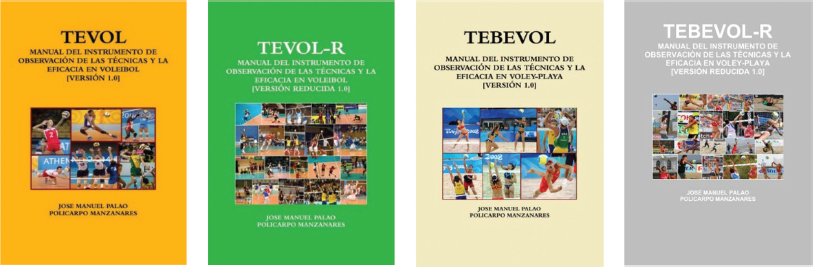
Figure 1. Cover page of the TEVOL and TEBEVOL instrument observer’s manual (full and reduced version). The manuals are available for download at the following links: TEVOL full version (Palao & Manzanares, 2009a), TEVOL-R, reduced version (Palao & Manzanares, 2009b), TEBEVOL, full version (Palao & Manzanares, 2009c), and TEVOL-R, reduced version (Palao & Manzanares, 2009d, TEBEVOL-R)
Note: The manual of the TEBEVOL is also available in Portugues.
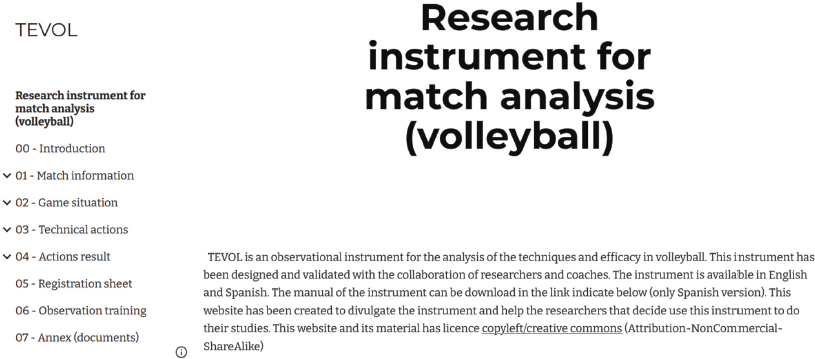
Figure 2. Front page of the TEVOL instrument website (link). The web page describes the TEVOL instrument and provides material to learn how to use this observation instrument. The web page is written in English, Spanish, and Portuguese
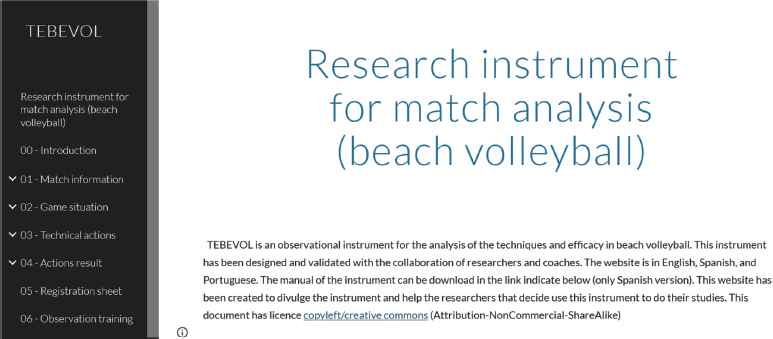
Figure 3. Front page of the TEBEVOL instrument website (link). The web page describes the TEVOL instrument and provides material to learn how to use this observation instrument. The web page is written in English, Spanish, and Portuguese
The purpose of the training is the observer knows the categories of the observation instrument, and he/she is able to identify them, and record them. Traditionally, a written document has been used to describe the variables, and it is normal to find tables, graphs, and drawings. The use of web pages (HTML) allows the incorporation of video sequences and presentations to support or control the training process. The use of a web page for the training process allows observers to access the information in a non-linear way, so depending on the observer level and needs they could adapt the process (e.g., jump from one variable to another). This online resource allows us to access it anywhere there is Internet access and serves as a guide for the training process and data collection.
The use of web pages allows training to combine text with graphics that describe the instrument, video presentations that highlight the most important aspects in a simplified and schematic way, and video playlists that allow the development of the ability to identify the actions explained. This combination of text, graphics, and videos facilitates the observer’s understanding of variables. After reviewing the variables and learning about them, the web page includes material to develop trainee observers’ ability to identify the categories of each variable. After describing the variables and examples, a section with common questions (F.A.Q.) or special situations was included. Two types of presentations were generated from the material created for observer training.
A. Presentations with the description of the variables (Figure 4). In this type of presentation, the observer learns about the variables, how to difference for others, and how the variables are recorded. For observers with experience in the analysis of the game or with previous knowledge of volleyball, the process can be performed using a presentation that describes the variables instead than from the manual. These presentations, in addition to the description of the variables, included videos showing examples of the different categories of each variable.
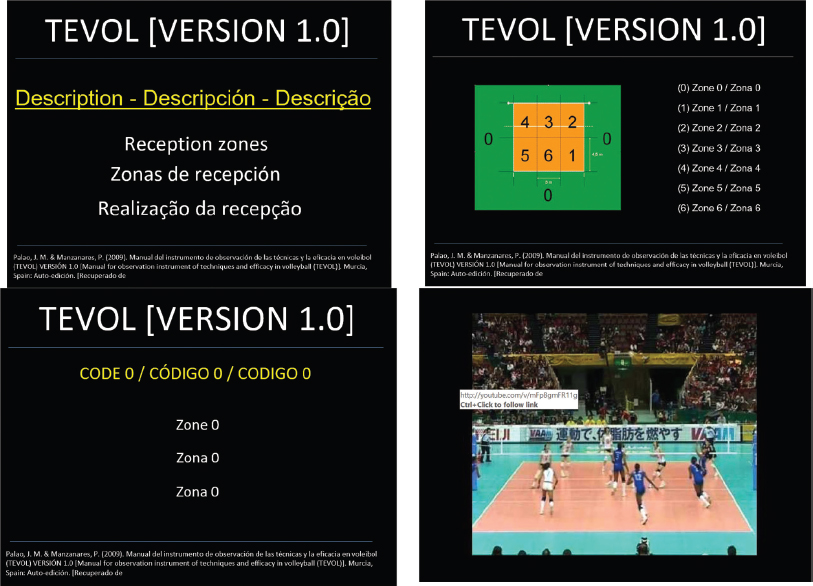
Figure 4. Example of slides and videos of the descriptive presentations of the training material for the TEVOL instrument. The presentation is written in English, Spanish, and Portuguese
B. Presentations for monitoring of the training process (Figure 5). In this presentation, the observer checks the degree of mastery in the observation of the instrumental variables. This allows him/her to determine whether it is necessary to revisit the description of the variable, the description of the categories, or the special situations or F.A.Q. (text, presentation, or videos).
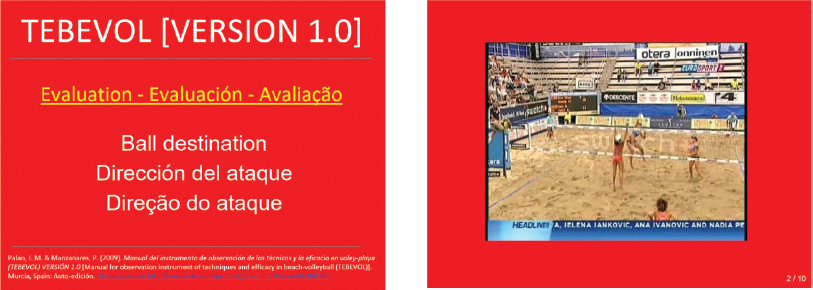
Figure 5. Example of a control presentation of the training process of the TEBEVOL observation instrument. The presentation is written in English, Spanish, and Portuguese
The incorporation of video sequences (playlist) allowed the observer to visualize while becoming familiar with the instrument’s categories (Figure 6). Thus, passive learning (reading the description of the variables) is combined with active learning (identifying the variables in the video). Once the observer knows the variables of the instrument and how to identify them, the next step of the process is the identification of the variables first in isolated video sequences of game complexes and then in match sets. After that phase, the next step is to carry out the observation under the same conditions as the observation is going to be performed to evaluate the reliability of the observers after her/his training. The use of online video platforms such as YouTube or Vimeo allows the inclusion of these videos on the web page and the visualization of these videos as part of the training process.
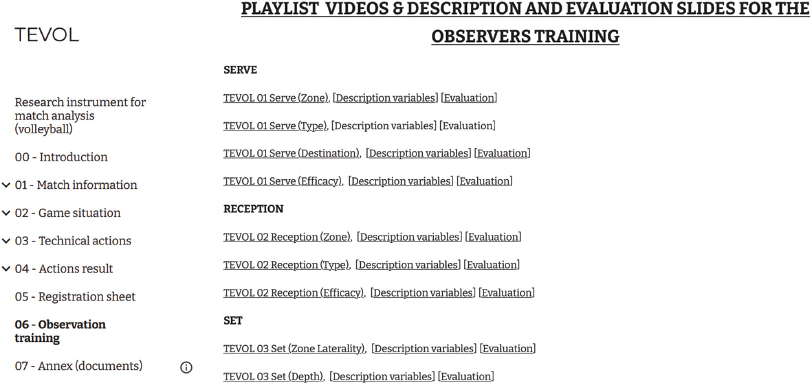
Figure 6. Examples of video sequence for the training process of observers in the use of the TEVOL instrument
Note: In our research group, observer training uses as a reference that the trainee observer achieves at least 70% correct answers to move on to the next phase of the training process.
In the training process, the observer must acquire the ability to record observations. This recording can be performed on a paper recording template, spreadsheet, or movement observation software (e.g., Lince). On the instrument’s website, reference templates for logging can be found in the PDF format, spreadsheet (Figure 7), and Lince software. If spreadsheets are used for recording, the use of descriptive supporting comments in the column header of each variable, formulas with alerts to detect combinations of variables that are not possible (e.g., a serve send that was out and that it is a point with the server (ace)), or the limitation of which codes can be entered into the cells of the different columns (e.g., values between 0 and 4) can help to reduce errors in the training process and data collection. The use of an online spreadsheet during training allowed us to control the training process. When an instrument is used in observation software such as Lince, quality control of the observers’ observations during the training process can be performed in the software.
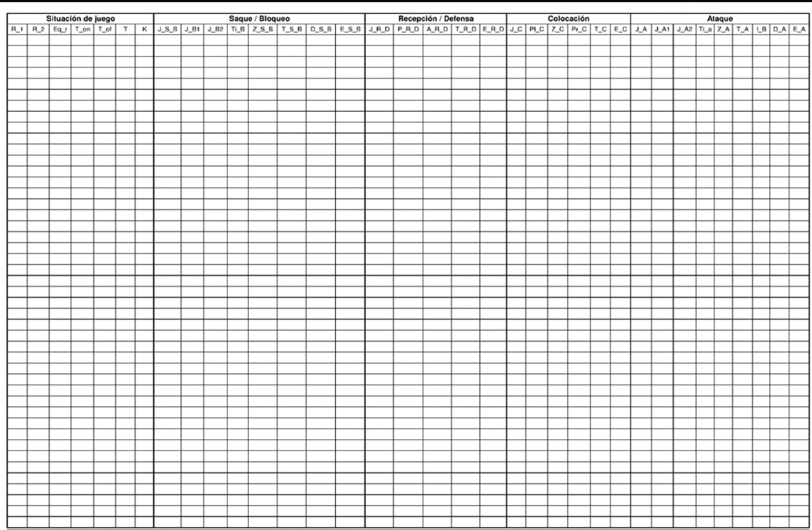
Figure 7. TEVOL instrument log sheet in a spreadsheet. The log sheet is available in English, Spanish, and Portuguese
On the web page, it is also possible to find supporting documents with a description of the variables or recording code. These documents are useful for assisting observers in the training and recording processes. It is common to have these support documents in hand to facilitate and expedite the observation process. These support documents help to refresh the memory and recall the observation criteria and variable coding codes (Figure 8).
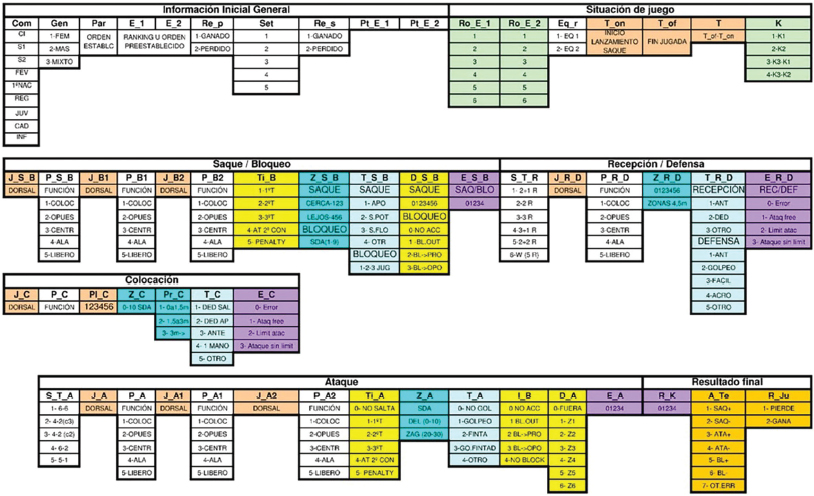
Figure 8. Support sheet for remembering the variables for recording the TEVOL instrument. The support sheet is available in English, Spanish, and Portuguese
Conclusions
The use of different technological tools facilitates the observer training process by allowing the incorporation of videos into the training process, allowing each observer to pace him/herself and self-monitor the process. Training material (description, examples, and observation exercises) can be used in a linear or nonlinear manner. However, it should be noted that the generation of this material requires extra time. The development and validation of the instrument and training observers in the use of the observation instrument require time and effort.
The final objective of this study is to make the TEVOL and TEBEVOL observation instruments known so other researchers and coaches can use them. TEVOL and TEBEVOL observation instruments have a copyleft license and can be used in whole, in part, or adapted. The researchers and coaches who have collaborated in the development and validation process of this instrument believe that collaborative work is what allows our society and volleyball sports to evolve. We would also like to invite other researchers and coaches to join the project to improve it or develop new versions of it.
Bibliographic references
Anguera, M. T. (2003). Observational Methods (General). In R. FernándezBallesteros (ed.), Encyclopedia of Psychological Assessment, Vol. 2 (pp 632-637). London, UK: Sage.
Behar, J. (1993). Sesgos del observador [Observer slant]. In M. T. Anguera et al. (eds.), Metodología observacional en la investigación psicológica - Volumen II (pp. 27-76) [Observational methodology in psychology research - Volume II]. 1st edition. Barcelona, SP: Promociones y publicaciones Universitarias.
Coleman, J. E., Neville, B., & Gordon, B. (1969). A statistical system for volleyball and its use in Chicago Women’s Association. International Volleyball Review, 17, 72-73.
Díaz, P. (1997). Voleibol: la dirección de equipo: métodos estadísticos y evaluación competitiva. Wanceulen.
Merino, C., & Livia, J. (2009). Intervalos de confianza asimétricos para el índice la validez de contenido: Un programa Visual Basic para la V de Aiken [Assymetric confidence intervals for content validity index: A Visual Basic software for Aiken’s V]. Anales de Psicología, 25(1), 169-171.
Ntoumanis, N. (2001). A step-by-step guide to SPSS for sport and exercise studies. London: Routledge.
Palao, J. M. (2012). Apoyo científico al entrenamiento. Un caso práctico de diseño y aplicación de apoyo al alto rendimiento [Scientific support for sport training. A case study of the design and application of support to peak performance]. Apunts: Educación Física, 110, 52-60. https://doi.org/10.5672/apunts.2014-0983.es.(2012/4).110.06
Palao, J. M., & Hernández-Hernández, E. (2014). Game statistical system and criteria used by Spanish volleyball coaches. International Journal of Performance Analysis in Sport, 14(2), 564-573. https://doi.org/10.1080/24748668.2014.11868743
Palao, J. M., & Manzanares, P. (2009a). Manual del instrumento de observación de las técnicas y la eficacia en voleibol (TEVOL - VERSIÓN 1.0) [Manual of the observation instrument of techniques and efficacy in volleyball (TEVOL - VERSIÓN 1.0)]. Murcia, España: Edición propia. https://www.lulu.com/shop/policarpo-manzanares-and-jose-m-palao/tevol/ebook/product-1qzv5827.html
Palao, J. M., & Manzanares, P. (2009b). Manual del instrumento de observación de las técnicas y la eficacia en voleibol (TEVOL-R - VERSIÓN REDUCIDA 1.0) [Manual of the observation instrument of techniques and efficacy in volleyball (TEVOL-R - REDUCED VERSIÓN 1.0)]. Murcia, España: Edición propia. https://www.lulu.com/shop/policarpo-manzanares-and-jose-m-palao/tevol-reducido/ebook/product-1gvmykqj.html
Palao, J. M., & Manzanares, P. (2009c). Manual del instrumento de observación de las técnicas y la eficacia en voley-playa (TEBEVOL - VERSIÓN 1.0) [Manual of the observation instrument of techniques and efficacy in beach volleyball (TEBEVOL - VERSIÓN 1.0)]. Murcia, España: Edición propia. https://www.lulu.com/shop/policarpo-manzanares-and-jose-m-palao/tebevol/ebook/product-1j9gyp5p.html
Palao, J. M., & Manzanares, P. (2009d). Manual del instrumento de observación de las técnicas y la eficacia en voley-playa (TEBEVOL-R - VERSIÓN REDUCIDA 1.0) [Manual of the observation instrument of techniques and efficacy in beach volleyball (TEBEVOL-R - REDUCED VERSIÓN 1.0)]. Murcia, España: Edición propia. https://www.lulu.com/shop/policarpo-manzanares-and-jose-m-palao/tebevol-reducido/ebook/product-159kvw4y.html
Palao, J. M., Manzanares, P., & Ortega, E. (2015a). Design and validation of an observation instrument for technical and tactical actions in indoor volleyball. European Journal of Human Movement, 34, 75-95. https://eurjhm.com/index.php/eurjhm/article/view/332
Palao, J. M., Manzanares, P., & Ortega, E. (2015b). Design and validation of an observational instrument for technical and tactical actions in beach volleyball. Motriz, 21(2), 137-147. https://doi.org/10.1590/S1980-65742015000200004
Penfield, R. D., & Giacobbi, P. R. (2004). Applying a score confidence interval to Aiken’s item content-relevance index. Measurement in Physical Education and Exercise Science, 8(4), 213-225. https://doi.org/10.1207/s15327841mpee0804_3
Silva, M., Marcelino, R., Lacerda, D., & João, P. V. (2016). Match Analysis in Volleyball: a systematic review. Montenegrin Journal of Sports Science and Medicine, 5(1), 35. https://www.mjssm.me/?sekcija=article&artid=120
Tabachnick, B. G., & Fidell, L. S. (2001). Using multivariate statistics (3rd ed.). New York: Harper Collins.
Trochim, W., & Donnelly, J. P. (2007). The research methods knowledge base (3rd edition). Mason, OH: Cengage Learning-Atomic Dog.
* Corresponding author: Jose M. Palao Andrés, palaoj@uwp.edu
Received: January 16, 2025
Accepted: January 20, 2026
Published: June 30, 2026
How to cite: Palao Andres, J. M., Manzanares, P., Hernández-Hernández, E., Echeverria, C., Valades, D., López-Martínez, A. B., Medeiros, A., Perez-Piñero, S., Alvarado-Ruano, R., Ortega-Toro, E. (2026). Observational instruments for technique and efficacy of volleyball (TEVOL) and of beach volleyball (TEBEVOL), and material for observer training in their usage. JUMP, 13, 19-29. https://doi.org/10.17651/jump.n13.944

This is an open access article under the CC-BY 4.0 license