CSR CO-CREATION ON DIGITAL PLATFORMS AS A STRATEGY TO INFLUENCE CONSUMER HAPPINESS
LA CO-CREACIÓN EN MATERIA DE RSC EN PLATAFORMAS DIGITALES COMO ESTRATEGIA PARA INFLUIR EN LA FELICIDAD DE LOS CONSUMIDORES
Pedro Cuesta-Valiño (Universidad de Alcalá, Madrid, España)1
Estela Núñez-Barriopedro (Universidad de Alcalá, Madrid, España)2*
Yanhua Yang (Universidad de Alcalá, Madrid, España)3
Abstract
In the context of digitalization and the expansion of collaborative platforms, the logic of Corporate Social Responsibility (CSR) is undergoing a process of structural transformation. The traditional company-centered and one-way communication approach is gradually being replaced by a co-creation model of responsibility in which consumers, communities, and digital platforms jointly participate in the generation of shared social value. This study analyses how the digital co-creation of platform-based CSR affects consumer happiness, considering the mediating role of collective emotions, social capital and perceived behavioral control. To this end, a structural equation model (PLS-SEM) is applied based on 517 questionnaires collected from active users of CSR platforms in China. The research findings show that the co-creation of digital CSR significantly improves consumers' collective emotions, social capital and perceived behavioural control, thereby affecting their hedonic and eudaimonic happiness. These findings provide a new perspective on how digital platforms can act as ecosystems of happiness, integrating well-being, social responsibility and civic participation into business strategy. Consequently, the study highlights the strategic value of digital participation mechanisms in CSR as catalysts for consumer happiness, providing theoretical and practical implications for the design of responsible management models.
Keywords: CSR, collective emotions, social capital, perceived behavioral control, consumer happiness.
JEL Codes: E62, H30
Resumen
En el contexto de la profunda digitalización y expansión de las plataformas colaborativas, la lógica de la Responsabilidad Social Corporativa (RSC) se encuentra en un proceso de transformación estructural. El enfoque tradicional, centrado en la empresa y basado en una comunicación unidireccional, está siendo sustituido por un modelo de co-creación de responsabilidad, donde múltiples actores; consumidores, comunidades y plataformas digitales, interactúan en la generación de valor social compartido. Este estudio analiza cómo la co-creación digital de la RSC basada en plataformas incide en la felicidad del consumidor, considerando el papel mediador de las emociones colectivas, el capital social y el control del comportamiento percibido. Para ello, se aplica un modelo de ecuaciones estructurales de segundo orden (PLS-SEM) a partir de 517 cuestionarios recogidos entre usuarios activos de plataformas de RSC en China. Los resultados de la investigación muestran que la co-creación de RSE digital mejora significativamente las emociones colectivas de los consumidores, el capital social y el control del comportamiento percibido, afectando así su felicidad hedónica y eudaimónica de los consumidores. Estos hallazgos aportan una nueva perspectiva sobre cómo las plataformas digitales pueden actuar como ecosistemas de felicidad, integrando el bienestar, la responsabilidad social y la participación cívica en la estrategia empresarial. En consecuencia, el estudio subraya el valor estratégico de los mecanismos de participación digital en la RSC como catalizadores de felicidad del consumidor, aportando implicaciones teóricas y prácticas para el diseño de modelos de gestión responsables.
Palabras clave: Plataformas digitales, RSC, co-creación, control percibido del comportamiento, felicidad del consumidor.
Códigos JEL: E62, H30
Fecha de envío: 25/01/2026. Fecha de aceptación: 27/07/2026
1. Introduction
Corporate social responsibility (CSR) has long been considered a supplementary responsibility for businesses, beyond their economic objectives. CSR encompasses more than simply pursuing shareholder value; it also encompasses ethical and responsible obligations to society, the environment, and other stakeholders (Carroll, 1991; Cuesta-Valiño et al., 2024b). The traditional CSR model is largely corporation-centered, emphasizing initiatives that are proactively launched and dominated by firms. The public, consumers, and other stakeholders typically passively accept these activities. This type of CSR primarily takes the form of charitable donations (Saha et al., 2023), environmental donations (Wu et al., 2021), advertising campaigns (Mercadé-Melé et al., 2018), and the publication of corporate social responsibility reports. The fundamental characteristic of these activities is one-way information transmission: companies demonstrate their responsible behavior to the public through external communication channels (Offermann et al., 2024), while the public primarily receives information and forms perceptions.
This traditional CSR model does help enhance a company's reputation and brand image (Kim et al., 2020), and to a certain extent, fosters trust between the company and society. However, it also has limitations. Due to a lack of practical channels for public participation, public awareness of CSR is low (Öberseder et al., 2011), lacking emotional investment and behavioral extension. A company's stakeholders also generally have a low level of awareness of its CSR activities (Du et al., 2010; Pomering & Dolnicar, 2009). Furthermore, CSR activities are weakly connected to the public's daily lives, making it difficult to establish long-term resonance in users' value systems. Consequently, traditional CSR is more of an external statement by company than a genuine social co-creation, and its role in improving consumers' happiness and life experience is limited, although existing research has shown that CSR can significantly improve individual well-being under certain conditions (Mercader et al., 2025).
With the advancement of the internet and digital technologies, the platform economy has continued to evolve. Consumers and businesses can interact more directly (Abbate et al., 2022; Alghamdi & Agag, 2024; Iglesias et al., 2020). The widespread use of digital tools such as social media, big data, mobile applications, and generative artificial intelligence has profoundly transformed the practice and communication logic of CSR (Song et al., 2025). Unlike the one-way communication of traditional CSR, CSR in a digital context is more transparent, traceable, and interactive. This digital transformation also echoes the views on customer-centric integration and touchpoint synergy in omnichannel management research (Alonso-Garcia et al., 2023), emphasizing the integration of diverse interactive scenarios through digital mechanisms. Digital platforms have enabled new modes of communication between businesses and users, creating instant interactions and feedback loops (Alhumud et al., 2025; Cuesta-Valiño et al., 2023b; Kent & Taylor, 2021), thereby encouraging active public participation in CSR practices. This is especially true in social media environments, where CSR-related content can significantly enhance user interaction and engagement (Castillo-Abdul et al., 2024). Related research shows that in the context of social media, brand content related to social responsibility is more likely to stimulate user interaction and engagement (Castillo-Abdul et al., 2022), highlighting the engagement potential of CSR issues in digital communication. Platforms are not only a window for businesses to demonstrate their responsible behavior but also a crucial venue for connecting with users, guiding participation, and co-creating value. Through the intervention of digital technology, CSR behaviors can be recorded in real time, providing immediate feedback and rapidly spreading through the communication effects of social networks (Chu et al., 2020; Okazaki et al., 2020). As a result, the public is no longer just a passive recipient of CSR but has become an active participant in responsible practices and a co-creator of value (Zhou et al., 2024).
In the digital era, the core characteristics of CSR have shifted from traditional one-way communication to a communication logic that integrates platformization and community. Digital CSR co-creation is not limited to individual user participation. First, leaderboard incentives are an external driving mechanism (Mekler et al., 2017). Through forms such as point rankings and public welfare contribution rankings, individual user behavior is transformed into visible group comparisons and incentives, enhancing the fun of participation and strengthening the willingness to continue participating in an atmosphere of competition and cooperation. Second, user-generated content (Sang et al., 2024) reflects the initiative and creativity of users in digital CSR. They are not only recipients of CSR information but also promote the diffusion of CSR values by generating, disseminating, and even adapting CSR-related content (such as sharing public welfare stories, low-carbon living experiences, and public welfare challenges). Through reflective expressions such as leaderboard incentives and user-generated content, the interactivity, participation, and sustainability of digital CSR can be empirically captured.
Driven by digital platforms, CSR has gradually transcended the traditional limitations of one-way corporate responsibility fulfillment, shifting to an interactive model that emphasizes the co-creation of value between companies and users. With this shift, users' psychological experiences and emotional responses have become a new research focus. Academic research on happiness often distinguishes between hedonic well-being and eudaimonic well-being: the former emphasizes the acquisition of pleasure and the avoidance of pain, while the latter focuses on the pursuit of meaning and self-actualization (Ravina-Ripoll et al., 2023). Accordingly, some literature has proposed two approaches to happiness, namely hedonic happiness and eudaimonic happiness, which more specifically address the subjective experience and evaluation of individuals (Ryan et al., 2008). Hedonic happiness focuses on immediate pleasure, satisfaction, and positive emotions, such as joy, relaxation, and contentment; eudaimonic happiness emphasizes deeper values and a sense of social contribution, involving individual self-growth and goal achievement. In contrast, well-being is more of a macro, framework concept, while happiness is more directly related to users' psychological experiences in interactive situations. When the concept is used in the consumer field, to avoid confusion, only the term happiness is used (Cuesta-Valiño et al., 2023a). Existing research has confirmed the applicability of the dual-path happiness model in areas such as consumer experience, tourism services, and public welfare marketing (Armbrecht & Andersson, 2019; Li et al., 2025a). Happiness management has also been extended to the level of university entrepreneurship and organizational strategy (Cuesta-Valiño et al., 2024c). Furthermore, research in different contexts has shown a significant correlation between happiness and behavioral outcomes. For example, in marketing contexts, emotions play a crucial role in purchasing decisions, and happiness can be strategically stimulated to maintain the consumption cycle (Ahumada-Tello et al., 2025). In organizational management, Happiness Management significantly reduces employee turnover intention by lowering work stress, demonstrating a stress-relief mechanism of happiness (Martínez-Arvizu et al., 2025). In contrast, digital CSR co-creation does not simply promote consumption through emotional stimulation, but rather shapes a more socially meaningful experience of happiness through social participation and value co-creation mechanisms. For the purposes of this article, we ultimately selected hedonic happiness and eudaimonic happiness as the core analytical dimensions.
The happiness generated by platform-based digital CSR co-creation is not solely driven by individual emotional and cognitive changes but is influenced by community interactions and socio-psychological mechanisms. First, collective emotions are prevalent in online communities (Penelas-Leguía et al., 2023). When users interact with others in virtual tasks, the group atmosphere often amplifies individual positive experiences and strengthens the intensity of happiness. Second, CSR strengthens social capital among users through interactive mechanisms (Lin, 2022), including trust, reciprocity, and the expansion of social networks. This social capital not only enhances a sense of community belonging and social support but also strengthens users' willingness to continue participating. Finally, when engaging in digital CSR activities, users tend to evaluate the effectiveness of their own actions, a phenomenon known as perceived behavioral control (Shi et al., 2025). When users are convinced that their small actions (such as online check-ins, charitable donations, or green consumption) can lead to tangible social or environmental improvements, their sense of meaning and value is strengthened, thereby driving the generation of happiness.
Therefore, platform-based digital CSR is not only a new form of social responsibility but also a crucial mechanism for stimulating consumers' multidimensional well-being. Through interaction and co-creation, it promotes the synergistic generation of hedonic and eudaimonic happiness, extending CSR from social responsibility to the co-creation of happiness. However, existing literature largely fragments its discussion of specific variables or mechanisms, lacking a systematic framework to uncover how group emotions, social capital, and perceived behavioral efficacy synergize to generate the dual pathways of consumer well-being.
While traditional CSR is primarily enterprise-led and one-way, in the context of digitalization and the platform economy, digital CSR emphasizes interaction and consumer participation (Zhou et al., 2024). This transformation not only enhances the transparency and sustainability of CSR practices but also provides users with a new model of engagement and a positive experience. However, current research on digital CSR focuses primarily on firm performance (Han et al., 2024), satisfaction (Rehman et al., 2025), and purchase intention (Gupta et al., 2021). Research on how digital CSR influences consumer well-being through psychological and social mechanisms remains limited. Two key research gaps can be identified. First, limited research has examined how digital CSR influences consumer happiness through integrated psychological and social mechanisms. Second, despite the prominence of the dual-path perspective of happiness in positive psychology, its application to platform-based CSR co-creation remains limited, particularly in terms of developing a unified framework that explains how digital CSR simultaneously contributes to both hedonic and eudaimonic happiness.
To address these gaps, this study makes two main contributions. First, based on the dual-pathway theory of happiness, it explores in depth how CSR co-creation on digital platforms influences consumer happiness through psychological and social mechanisms such as group emotions, social capital, and perceived behavioral control. Second, it constructs and validates an integrative framework to reveal the pathways and interrelationships between different mechanisms in promoting hedonic and eudaimonic happiness. This research aims to deepen understanding of the social-psychological value of digital CSR, enrich theoretical perspectives on CSR and happiness research, and provide theoretical support and practical insights for companies to enhance consumer happiness, strengthen customer retention, and achieve social and environmental sustainability through digital platforms.
2. Theoretical framework
This study proposes a theoretical model (Figure 1) to explain how platform-based digital CSR co-creation influences consumer happiness. Specifically, digital CSR co-creation is expected to affect both hedonic happiness and eudaimonic happiness through key psychological and social mechanisms, including collective emotions, social capital, and perceived behavioral control. The model contains 9 hypotheses.
FIGURE 1. THEORETICAL MODEL
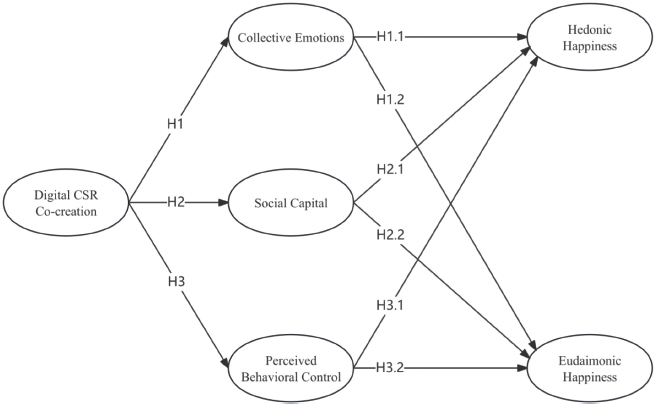
Source: Prepared by the authors.
2.1. Collective emotions
Collective emotions refer to a macro-level emotional phenomenon. They are not simply the sum of individual emotions, but rather the shared emotional experiences that emerge from the interactions of multiple individuals facing the same situation (e. g., emotional contagion, emotional resonance, and polarization) (Goldenberg et al., 2020; Von Scheve & Ismer, 2013). Unlike individual emotions, group emotions not only spread through direct emotional expression and imitation (Barsade, 2002) but are also reinforced by social identification and shared values among group members (Von Scheve & Ismer, 2013). Previous research has shown that group emotions play a key role in teamwork (Barsade, 2002), organizational performance (Barsade & Knight, 2015), and social movements (Van Zomeren et al., 2004). They can enhance cohesion among members, promote cooperation, and enhance the overall sense of efficacy of the group.
In digital CSR co-creation scenarios, users use online platforms to record, showcase, and share their charitable activities, pursuing social or environmental goals with others (Núñez-Barriopedro et al., 2023b). This process not only provides individuals with positive emotional feedback (such as satisfaction and a sense of accomplishment), but more importantly, it fosters a shared collective sentiment through interaction and co-creation. Specifically, witnessing the charitable actions of others creates an emotional resonance, which is further amplified through likes, comments, and reposts (Penelas-Leguía et al., 2023). Witnessing the achievement of a goal together strengthens users' collective pride and sense of belonging. As positive group sentiment accumulates, the platform's charitable atmosphere is continuously strengthened, creating a virtuous cycle.
Therefore, this paper proposes the following hypothesis:
H1: Digital CSR co-creation is positively correlated with collective emotions.
The Broaden-and-Build Theory in positive psychology suggests that positive emotions not only bring immediate pleasure but also expand an individual's scope of thought and behavior, gradually building psychological resources and social relationships (Fredrickson, 2001). In group settings, the emotions experienced by individuals spread and intensify through emotional contagion and resonance, ultimately forming shared emotions at the group level (Barsade, 2002). This shared positive collective emotions not only strengthen users' emotional connections during interactions but also, at a deeper level, reinforces their identification with social values and the meaning of life. In the context of digital CSR co-creation, the impact of collective emotions on customer happiness is particularly pronounced. On the one hand, collective emotions can directly enhance users' hedonic happiness through the emotional pleasure, satisfaction, and relief brought about by collective participation. When users work together to achieve public welfare goals, interactive behaviors such as likes, comments, and shares strengthen emotional resonance, allowing users to gain greater satisfaction from the immediate pleasure (Penelas-Leguía et al., 2023). On the other hand, collective emotions may also enhance users' eudaimonic happiness through goal congruence and social identity. When users perceive alignment with group members in values and social goals, they more strongly identify with the significance of public welfare activities, thereby experiencing a sense of self-growth, fulfillment, and social contribution (Ravina-Ripoll et al, 2023).
Therefore, this paper proposes the following hypothesis:
H1.1: Collective emotions are positively correlated with hedonic happiness.
H1.2: Collective emotions are positively correlated with eudaimonic happiness.
2.2. Social capital
Social capital can be understood as generated by relationship networks, reciprocity, trust, and social norms (Coleman, 1988; Putnam, 2000). It can bring informational, emotional, and cooperative benefits to individuals and groups. In traditional settings, social capital is typically accumulated gradually through long-term interactions, mutual support, and shared norms. In the context of digitalization and the platform economy, however, online interaction and user participation have become important new channels for the generation of social capital.
Digital CSR co-creation, through community communication, collaborative tasks, and interactive feedback mechanisms, provides important conditions for building trust and reciprocity among users. On the one hand, users' joint actions on the platform around social or environmental goals not only allow individuals to experience value recognition and a sense of accomplishment in practice (Wang et al., 2022) but also strengthen trust and emotional connections among groups. By achieving common goals, users enhance group cohesion and relationship commitment. On the other hand, the interactive mechanisms of digital platforms (such as likes, comments, sharing, and task collaboration) provide users with channels for emotional expression and information exchange (Wang et al., 2022). Social media research also shows that interactive brand content can significantly enhance user engagement and relationship building (Castillo-Abdul et al., 2021), creating conditions for the formation of trust and network relationships. These interactions can amplify emotional resonance (Lu et al., 2024) and promote the flow of useful information and social resources. As the frequency and depth of interactions increase, users gradually accumulate trust and network resources—social capital—that can be leveraged in future collaborations. Over time, this network of relationships based on interaction and co-creation not only enhances users' willingness to cooperate but also fosters an atmosphere of mutual assistance, support, and belonging within the platform. Therefore, digital CSR co-creation is not only a new model for practicing corporate social responsibility but also an important mechanism for promoting and strengthening social capital among users.
Therefore, this paper proposes the following hypothesis:
H2: Digital CSR co-creation is positively correlated with social capital.
In the context of digital CSR co-creation, platforms provide a variety of interactive mechanisms, enabling consumers to gradually build trust and collaborative bonds through communication and collaboration, thereby promoting the generation and accumulation of social capital (Nahapiet & Ghoshal, 1998; Putnam, 2000). The emotional support and trust mechanisms inherent in social capital not only provide immediate positive experiences but also help individuals achieve deeper self-worth and happiness over the long term (Helliwell & Putnam, 2004). On the one hand, social capital provides users with enjoyable social experiences through interpersonal interaction and emotional support. On CSR platforms, users can receive immediate positive feedback by participating in public welfare challenges, sharing low-carbon lifestyles, and giving likes to others. They can also experience acceptance and recognition from the community through their interactions. This positive social experience provides users with psychological satisfaction and relaxation (Ellison et al., 2007), enhancing their emotional pleasure and well-being, thereby enhancing their hedonic happiness. On the other hand, social capital, through the long-term accumulation of mutually beneficial networks, provides users with a continuous channel for value realization. As users continuously build trust and mutual support through digital CSR co-creation, they gradually perceive their actions as not only personally meaningful but also contributing to the achievement of social and environmental goals. Through this positive connection between personal behavior and social value, users experience eudaimonic happiness through participation (Ravina-Ripoll et al, 2023).
Therefore, this paper proposes the following hypothesis:
H2.1: Social capital is positively correlated with hedonic happiness.
H2.2: Social capital is positively correlated with eudaimonic happiness.
2.3. Perceived behavioral control
Perceived behavioral control (PBC) is a core construct in the Theory of Planned Behavior (Ajzen, 1991). It refers to an individual's subjective perception of their ability and control over their ability to perform a particular behavior, taking into account internal capabilities and external conditions. PBC not only directly influences an individual's behavioral intention but may also play an independent role in actual behavior (Ajzen, 2002).
In the context of digital CSR co-creation, platforms provide convenient participation methods and instant feedback mechanisms, allowing users to contribute with low barriers to entry (Cuesta-Valiño et al, 2024a). Specifically, they can participate in public welfare through virtual tree planting (Zhang et al., 2021), online step donation (Li et al., 2025b), and click-to-support (Wang, 2023). These digital forms of interaction are often directly linked to real social or environmental outcomes. For example, platforms transform users' virtual actions into actual corporate public welfare contributions, thereby strengthening users' perception that their individual actions can lead to real, positive change. This enhanced sense of empowerment and control is a key manifestation of perceived control in digital CSR co-creation. Furthermore, digital CSR's interactive mechanisms (such as visual displays of task progress and collective goal achievement) not only enhance users' immediate feedback experience (Von Ahn & Dabbish, 2008) but also enhance their perception of control over their actions through increased transparency and traceability. Similarly, digital marketing research shows that users' perceptions of the usefulness of online mechanisms and their awareness of privacy significantly influence their attitudes and behavioral responses (Núñez-Barriopedro et al., 2023a), further highlighting the crucial role of cognitive assessment in technological contexts. As users continue to participate and witness the positive connections between their actions and external outcomes, their perceived control over their actions will further strengthen, fostering a stronger motivation for continued participation.
Therefore, this paper proposes the following hypothesis:
H3: Digital CSR co-creation is positively correlated with perceived behavioral control.
Increasing PBC enhances happiness through two pathways. First, at the level of hedonic happiness, users experience immediate satisfaction, ease, and pleasure when completing tasks and achieving goals. This satisfaction stems from the belief that "I can do it" and the reinforcing effect of immediate feedback, enabling individuals to experience positive emotions during interactions. Second, at the level of eudaimonic happiness, higher PBC makes it easier for users to establish a direct causal connection between their actions and social/environmental goals. When users are convinced that their actions truly contribute to public welfare outcomes, they experience a stronger sense of self-efficacy, personal growth, and social contribution. This deep experience of meaning not only strengthens individuals' identification with the value of life but also further promotes long-term happiness and motivation for continued engagement (Ajzen, 2002; Caprara & Steca, 2005).
Therefore, this paper proposes the following hypothesis:
H3.1: Perceived behavioral control is positively correlated with hedonic happiness.
H3.2: Perceived behavioral control is positively correlated with eudaimonic happiness.
3. Methodology
The questionnaire survey for this study was developed to examine individuals' participation in digital CSR co-creation behaviors. All scales used a 5-point Likert scale (1 = strongly disagree, 5 = strongly agree) to ensure comparability of quantitative data and validity of statistical analysis.
The core variable measurement items of the questionnaire structure are shown in Table 1.
TABLE 1. CONSTRUCTS, ITEMS AND SOURCES
Variable |
Code |
Items |
Source (Adapted from) |
Digital CSR co-creation |
CSR1 |
Whenever I am at the top of the weekly rankings, I think the time and experience on digital CSR platform is worth it. |
|
CSR2 |
Receiving badges or certificates on digital CSR platform motivates me to engage in sustainable behaviors. |
||
CSR3 |
I care about my position on the energy ranking list very much. |
||
CSR4 |
I enjoy creating content related to digital CSR platform |
||
CSR5 |
I am willing to share my environmental actions or achievements on social media platforms. |
||
CSR6 |
I believe that the content I create or share can inspire more people to participate on digital CSR platform. |
||
Social capital (SC) |
SC1 |
Using digital CSR platform helps me to interact with my friends. |
|
SC2 |
I think that on digital CSR platform helping each other is a fair practice. |
||
SC3 |
Digital CSR platform has encouraged me to participate in more environmental public welfare activities. |
||
Collective emotions (CE) |
CE1 |
I feel happy when I see my friends completing public welfare tasks on digital CSR platform. |
|
CE2 |
The enthusiasm of other users on digital CSR platform influences me and makes me participate more actively. |
||
CE3 |
When we participate in CSR activities together on a digital CSR platform, I feel a sense of collective pride. |
||
Perceived behavioral control (PBC) |
PBC1 |
I am confident I will complete the game task on digital CSR platform and get the environment protection certificate. |
|
PBC2 |
While participating in activities on a digital CSR platform, I feel everything is under control. |
||
PBC3 |
I believe that my actions on digital CSR platform have a positive impact on society and the environment. |
||
Hedonic happiness (HH) |
HH1 |
In my opinion, using digital CSR platform is a pleasant way to spend leisure time. |
|
HH2 |
Playing digital CSR platform will make me feel very happy. |
||
HH3 |
I feel relaxed while participating in activities on a digital CSR platform. |
||
Eudaimonic happiness (EH) |
EH1 |
I feel a sense of achievement when I complete digital CSR activities on a platform. |
|
EH2 |
Using digital CSR platform has kept me in the process of growing and improving. |
||
EH3 |
Using digital CSR platform makes me feel that I am contributing to society. |
Source: Prepared by the authors.
The questionnaire survey for this study was conducted in 2025. The research object is the user group of digital CSR platform. To ensure the relevance of the sample and the pertinence of the study, the screening criteria are set as follows: respondents have participated digital CSR platform related activity at least once in the past three months. After collection and organization, a total of 517 valid questionnaires were obtained, providing a reliable data foundation for subsequent empirical analysis.
4. Results
Structural Equation Modeling (SEM) is a data analysis method for studying complex causal relationships between multiple variables. At present, there are two main methods for estimating relationships in structural equation models, including PLS-SEM and CB-SEM. This article chooses PLS-SEM as the empirical model analysis method. The main reason is that PLS-SEM is suitable for models that are in the exploratory stage and need further development (Hair et al., 2011). This article aims to explore how platform-based digital CSR co-creation affects hedonic happiness and eudaimonic happiness through collective emotions, social capital, and perceived behavioral control. This study is exploratory. This study employed SmartPLS 4 to estimate the proposed model using partial least squares structural equation modeling (PLS-SEM).
4.1. Evaluation of measurement models
Firstly, there is a reliability test. In PLS-SEM, it is necessary to conduct evaluation tests on reflective variables. In the structural model of this article, all latent variables are reflective variables. The reliability test results are shown in Table 2. This article conducted a calculation and verification of factor loadings, and all factor loadings were higher than the recommended value of 0.7. This article tested the Cronbach's alpha and Composite Reliability (CR) of each latent variable (Henseler et al., 2009). The Cronbach's alpha of all latent variables is greater than 0.70, and the Composite Reliability (CR) exceeds the recommended value of 0.80, indicating good internal consistency and measurement stability of each latent variable.
TABLE 2. RELIABILITY ANALYSIS
Loading |
Cronbach's alpha |
Composite reliability (rho_c) |
Average variance extracted (AVE) |
||
Digital CSR co-creation |
CSR1 |
0.84 |
0.916 |
0.934 |
0.704 |
CSR2 |
0.875 |
||||
CSR3 |
0.857 |
||||
CSR4 |
0.836 |
||||
CSR5 |
0.837 |
||||
CSR6 |
0.787 |
||||
Collective emotions |
CE1 |
0.887 |
0.898 |
0.936 |
0.83 |
CE2 |
0.925 |
||||
CE3 |
0.92 |
||||
Social capital |
SC1 |
0.924 |
0.831 |
0.891 |
0.732 |
SC2 |
0.887 |
||||
SC3 |
0.746 |
||||
Perceived behavioral control |
PBC1 |
0.788 |
0.778 |
0.87 |
0.691 |
PBC2 |
0.831 |
||||
PBC3 |
0.872 |
||||
Hedonic happiness |
HH1 |
0.902 |
0.881 |
0.924 |
0.803 |
HH2 |
0.925 |
||||
HH3 |
0.859 |
||||
Eudaimonic happiness |
EH1 |
0.859 |
0.849 |
0.909 |
0.769 |
EH2 |
0.891 |
||||
EH3 |
0.88 |
Source: Prepared by the authors.
In terms of convergent validity, it is tested from the perspectives of "external load" and average variance extraction (AVE). The factor loadings of each latent variable meet the requirements. Meanwhile, Table 2 shows that the AVE value meets the criterion of being greater than 0.5 (Fornell & Larcker, 1981), indicating that the latent variable has good convergent validity.
In terms of discriminant validity, as shown in Table 3, the square root (diagonal position) of the AVE of each latent variable is higher than its correlation coefficient with other latent variables, which meets the discriminant validity requirements of the Fornell Larcker criterion (Fornell & Larcker, 1981).
TABLE 3. FORNELL-LARCKER
CE |
CSR |
EH |
HH |
PBC |
SC |
|
CE |
0.911 |
|||||
CSR |
0.755 |
0.839 |
||||
EH |
0.7 |
0.666 |
0.877 |
|||
HH |
0.508 |
0.616 |
0.58 |
0.896 |
||
PBC |
0.742 |
0.646 |
0.68 |
0.463 |
0.831 |
|
SC |
0.209 |
0.21 |
0.201 |
0.067 |
0.271 |
0.856 |
Source: Prepared by the authors.
The requirement for evaluating discriminant validity using HTMT values is that the HTMT value should not exceed 0.9 (Henseler et al., 2015). According to Table 4, discriminant validity was assessed using HTMT. All HTMT values were below the recommended threshold of 0.90, indicating that the constructs are empirically distinct and that discriminant validity is established.
TABLE 4. HTMT
CE |
CSR |
EH |
HH |
PBC |
SC |
|
CE |
||||||
CSR |
0.825 |
|||||
EH |
0.802 |
0.752 |
||||
HH |
0.540 |
0.677 |
0.667 |
|||
PBC |
0.896 |
0.757 |
0.829 |
0.504 |
||
SC |
0.208 |
0.217 |
0.213 |
0.087 |
0.321 |
Source: Prepared by the authors.
4.2. Structural model evaluation
Prior to testing the structural relationships, collinearity was assessed. All inner VIF values were below the recommended threshold of 3.3, indicating that multicollinearity is not a concern in the model.
This study used Bootstrap sampling method (repeated sampling 5000 times) to test the significance of the model path coefficients. The results in Table 5 indicate that most of the research hypotheses have been supported. Specifically, digital CSR co-creation (CSR) has a significant positive impact on collective emotions (CE), perceived behavior control (PBC), and social capital (SC) (β=0.755, p<0.001; β=0.646, p<0.001; β=0.21, p<0.001). Collective emotions (CE) have significant positive effects on eudaimonic happiness (EH) and hedonic happiness (HH), respectively (β=0.436, p<0.001; β=0.368, p<0.001). Perceived behavioral control (PBC) also significantly positively affects eudaimonic happiness (EH) and hedonic happiness (HH) (β=0.353, p<0.001; β=0.208, p<0.001). However, the effects of social capital (SC) on eudaimonic happiness (β=0.014, p=0.667) and hedonic happiness (β=-0.066, p=0.103) did not reach statistical significance, indicating that these two pathway hypotheses are not supported. Social capital did not significantly enhance happiness in digital CSR co-creation contexts, possibly because the social capital formed in platform settings is mostly weak ties and instrumental connections, lacking deep emotional support. In contrast, collective emotions and perceived behavioral control, as more direct psychological mechanisms, are more easily translated into subjective well-being. Therefore, in digital co-creation environments, emotions and a sense of participation play a more crucial role than the relational structure itself.
TABLE 5. SUMMARY OF HYPOTHESIS TESTING RESULTS
Hypothesis |
Path |
β |
t-value |
p-value |
Results |
H1 |
CSR -> CE |
0.755 |
26.049 |
0 |
Support |
H1.1 |
CE -> HH |
0.368 |
5.674 |
0 |
Support |
H1.2 |
CE -> EH |
0.436 |
7.675 |
0 |
Support |
H2 |
CSR -> SC |
0.21 |
6.359 |
0 |
Support |
H2.1 |
SC -> HH |
-0.066 |
1.631 |
0.103 |
Not supported |
H2.2 |
SC -> EH |
0.014 |
0.43 |
0.667 |
Not supported |
H3 |
CSR -> PBC |
0.646 |
13.693 |
0 |
Support |
H3.1 |
PBC -> HH |
0.208 |
3.646 |
0 |
Support |
H3.2 |
PBC -> EH |
0.353 |
6.644 |
0 |
Support |
Source: Prepared by the authors.
This study evaluated the predictive ability of the model using the PLSpredict program. As shown in Table 6, the R² and Q² prediction values for all latent variables are greater than zero, indicating that the model has good explanatory and predictive power. Specifically, the Q² values for collective emotions (CE), eudaimonic happiness (EH), and perceived behavioral control (PBC) are 0.563, 0.427, and 0.407, suggesting moderate to strong predictive relevance. The Q² value for hedonic happiness (HH) is 0.326, indicating acceptable predictive ability. In contrast, the Q² value for social capital (SC) is relatively low (0.04), suggesting limited predictive relevance. The overall results indicate that the model demonstrates satisfactory predictive power for the main constructs.
TABLE 6. DETERMINATION COEFFICIENT AND PREDICTIVE POWER OF STRUCTURAL MODEL
R-square |
Q²predict |
|
CE |
0.569 |
0.563 |
EH |
0.548 |
0.427 |
HH |
0.279 |
0.326 |
PBC |
0.417 |
0.407 |
SC |
0.044 |
0.04 |
Source: Prepared by the authors.
5. Discussion
5.1. Theoretical implications
Firstly, this study introduces the concept of digital CSR co-creation, in response to the trend of CSR transformation from one-way responsibility of enterprises to co-creation between enterprises and users in the digital context (Lin & An, 2025; Morsing & Schultz, 2006; J. Zhang et al., 2024). This conceptual construction not only enriches the extension of CSR theory in the context of digital platforms, but also provides a feasible measurement framework for subsequent research. Furthermore, it can be embedded within an omnichannel integration perspective, whereby firms achieve collaborative interaction and value co-creation with users through multiple digital touchpoints (Alonso-Garcia et al., 2021).
Secondly, this study introduces three psychological and social mechanisms, namely collective emotions, social capital, and perceived behavioral control, as mediating variables to reveal how platform interactive behavior indirectly affects consumer happiness. Traditional CSR research often suggests that CSR perception directly drives consumer purchasing behavior or brand loyalty (Becker-Olsen et al., 2006; Bianchi et al., 2019; Lichtenstein et al., 2004). However, previous studies have shown that the impact of CSR on consumer behavior does not occur automatically, but depends on consumers' emotional identification, attribution judgments (Sen & Bhattacharya, 2001; Vlachos et al., 2009), and psychological mechanisms (Lee et al., 2021). One finding of this study is that, in the context of digital CSR co-creation, social capital does not significantly enhance eudaimonic or hedonic happiness. While digital CSR activities significantly increase social capital, the structural relational resources generated on digital platforms do not directly translate into subjective well-being. This result suggests that in a digital co-creation environment, relational connections may be relatively weak, instrumental, or platform-mediated, thus insufficient to generate immediate emotional pleasure or a deeper sense of meaning. In contrast, collective emotion and perceived behavioral control become important mediating mechanisms. These findings indicate that, in the context of digital CSR, emotional investment and perceived agency play a more central role than structural social resources in shaping consumer happiness. Therefore, this study extends the theory of value co-creation, demonstrating that psychological mechanisms (rather than merely relational assets) are the primary pathways through which digital CSR co-creation enhances consumer happiness.
Thirdly, this study introduces the dual path happiness model into CSR research, enriching the theoretical explanation of digital responsibility practices at the consumer psychological level. Drawing on the perspective of positive psychology, we have clearly distinguished the dual effects of CSR behavior on consumer happiness in two dimensions: emotional pleasure and meaning construction. The empirical results of this study indicate that both are positively influenced by the platform CSR co-creation mechanism, confirming the multidimensional characteristics of happiness (Huta & Ryan, 2010; Ravina-Ripoll et al., 2023). Incorporating dual pathway happiness into CSR research helps to gain a more comprehensive understanding of how corporate responsibility behavior enhances consumers' subjective well-being through psychological mechanisms, and provides a more explanatory theoretical dimension for measuring CSR effectiveness.
5.2. Managerial implications
Firstly, enterprises should embed CSR co-creation strategy into the core mechanism of the platform and create a consumer-centered responsibility co-creation model. In the context of the platform economy, consumers are no longer just the audience of CSR, but important actors who participate in value co-construction through digital interaction (J. Zhang et al., 2024). Enterprises should establish a consumer-centered CSR system, from low threshold participation (such as donating steps and liking assistance) to deep co-creation (such as public welfare planning and community operation), fully activating consumers' sense of responsibility and emotional connection, so that they can participate in CSR actions synchronously in the consumption process. This role shift helps businesses enhance consumer trust (Iglesias et al., 2020) and loyalty (Ravina-Ripoll et al., 2021), achieving a transition from product relationships to value relationships.
Secondly, enterprises should design CSR systems with emotional incentives and behavioral feedback mechanisms to enhance consumers' participation experience and sense of control. This study suggests that positive group emotions and perceived behavioral control are important pathways driving consumer happiness. Enterprises should stimulate emotional resonance among consumers in public welfare scenarios through community interaction, task collaboration, ranking, and virtual gamification design (Jun et al., 2020). At the same time, by visualizing public welfare achievements and tracking their influence, we aim to enhance consumers' awareness of the effectiveness of their behavior and strengthen their self-efficacy of 'I can change'. This not only enhances consumers' psychological satisfaction, but also helps to form a continuous cycle of participation.
Thirdly, companies should promote CSR from instant interaction to long-term resonance, enabling consumers to achieve value co-creation through participation (Jaakkola & Alexander, 2014; Kull & Heath, 2016). Digital CSR should not only provide short-term pleasant user experience, but also stimulate consumers' deep recognition of brand social responsibility through the continuous transmission of value concepts. Enterprises can engage consumers in the sustainable development of the enterprise through real public welfare stories, user generated content dissemination, and sustainable project display (Reppmann et al., 2025), and gain a sense of moral happiness through continuous interaction, thereby enhancing brand loyalty and long-term stickiness. Transforming CSR from a single point of action into a part of consumers' daily lifestyle, truly achieving the synergy and unity of social influence and business growth. However, in the context of multi platform interaction and omnichannel integration, companies may also face operational complexity and performance constraints when implementing such CSR co-creation strategies (Cuesta-Valiño et al., 2024a). Therefore, companies need to strike a balance between increasing user engagement and managing system complexity to ensure the sustainable development of CSR co-creation initiatives.
5.3. Social implications
Firstly, digital CSR co-creation broadens the channels for public participation in social responsibility, promoting the daily and socialization of responsibility awareness. In traditional contexts, public participation in CSR activities often relies on organizational mobilization or physical accessibility. Platform-based digital CSR leverages low barriers to integrate socially responsible behavior into consumers' daily lives (Cuesta-Valiño et al., 2026; Jiménez-Marín et al., 2021). This digital participation approach is closely related to the impact of digital capabilities on individual well-being and willingness to act (Tello, 2023), prompting philanthropic practices to shift from traditional centralized organizational forms to more everyday and platform-based models. Participatory activities can also enhance consumers' perceived interactivity (Lee et al., 2021), which echoes the emphasis on interactive integration and multi-layered experience structures in online customer experience research (Goyal and Deshwal, 2024). Digital CSR co-creation promotes public awareness and actual participation in social responsibility (Ruiz de Maya et al., 2016), stimulates individual responsibility awareness, and effectively creates a digital social and cultural atmosphere of normalized participation in public welfare. This process not only enhances the widespread dissemination of social responsibility, but also strengthens the public's attention and recognition of CSR, further expanding the social foundation and influence of CSR (Elías Zambrano et al., 2021; Jiménez-Marín et al., 2020).
Secondly, the emotional interaction and community connection mechanism in digital CSR can help rebuild emotional communities in the digital environment. The dissemination of collective emotions and the resonance of values between communities can stimulate a sense of belonging, identification, and empathy among users in highly digitalized and fragmented information environments (Martínez-Arvizu et al., 2022), with technological and experiential contexts further reinforcing such positive outcomes (Leal-Solís et al., 2025). Related research has shown a significant association between collective emotional capacity and subjective well-being (Ahumada-Tello et al., 2022), further illustrating the important role of group emotions in digital interaction. The collaborative creation of users can stimulate a sense of identity within the group, while also enhancing each user's expectations for the company's social responsibility (Korschun & Du, 2013). The CSR platform promotes emotional communication and mutual encouragement among users through mechanisms such as task collaboration, leaderboards (Robina-Ramírez et al., 2026), and public welfare message walls, alleviating common alienation and apathy in online participation. At the same time, the mutual trust network established among users based on common public welfare goals has invisibly strengthened the accumulation of social capital (Galván-Vela et al., 2024).
Thirdly, platform-based enterprises play the role of social value organizers in CSR co-creation, promoting enterprises from technology service providers to public responsibility entities. In the context of globalization and digitization, enterprises are gradually assuming social governance functions (Scherer & Palazzo, 2012; Salazar-Altamirano et al., 2026). In the era dominated by the platform economy, enterprises are no longer just providers of goods and services, but also providers of value co-creation platforms that allow for the creation of experiential value through interaction (Jurietti et al., 2017). Within the framework of today's globalized and highly interconnected markets, fostering Happiness Management represents a deeper dedication to building business models that are both sustainable and people-oriented (Martínez-Arvizu et al., 2025). Therefore, enterprises have gradually become important hubs connecting the public and social issues (Ravina-Ripoll et al., 2022). Through institutional design and technology-driven approaches, enterprises can embed CSR into platform structures and algorithmic logic, playing the role of responsibility leaders. This kind of responsible co-creation not only helps to enhance corporate social trust and brand warmth, but also strengthens brand value by enhancing consumer participation and trust mechanisms (Saikia & Bhattacharjee, 2024), and constitutes a new path for corporate participation in digital social governance (Hernández García de Velazco et al., 2020). However, interactions and information dissemination on digital platforms can also amplify collective emotions and intensify opinion polarization, thus posing a potential risk of social polarization (Penelas-Leguía et al., 2023). Therefore, while promoting public participation, it is also necessary to strengthen platform governance and guidance mechanisms to achieve a balance between social value creation and risk control.
6. Conclusion
This study constructs a theoretical model around how platform-based digital CSR co-creation affects consumer happiness. Empirical tests are conducted based on user data from digital CSR platform. Research has found that digital CSR co-creation can significantly enhance users' sense of hedonic and moral well-being through group emotional and perceived behavioral control, verifying the positive effect of platform participation mechanisms on users' psychological well-being. This study not only expands the cross-disciplinary theoretical integration of digital CSR and happiness, but also provides empirical support and management insights for enterprises and platforms in designing high-quality and sustainable CSR co-creation mechanisms. It also provides a research foundation for building a digital platform ecosystem that combines emotional warmth and social value.
6.1. Limitations and future directions of research
Firstly, the research mainly focuses on digital CSR platform users. However, the platform's gamification mechanism and enterprise resource support may have a structural impact on user behavior. Future research can compare the mechanism differences and effects of different platforms. Secondly, this article uses cross-sectional data, which cannot fully reveal the dynamic causal relationships between variables. In the future, longitudinal tracking studies or experimental designs can be used to test the long-term impact and trajectory of digital CSR co-creation on happiness. Third, the model has not considered the moderating effect of individual user differences on the mediation mechanism. In the future, variables such as value co creation motivation, public welfare identity recognition, and platform trust can be introduced to further enrich the explanatory power of the model and explore the boundary conditions that affect the effectiveness of CSR co creation.
7. Funding
This research has been funded by the UAH’s own research programme through a project entitled ‘Models of technological innovation in organisations and their impact on consumer behaviour and wellbeing’, with the acronym TECHWELLBEING.
8. Author’s contribution
Conceptualisation, C-V.P., N-B.E. and Y.Y.; Methodology, C-V.P., N-B.E. and Y.Y.; Data collection, C-V.P., N-B.E. and Y.Y.; Data analysis, C-V.P., N-B.E. and Y.Y.; Writing – preparation of the original draft, C-V.P., N-B.E. and Y.Y.; Writing – review and editing, C-V.P., N-B.E. and Y.Y.; Supervision, C-V.P., N-B.E. and Y.Y.
9. References
Abbate, T., Codini, A., Aquilani, B., & Vrontis, D. (2022). From knowledge ecosystems to capabilities ecosystems: When open innovation digital platforms lead to value co-creation. Journal of the Knowledge Economy, 13(1), 290–304. https://doi.org/10.1007/s13132-021-00720-1
Ahumada-Tello, E., Galván-Vela, E., Ravina-Ripoll, R., & Tobar-Pesantez, L. B. (2025). The marketing-happiness paradox: Exploring technological consumer behavior. Revista Empresa y humanismo, 19–52. https://doi.org/10.15581/015.XXVIII.1.19-52
Ahumada-Tello, E., Ramos, K., Galván Vela, E., & Ravina-Ripoll, R. (2022). Collective emotional intelligenge in it firms: the role of subjective well-being and happiness. Polish Journal of Management Studies, 26(2), 7-23 https://doi.org/10.17512/pjms.2022.26.2.01
Ajzen, I. (1991). The theory of planned behavior. Organizational Behavior and Human Decision Processes, 50(2), 179–211. https://doi.org/10.1016/0749-5978(91)90020-t
Ajzen, I. (2002). Perceived behavioral control, self‐Efficacy, locus of control, and the theory of planned behavior1. Journal of Applied Social Psychology, 32(4), 665–683. Portico. https://doi.org/10.1111/j.1559-1816.2002.tb00236.x
Alghamdi, OmarA., & Agag, G. (2024). Competitive advantage: A longitudinal analysis of the roles of data-driven innovation capabilities, marketing agility, and market turbulence. Journal of Retailing and Consumer Services, 76, 103547. https://doi.org/10.1016/j.jretconser.2023.103547
Alhumud, A. A., Leonidou, L. C., Alarfaj, W., & Ioannidis, A. (2025). The impact of digital CSR disclosure on customer trust and engagement: The moderating role of consumer deontology and law obedience. Journal of Business Research, 186, 115035. https://doi.org/10.1016/j.jbusres.2024.115035
Alonso-Garcia, J., Pablo-Martí, F., & Nunez-Barriopedro, E. (2021). Omnichannel Management in a B2B context: Concept, research agenda and bibliometric review. International Journal of Industrial Engineering and Management, 12(1), 37–48. https://doi.org/10.24867/IJIEM-2021-1-275
Alonso-Garcia, J., Pablo-Marti, F., Núñez-Barriopedro, E., Cuesta-Valiño, P. (2023). Digitalization in B2B marketing: omnichannel management from a PLS-SEM approach. Journal of Business & Industrial Marketing, 38(2), 317–336. https://doi.org/10.1108/JBIM-09-2021-0421
Armbrecht, J., & Andersson, T. D. (2019). The event experience, hedonic and eudaimonic satisfaction and subjective well-being among sport event participants. Journal of Policy Research in Tourism, Leisure and Events, 12(3), 457–477. https://doi.org/10.1080/19407963.2019.1695346
Barsade, S. G. (2002). The ripple effect: Emotional contagion and its influence on group behavior. Administrative Science Quarterly, 47(4), 644–675. https://doi.org/10.2307/3094912
Barsade, S. G., & Knight, A. P. (2015). Group affect. Annual Review of Organizational Psychology and Organizational Behavior, 2(1), 21–46. https://doi.org/10.1146/annurev-orgpsych-032414-111316
Becker-Olsen, K. L., Cudmore, B. A., & Hill, R. P. (2006). The impact of perceived corporate social responsibility on consumer behavior. Journal of Business Research, 59(1), 46–53. https://doi.org/10.1016/j.jbusres.2005.01.001
Bi, C., Zhang, D., Sun, Z., Jin, Y., & Yang, R. (2024). Gamification effects in green behaviors: A double-edged sword. Journal of Cleaner Production, 483, 144312. https://doi.org/10.1016/j.jclepro.2024.144312
Bianchi, E., Bruno, J. M., & Sarabia-Sanchez, F. J. (2019). The impact of perceived CSR on corporate reputation and purchase intention. European Journal of Management and Business Economics, 28(3), 206–221. https://doi.org/10.1108/ejmbe-12-2017-0068
Cao, C., & Cheng, S. (2024). Does competition in online games foster green behaviour in life? The relationship between gamification affordances and engagement in green behaviours. International Journal of Human–Computer Interaction, 41(5), 3491–3508. https://doi.org/10.1080/10447318.2024.2338657
Caprara, G. V., & Steca, P. (2005). Affective and social self- regulatory efficacy beliefs as determinants of positive thinking and happiness. European Psychologist, 10(4), 275–286. https://doi.org/10.1027/1016-9040.10.4.275
Carroll, A. B. (1991). The pyramid of corporate social responsibility: Toward the moral management of organizational stakeholders. Business Horizons, 34(4), 39–48. https://doi.org/10.1016/0007-6813(91)90005-g
Castillo-Abdul, B., Bonilla-del-Río, M., & Núñez-Barriopedro, E. (2021). Influence and relationship between branded content and the social media consumer interactions of the luxury fashion brand Manolo Blahnik. Publications, 9(1), 10. https://doi.org/10.3390/publications9010010
Castillo-Abdul, B., Ortega Fernandez, E., & Romero-Rodriguez, L. M. (2024). Corporate social responsibility communication of male luxury fashion brands: analysis on Instagram, Facebook and TikTok. Management Decision, 62(2), 471–491. https://doi.org/10.1108/MD-09-2022-1316
Castillo-Abdul, B., Pérez-Escoda, A., & Núñez-Barriopedro, E. (2022). Promoting social media engagement via branded content communication: A fashion brands study on Instagram. Media and Communication, 10(1), 185–197. https://doi.org/10.17645/mac.v10i1.4728
Chen, B., Feng, Y., Sun, J., & Yan, J. (2020). Motivation analysis of online green users: Evidence from chinese "Ant Forest." Frontiers in Psychology, 11. https://doi.org/10.3389/fpsyg.2020.01335
Cheung, C. M. K., & Lee, M. K. O. (2012). What drives consumers to spread electronic word of mouth in online consumer-opinion platforms. Decision Support Systems, 53(1), 218–225. https://doi.org/10.1016/j.dss.2012.01.015
Chu, S.-C., Chen, H.-T., & Gan, C. (2020). Consumers' engagement with corporate social responsibility (CSR) communication in social media: Evidence from China and the United States. Journal of Business Research, 110, 260–271. https://doi.org/10.1016/j.jbusres.2020.01.036
Coleman, J. S. (1988). Social capital in the creation of human capital. American Journal of Sociology, 94, S95–S120. https://doi.org/10.1086/228943
Cuesta-Valiño, P., Alonso-García, J., Pablo-Martí, F., & Núñez-Barriopedro, E. (2024a). Constraints and barriers on industrial customer performance in an omnichannel ecosystem. Review of Managerial Science, 18(9), 2749–2780. https://doi.org/10.1007/s11846-024-00780-y
Cuesta-Valiño, P., Gutiérrez-Rodríguez, P., & Contreras-Contreras, P. (2023a). Consumer happiness: Origin and development of the concept. Anduli, 23, 83–98. https://doi.org/10.12795/anduli.2023.i23.05
Cuesta-Valiño, P., Gutiérrez-Rodríguez, P., García-Henche, B., & Núñez-Barriopedro, E. (2024b). The impact of corporate social responsibility on consumer brand engagement and purchase intention at fashion retailers. Psychology & Marketing, 41(3), 649–664. https://doi.org/10.1002/mar.21940
Cuesta-Valiño, P., Gutiérrez-Rodríguez, P., Núnez-Barriopedro, E., & García-Henche, B. (2023b). Strategic orientation towards digitization to improve retailer loyalty in an omnichannel context. Journal of Business Research, 156, 113475. https://doi.org/10.1016/j.jbusres.2022.113475
Cuesta-Valiño, P., Penelas-Leguía, A., López-Sanz, J. M., & Loranca-Valle, C. (2026). Digital transformation, happiness-based leadership and artificial intelligence: rethinking organizational futures through happiness management. Management Research: Journal of the Iberoamerican Academy of Management, 1–19. https://doi.org/10.1108/MRJIAM-07-2025-1792
Cuesta-Valiño, P., Yustres Duro, P., Melendo, L., & Núñez-Barriopedro, E. (2024c). Happiness management and university entrepreneurship: literature review. https://doi.org/10.17163/ret.n28.2024.05
Du, S., Bhattacharya, C. B., & Sen, S. (2010). Maximizing business returns to corporate social responsibility (CSR): The role of CSR communication. International Journal of Management Reviews, 12(1), 8–19. Portico. https://doi.org/10.1111/j.1468-2370.2009.00276.x
Elías Zambrano, R., Jiménez-Marín, G., Galiano-Coronil, A., & Ravina-Ripoll, R. (2021). Children, media and food. A new paradigm in food advertising, social marketing and happiness management. International Journal of Environmental Research and Public Health, 18(7), 3588. https://doi.org/10.3390/ijerph18073588
Ellison, N. B., Steinfield, C., & Lampe, C. (2007). The benefits of Facebook "Friends:" social capital and college students' use of online social network sites. Journal of Computer-Mediated Communication, 12(4), 1143–1168. https://doi.org/10.1111/j.1083-6101.2007.00367.x
Fornell, C., & Larcker, D. F. (1981). Evaluating structural equation models with unobservable variables and measurement error. Journal of marketing research, 18(1), 39–50. https://doi.org/10.1177/002224378101800104
Fredrickson, B. L. (2001). The role of positive emotions in positive psychology: The broaden-and-build theory of positive emotions. American Psychologist, 56(3), 218–226. https://doi.org/10.1037//0003-066x.56.3.218
Galván-Vela, E., Ripoll, R. R., Altamirano, M. A. S., & Rodriguez, D. M. S. (2024). El trinomio compromiso, satisfacción y justicia organizacional en el binomio felicidad e intención de rotar. Retos, 14(28), 187–202. https://doi.org/10.17163/ret.n28.2024.01
Goldenberg, A., Garcia, D., Halperin, E., & Gross, J. J. (2020). Collective Emotions. Current Directions in Psychological Science, 29(2), 154–160. https://doi.org/10.1177/0963721420901574
Goyal, M., & Deshwal, P. (2024). Online customer experience: a review based on theories. International Journal of Internet Marketing and Advertising, 21(1-2), 84–117. https://doi.org/10.1504/IJIMA.2024.140477
Gupta, S., Nawaz, N., Alfalah, A. A., Naveed, R. T., Muneer, S., & Ahmad, N. (2021). The relationship of CSR communication on social media with consumer purchase intention and brand admiration. Journal of Theoretical and Applied Electronic Commerce Research, 16(5), 1217–1230. https://doi.org/10.3390/jtaer16050068
Hair, J. F., Ringle, C. M., & Sarstedt, M. (2011). Pls-sem: indeed a silver bullet. Journal of Marketing Theory & Practice, 19(2), 139–152. https://doi.org/10.2753/MTP1069-6679190202
Han, S., Liu, Z., Deng, Z., Gupta, S., & Mikalef, P. (2024). Exploring the effect of digital CSR communication on firm performance: A deep learning approach. Decision Support Systems, 176, 114047. https://doi.org/10.1016/j.dss.2023.114047
Helliwell, J. F., & Putnam, R. D. (2004). The social context of well–being. Philosophical Transactions of the Royal Society of London. Series B: Biological Sciences, 359(1449), 1435–1446. https://doi.org/10.1098/rstb.2004.1522
Henseler, J., Ringle, C. M., & Sarstedt, M. (2015). A new criterion for assessing discriminant validity in variance-based structural equation modeling. Journal of the academy of marketing science, 43(1), 115–135. https://doi.org/10.1007/s11747-014-0403-8
Henseler, J., Ringle, C. M., & Sinkovics, R. R. (2009). The use of partial least squares path modeling in international marketing. In R. R. Sinkovics & P. N. Ghauri (Eds.), New challenges to international marketing (Vol. 20, pp. 277–319). Emerald Group Publishing Limited. https://doi.org/10.1108/S1474-7979(2009)0000020014
Hernández García de Velazco, J. J., Ravina-Ripoll, R., & Chumaceiro Hernández, A. C. (2020). Relevance and social responsibility of sustainable university organizations: Analysis from the perspective of endogenous capacities. Entrepreneurship and Sustainability Issues, 7(4), 2967–2977. https://doi.org/10.9770/jesi.2020.7.4(26)
Hu, H., Lin, Q., Tang, D., & Zhao, R. (2025). I've got a forest far away: can online green games promote low-carbon behavior offline? Current Psychology, 44(7), 6025–6039. https://doi.org/10.1007/s12144-025-07631-3
Huang, M., Mohamad Saleh, M. S., & Zolkepli, I. A. (2023). The moderating effect of green advertising on the relationship between gamification and sustainable consumption behavior: A Case Study of the Ant Forest Social Media App. Sustainability, 15(4), 2883. https://doi.org/10.3390/su15042883
Huta, V., & Ryan, R. M. (2010). Pursuing pleasure or virtue: The differential and overlapping well-being benefits of hedonic and eudaimonic motives. Journal of Happiness Studies, 11(6), 735–762. https://doi.org/10.1007/s10902-009-9171-4
Iglesias, O., Markovic, S., Bagherzadeh, M., & Singh, J. J. (2020). Co-creation: A key link between corporate social responsibility, customer trust, and customer loyalty. Journal of Business Ethics, 163(1), 151–166. https://doi.org/10.1007/s10551-018-4015-y
Jaakkola, E., & Alexander, M. (2014). The role of customer engagement behavior in value co-Creation: A service system perspective. Journal of Service Research, 17(3), 247–261. https://doi.org/10.1177/1094670514529187
Jiménez-Marín, G., Elías Zambrano, R., Galiano-Coronil, A., & Ravina-Ripoll, R. (2020). Food and beverage advertising aimed at Spanish children issued through mobile devices: a study from a social marketing and happiness management perspective. International Journal of Environmental Research and Public Health, 17(14), 5056. https://doi.org/10.3390/ijerph17145056
Jiménez-Marín, G., Zambrano, R. E., Galiano-Coronil, A., & Ravina-Ripoll, R. (2021). Business and energy efficiency in the age of Industry 4.0: The Hulten, Broweus and Van Dijk sensory marketing model applied to Spanish textile stores during the COVID-19 crisis. Energies, 14(7), 1966. https://doi.org/10.3390/en14071966
Jun, F., Jiao, J., & Lin, P. (2020). Influence of virtual CSR gamification design elements on customers' continuance intention of participating in social value co-creation: The mediation effect of psychological benefit. Asia Pacific Journal of Marketing and Logistics, 32(6), 1305–1326. https://doi.org/10.1108/apjml-03-2019-0213
Jurietti, E., Mandelli, A., & Fudurić, M. (2017). How do virtual corporate social responsibility dialogs generate value? A case study of The Unilever Sustainable Living Lab. Corporate Social Responsibility and Environmental Management, 24(5), 357–367. Portico. https://doi.org/10.1002/csr.1407
Kent, M. L., & Taylor, M. (2021). Fostering dialogic engagement: Toward an architecture of social media for social change. Social Media + Society, 7(1). https://doi.org/10.1177/2056305120984462
Kim, M., Yin, X., & Lee, G. (2020). The effect of CSR on corporate image, customer citizenship behaviors, and customers' long-term relationship orientation. International Journal of Hospitality Management, 88, 102520. https://doi.org/10.1016/j.ijhm.2020.102520
Korschun, D., & Du, S. (2013). How virtual corporate social responsibility dialogs generate value: A framework and propositions. Journal of Business Research, 66(9), 1494–1504. https://doi.org/10.1016/j.jbusres.2012.09.011
Kull, A. J., & Heath, T. B. (2016). You decide, we donate: Strengthening consumer–brand relationships through digitally co-created social responsibility. International Journal of Research in Marketing, 33(1), 78–92. https://doi.org/10.1016/j.ijresmar.2015.04.005
Leal-Solís, A., Robina-Ramírez, R., Ravina-Ripoll, R., & Medina-Merodio, J. A. (2025). The role of technological and sustainable innovation in enhancing tourist happiness: a comparison between Blue and Green Tourism. Annals of Leisure Research, 1–29. https://doi.org/10.1080/11745398.2025.2576058
Lee, S. Y., Kim, Y., & Kim, Y. (2021). Engaging consumers with corporate social responsibility campaigns: The roles of interactivity, psychological empowerment, and identification. Journal of Business Research, 134, 507–517. https://doi.org/10.1016/j.jbusres.2021.05.062
Li, L., Yu, M., Choi, H.-S. C., & Lee, H. (2025a). Exploring the psychological benefits of value co-creation in tourism: Enhancing hedonic and eudaimonic well-being through empowerment, social connectedness, and positive emotions. Journal of Vacation Marketing. https://doi.org/10.1177/13567667251320111
Li, W., Wang, T., & Wu, D. C. (2025b). User motivation and sustained participation in walking donation as a virtual corporate social responsibility co-creation project. Humanities and Social Sciences Communications, 12(1). https://doi.org/10.1057/s41599-025-05106-1
Lichtenstein, D. R., Drumwright, M. E., & Braig, B. M. (2004). The effect of corporate social responsibility on customer donations to corporate-supported nonprofits. Journal of Marketing, 68(4), 16–32. https://doi.org/10.1509/jmkg.68.4.16.42726
Lin, L., An, L. (2025). Virtual corporate social responsibility co-creation and consumer engagement. In W. Ozuem, S. Ranfagni, & C. Millman (Eds.), Sustainable Digital Marketing for Fashion and Luxury Brands. Palgrave Macmillan, Cham. https://doi.org/10.1007/978-3-031-82467-8_13
Lin, Y. H. (2022). Antecedents and outcomes of social capital: Evidence from a professional baseball franchise. Psychology Research and Behavior Management, 15, 261–272. https://doi.org/10.2147/prbm.s338512
Lu, X., Ren, F., Wang, X., & Meng, H. (2024). How gamified interactions drive users' green value co-creation behaviors: An empirical study from China. Sustainability, 16(9), 3512. https://doi.org/10.3390/su16093512
Martínez-Arvizu, J., Ravina-Ripoll, R., & Ahumada-Tello, E. (2022). Collective emotional intelligence in IT firms: The role of subjective well-being and happiness. Polish Journal of Management Studies, 26(2), 7–23. https://doi.org/10.17512/pjms.2022.26.2.01
Martínez-Arvizu, O. J., Salazar-Altamirano, M. A., Galván Vela, E., & Ravina-Ripoll, R. (2025). Happiness management and turnover intention: sectoral differences in stress mediation effects. Revista de Estudios Empresariales Segunda Epoca, 2, 109–135. https://doi.org/10.17561/ree.n2.2025.9542
Mekler, E. D., Brühlmann, F., Tuch, A. N., & Opwis, K. (2017). Towards understanding the effects of individual gamification elements on intrinsic motivation and performance. Computers in Human Behavior, 71, 525–534. https://doi.org/10.1016/j.chb.2015.08.048
Mercadé-Melé, P., Molinillo, S., Fernández-Morales, A., & Porcu, L. (2018). CSR activities and consumer loyalty: The effect of the type of publicizing medium. Journal of Business Economics and Management, 19(3), 431–455. https://doi.org/10.3846/jbem.2018.5203
Mercader, V., Galván-Vela, E., Salazar-Altamirano, M. A., & Ravina-Ripoll, R. (2025). Business ethics, corporate social responsibility and fostering innovation as predictors of employee happiness. Suma de Negocios, 16(34), 92–103. https://doi.org/10.14349/sumneg/2025.v16.n34.a9
Morsing, M., & Schultz, M. (2006). Corporate social responsibility communication: stakeholder information, response and involvement strategies. Business Ethics: A European Review, 15(4), 323–338. Portico. https://doi.org/10.1111/j.1467-8608.2006.00460.x
Nahapiet, J., & Ghoshal, S. (1998). Social Capital, Intellectual Capital, and the Organizational Advantage. The Academy of Management Review, 23(2), 242. https://doi.org/10.2307/259373
Núñez-Barriopedro, E., Cuesta-Valiño, P., & Mansori-Amar, S. (2023a). The role of perceived usefulness and annoyance on programmatic advertising: the moderating effect of Internet user privacy and cookies. Corporate Communications: An International Journal, 28(2), 311–324. https://doi.org/10.1108/CCIJ-03-2022-0033
Núñez-Barriopedro, E., Cuesta-Valiño, P., & Yang, Y. (2023b). Corporate Social Responsibility of "Ant Forest": Ant Group's "Internet + Tree Planting" Public Welfare Project. In Responsible Consumption and Sustainability (pp. 119–133). https://doi.org/10.1007/978-3-031-30742-3_7
Öberseder, M., Schlegelmilch, B. B., & Gruber, V. (2011). "Why don't consumers care about CSR?": A qualitative study exploring the role of CSR in consumption decisions. Journal of Business Ethics, 104(4), 449–460. https://doi.org/10.1007/s10551-011-0925-7
Offermann, J., Rohowsky, A., & Ziefle, M. (2024). Thinking out loud? Internal vs. external communication of sustainability in companies. Sustainability, 16(13), 5416. https://doi.org/10.3390/su16135416
Okazaki, S., Plangger, K., West, D., & Menéndez, H. D. (2020). Exploring digital corporate social responsibility communications on Twitter. Journal of Business Research, 117, 675–682. https://doi.org/10.1016/j.jbusres.2019.09.006
Penelas-Leguía, A., Núnez-Barriopedro, E., López-Sanz, J. M., & Ravina-Ripoll, R. (2023). Positioning analysis of Spanish politicians through their Twitter posts versus Spanish public opinion. Humanities and Social Sciences Communications, 10(1), 307. https://doi.org/10.1057/s41599-023-01805-9
Pomering, A., & Dolnicar, S. (2009). Assessing the prerequisite of successful CSR implementation: Are consumers aware of CSR initiatives? Journal of Business Ethics, 85(S2), 285–301. https://doi.org/10.1007/s10551-008-9729-9
Putnam, R. D. (2000). Bowling Alone: The collapse and revival of american community. In S. Salzborn (Ed.), Klassiker der Sozialwissenschaften (pp. 408–411). Simon & Schuster. https://doi.org/10.1007/978-3-658-13213-2_95
Ravina-Ripoll, R., Balderas-Cejudo, A., Núñez-Barriopedro, E., & Galván-Vela, E. (2023). Are chefs happiness providers? Exploring the impact of organisational support, intrapreneurship and interactional justice from the perspective of happiness management. International Journal of Gastronomy and Food Science, 100818. https://doi.org/10.1016/j.ijgfs.2023.100818
Ravina-Ripoll, R., Foncubierta-Rodríguez, M. J., & Sanagustín-Fons, M. V. (2022). ¿Son felices los emprendedores españoles en el siglo XXI? Un estudio cuantitativo a través de la encuesta del Centro de Investigaciones Sociológicas (CIS). Cauriensia: Revista Anual de Ciencias Eclesiásticas, 17, 455–472. https://doi.org/10.17398/2340-4256.17.455
Ravina-Ripoll, R., Nunez-Barriopedro, E., Almorza-Gomar, D., & Tobar-Pesantez, L. B. (2021). Happiness management: a culture to explore from brand orientation as a sign of responsible and sustainable production. Frontiers in Psychology, 12, 727845.
Rehman, M., Zelin, T., Wang, C., Zhang, P., Hussain, T., Khan, M. A., & Bajwa, F. A. (2025). Digital CSR impact on Chinese auto brands: Mediating and moderating customer satisfaction and engagement. Acta Psychologica, 258, 105155. https://doi.org/10.1016/j.actpsy.2025.105155
Reppmann, M., Harms, S., Edinger-Schons, L. M., & Foege, J. N. (2025). Activating the sustainable consumer: The role of customer involvement in corporate sustainability. Journal of the Academy of Marketing Science, 53(2), 310–340. https://doi.org/10.1007/s11747-024-01036-7
Robina-Ramírez, R., Ravina-Ripoll, R., Leal-Solís, A., & Medina-Merodio, J. A. (2026). Generative artificial intelligence as a catalyst for employee happiness and sustainable performance in green hotel management. International Journal of Productivity and Performance Management, 75(4), 1278–1301. https://doi.org/10.1108/IJPPM-04-2025-0303
Ruiz de Maya, S., Lardín-Zambudio, R., & López-López, I. (2016). I will do it if I enjoy it! The moderating effect of seeking sensory pleasure when exposed to participatory CSR campaigns. Frontiers in Psychology, 6. https://doi.org/10.3389/fpsyg.2015.01940
Ryan, R. M., Huta, V., & Deci, E. L. (2008). Living well: a self-determination theory perspective on eudaimonia. Journal of Happiness Studies, 9(1), 139–170. https://doi.org/10.1007/s10902-006-9023-4
Saha, S., Ranjan, K. R., Pappu, R., & Akhlaghpour, S. (2023). Corporate giving and its impact on consumer evaluations: A meta-analysis. Journal of Business Research, 158, 113656. https://doi.org/10.1016/j.jbusres.2023.113656
Saikia, W., & Bhattacharjee, A. (2024). Estimating consumer brand engagement with brand equity via brand trust for organic retail products on social media. International Journal of Internet Marketing and Advertising, 21(1-2), 118–148. https://doi.org/10.1504/IJIMA.2024.140460
Salazar-Altamirano, M. A., Ravina-Ripoll, R., & Galván-Vela, E. (2026). Happiness management mediates between human resource practices, brand pride and performance. Management Research: Journal of the Iberoamerican Academy of Management. Advance online publication. https://doi.org/10.1108/MRJIAM-09-2025-1812
Sang, V. M., Thanh, T. N. P., Gia, H. N., Nguyen Quoc, D., Long, K. L., & Yen, V. P. T. (2024). Impact of user-generated content in digital platforms on purchase intention: the mediator role of user emotion in the electronic product industry. Cogent Business & Management, 11(1). https://doi.org/10.1080/23311975.2024.2414860
Scherer, A. G., & Palazzo, G. (2012). The new political role of business in a globalized world—A review of a new perspective on CSR and its implications for the firm, governance, and democracy. In H. Corsten & S. Roth (Eds.), Nachhaltigkeit: Unternehmerisches Handeln in globaler Verantwortung (pp. 15–50). Springer Fachmedien Wiesbaden. https://doi.org/10.1007/978-3-8349-3746-9_2
Sen, S., & Bhattacharya, C. B. (2001). Does doing good always lead to doing better? Consumer reactions to corporate social responsibility. Journal of Marketing Research, 38(2), 225–243. https://doi.org/10.1509/jmkr.38.2.225.18838
Shao, Z., & Xu, Y. (2023). Moving towards carbon neutral lifestyle through FinTech social media platform: a case study of Ant Forest. Frontiers in Environmental Science, 11. https://doi.org/10.3389/fenvs.2023.1160986
Shi, W., Li, L., Zhang, Z., Li, M., & Li, J. (2025). Research on driving factors of consumer purchase intention of artificial intelligence creative products based on user behavior. Scientific Reports, 15(1). https://doi.org/10.1038/s41598-025-01258-x
Song, D., Tan, Z., Wang, W., & Zhai, R.-X. (2025). Digital transformation and corporate social responsibility engagement: Evidence from China. International Review of Financial Analysis, 97, 103805. https://doi.org/10.1016/j.irfa.2024.103805
Tello, E. A. (2023). Redes sociales y competencias digitales en la gestión de felicidad de emprendedores tecnológicos. Anduli: revista andaluza de ciencias sociales, (23), 159–173. https://doi.org/10.12795/anduli.2023.i23.09
van Zomeren, M., Spears, R., Fischer, A. H., & Leach, C. W. (2004). Put your money where your mouth Is! Explaining collective action tendencies through group-based anger and group efficacy. Journal of Personality and Social Psychology, 87(5), 649–664. https://doi.org/10.1037/0022-3514.87.5.649
Vlachos, P. A., Tsamakos, A., Vrechopoulos, A. P., & Avramidis, P. K. (2009). Corporate social responsibility: attributions, loyalty, and the mediating role of trust. Journal of the Academy of Marketing Science, 37(2), 170–180. https://doi.org/10.1007/s11747-008-0117-x
von Ahn, L., & Dabbish, L. (2008). Designing games with a purpose. Communications of the ACM, 51(8), 58–67. https://doi.org/10.1145/1378704.1378719
von Scheve, C., & Ismer, S. (2013). Towards a theory of collective emotions. Emotion Review, 5(4), 406–413. https://doi.org/10.1177/1754073913484170
Wang, S., Ibrahiem, M. H., & Li, M. (2022). Motivations influencing alipay users to participate in the Ant Forest campaign: An empirical study. International Journal of Environmental Research and Public Health, 19(24), 17034. https://doi.org/10.3390/ijerph192417034
Wang, Z. (2023). Platforms for helping: Companies' CSR communication and consumers' response on Weibo during the pandemic lockdown. Global Media and China, 9(3), 260–278. https://doi.org/10.1177/20594364231182720
Wasko, M. M., & Faraj, S. (2005). Why should I share? Examining social capital and knowledge contribution in electronic networks of practice. MIS Quarterly, 29(1), 35–57. https://doi.org/10.2307/25148667
Wu, B., Jin, C., Monfort, A., & Hua, D. (2021). Generous charity to preserve green image? Exploring linkage between strategic donations and environmental misconduct. Journal of Business Research, 131, 839–850. https://doi.org/10.1016/j.jbusres.2020.10.040
Xiong, N., Ren, P., Sun, B., He, S., Jiang, L., & Cui, H. (2022). Influence of incentive mechanism and fit degree on user's environmental behavior—Taking Alipay "Ant Forest" in China as an example. Frontiers in Psychology, 13. https://doi.org/10.3389/fpsyg.2022.1033553
Yang, Y., Cuesta-Valiño, P., & Núñez-Barriopedro, E., (2026). Corporate social responsibility and its relationship with the happiness consumer: Concept, research agenda and bibliometric review. Tirant lo Blanc. Valencia.
Yu, L., Li, R., & Cheng, S. (2025). Exploring the effect of platform gamification on users' intermittent discontinuance: An ambivalence perspective. Electronic Markets, 35(1). https://doi.org/10.1007/s12525-025-00805-8
Zhang, B., Hu, X., & Gu, M. (2022). Promote pro-environmental behaviour through social media: An empirical study based on Ant Forest. Environmental Science & Policy, 137, 216–227. https://doi.org/10.1016/j.envsci.2022.08.020
Zhang, J., Tang, B., Lyu, B., & Song, Z. (2024). The impact of marketing appeals on consumer willingness to participate in virtual CSR co-creation. Marketing Intelligence & Planning, 42(5), 771–789. https://doi.org/10.1108/mip-04-2023-0177
Zhang, N., Sun, X., Majeed, S., Hu, A., & Zhou, Z. (2025). Investigating the impact of environmental communication gamification on green perceived value and green value Co-creation intention: The mediating role of psychological and social well-being. Environmental Development, 54, 101136. https://doi.org/10.1016/j.envdev.2025.101136
Zhang, Y., Chen, J., Han, Y., Qian, M., Guo, X., Chen, R., Xu, D., & Chen, Y. (2021). The contribution of Fintech to sustainable development in the digital age: Ant forest and land restoration in China. Land Use Policy, 103, 105306. https://doi.org/10.1016/j.landusepol.2021.105306
Zhang, Z., Niu, P., Li, C., & Feng, Y. (2024). Does using a green gaming system make people more environmentally friendly? Computers in Human Behavior, 161, 108392. https://doi.org/10.1016/j.chb.2024.108392
Zhou, F., Zhang, N., Mou, J., & Zhang, Q. (2024). Fueling user engagement in virtual CSR co-creation with mental simulation: A cognitive appraisal perspective. Journal of Business Research, 172, 114438. https://doi.org/10.1016/j.jbusres.2023.114438
______________________________________
1 ORCID: https://orcid.org/0000-0001-9521-333X
2 ORCID: https://orcid.org/0000-0002-2292-8147
3 ORCID: https://orcid.org/0009-0004-7670-6795
* Correspondence author: estela.nunezb@uah.es