Miscelánea
water and landscape
AGUA y TERRITORIO
Trust and pollution management in Lake Villarrica, Chile
Confianza y gestión de la contaminación en el Lago Villarrica, Chile
Arturo Vallejos-Romero
Universidad de La Frontera Temuco, Chile
arturo.vallejos@ufrontera.cl
 ORCID: 0000-0002-0393-7275
Felipe Sáez Ardura
Universidad de La Frontera Temuco, Chile
felipe.saez@ufrontera.cl
ORCID: 0000-0001-9472-5552
Ignacio Rodríguez
Universidad de La Frontera Temuco, Chile
ignacio.rodriguez@ufrontera.cl
ORCID: 0000-0003-3925-5759
César Cisternas
Universidad de La Frontera Temuco, Chile.
cesar.cisternas@ufrontera.cl
ORCID: 0000-0002-4510-4239
Minerva Cordovés-Sánchez
Universidad de La Frontera Temuco, Chile.
minerva.cordoves@ufrontera.cl
ORCID: 0000-0002-0513-7837
Antonio Aledo Tur
Universidad de Alicante, Alicante, España
antonio.aledo@ua.es
ORCID: 0000-0002-9261-1292
Alex Boso
Centro de Investigaciones Energéticas, Medioambientales y Tecnológicas (CIEMAT)
Madrid, España.
alex.boso@ciemat.es
ORCID: 0000-0002-0313-8238
Jordi Prades Tena
Universidad Rovira i Virgili, Tarragona, España
jordi.prades@urv.cat
ORCID: 0000-0001-5131-127X
Información del artículo
Recibido: 22/08/2023
Revisado: 07/02/2024
Aceptado: 06/03/2024
Online: 31/01/2025
Publicado: 10/04/2025
ISSN 2340-8472
ISSNe 2340-7743
 cc-by
cc-by
© Universidad de Jaén (España).
Seminario Permanente Agua, Territorio y Medio Ambiente (CSIC)
ABSTRACT
This paper examines trust in pollution management in Lake Villarrica, located in La Araucanía, Chile. Twenty-four semi-structured interviews were conducted with actors from three sectors: local and regional government, civil society, and private companies. Findings show that trust and mistrust relate to poor lake management by public institutions and the responsibility of polluting industries in this region. There is little concern for those affected in favour of political and private interests, a lack of transparency of information, little confidence that the commitments made by the institutional framework will be fulfilled, and the need for greater involvement of those affected in solving the problems arising from the pollution of this ecosystem. It concludes that the lack of trust between the actors involved in risk management hinders the resolution of the issue despite the possibility of improving the lake’s state by working on the affective dimension of trust.
KEYWORDS: Trust, Risks, Management, Pollution, Lake Villarrica.
RESUMEN
Este artículo examina la confianza en la gestión de la contaminación en el Lago Villarrica, situado en La Araucanía, Chile. Se realizaron 24 entrevistas semiestructuradas a actores de tres sectores: gobierno local y regional, sociedad civil y empresas privadas. Los resultados muestran que la confianza se relaciona con la gestión de las instituciones públicas y la responsabilidad de las industrias contaminantes presentes en esta región. Existe una escasa preocupación por los afectados, falta de transparencia informativa, poca confianza en que se cumplan los compromisos adquiridos por las instituciones y la necesidad de una mayor implicación de los afectados en la solución de los problemas derivados de la contaminación de este ecosistema. Se concluye que la falta de confianza entre los actores implicados en la gestión del riesgo dificulta la resolución del problema, a pesar de las posibilidades de mejorar el estado del lago trabajando en la dimensión afectiva de la confianza.
PALABRAS CLAVE: Confianza, Riesgos, Gestión, Contaminación, Lago Villarrica.
Confiança e gestão da poluição no Lago Villarrica, Chile
RESUMO
Este artigo examina a confiança na gestão da poluição no Lago Villarrica, localizado em La Araucanía, Chile. Foram realizadas vinte e quatro entrevistas semi-estruturadas com actores de três sectores: governo local e regional, sociedade civil e empresas privadas. Os resultados mostram que tanto a confiança como a desconfiança estão relacionadas com a má gestão do lago pelas instituições públicas e com a responsabilidade das indústrias poluentes presentes nesta região. Há pouca preocupação com os afectados em favor de interesses políticos e privados, falta de transparência da informação, pouca confiança no cumprimento dos compromissos assumidos pelo quadro institucional e a necessidade de um maior envolvimento dos afectados na resolução dos problemas decorrentes da poluição deste ecossistema. Conclui-se que a falta de confiança entre os actores envolvidos na gestão do risco impede a resolução do problema, apesar das possibilidades de melhorar o estado do lago trabalhando a dimensão afectiva da confiança.
PALAVRAS-CHAVE: Confiança, Riscos, Gestão, poluição, Lago Villarrica.
Confiance et gestion de la pollution dans le Lac Villarrica, Chili
RÉSUMÉ
Cet article examine la confiance dans la gestion de la pollution du lac Villarrica, situé dans l’Araucanie, au Chili. Vingt-quatre entretiens semi-structurés ont été menés avec des acteurs issus de trois secteurs: les autorités locales et régionales, la société civile et les entreprises privées. Les résultats montrent que la confiance et la méfiance sont liées à la mauvaise gestion des lacs par les institutions publiques et à la responsabilité des industries polluantes présentes dans cette région. Il y a peu d’intérêt pour les personnes affectées en faveur d’intérêts politiques et privés, un manque de transparence de l’information, peu de confiance dans le respect des engagements pris par le cadre institutionnel, et la nécessité d’une plus grande implication des personnes affectées dans la résolution des problèmes découlant de la pollution de cet écosystème. Il conclut que le manque de confiance entre les acteurs impliqués dans la gestion des risques entrave la résolution du problème, malgré les possibilités d’améliorer l’état du lac en travaillant sur la dimension affective de la confiance.
MOTS-CLÉs: Confiance, Risques, Gestion, Pollution, Lac Villarrica.
Fiducia e gestione dell'inquinamento nel Lago di Villarrica, Cile
SOMMARIO
Questo articolo esamina la fiducia nella gestione dell’inquinamento nel lago Villarrica, situato a La Araucanía, in Cile. Sono state condotte ventiquattro interviste semi-strutturate con attori di tre settori: governo locale e regionale, società civile e aziende private. I risultati mostrano che sia la fiducia che la sfiducia sono legate alla cattiva gestione del lago da parte delle istituzioni pubbliche e alla responsabilità delle industrie inquinanti presenti nella regione. C’è poca preoccupazione per le persone colpite a favore di interessi politici e privati, una mancanza di trasparenza delle informazioni, poca fiducia nel fatto che gli impegni presi dal quadro istituzionale saranno rispettati e la necessità di un maggiore coinvolgimento delle persone colpite nella risoluzione dei problemi derivanti dall’inquinamento di questo ecosistema. Si conclude che la mancanza di fiducia tra gli attori coinvolti nella gestione del rischio ostacola la risoluzione del problema, nonostante le possibilità di migliorare lo stato del lago lavorando sulla dimensione affettiva della fiducia.
PAROLE CHIAVE: Fiducia, Rischi, Gestione, Inquinamento, Lago di Villarrica.
Introduction
Agricultural, industrial, and urban activities threaten the quality of freshwater systems worldwide, mainly through land use and pollution1. Some authors argue that these environmental impacts are the consequence of a risk society, expressed in an increasingly fragmented, complex, and uncertainty-ridden society, and a hegemonic model that endangers natural ecosystems2.
Complexity limits the forms of governance aimed at the technical and political management of these problems, resulting in conflicts between multiple parties3. In a modern society under constant threat, it is therefore essential to ensure the conservation and functioning of aquatic ecosystems so that they can continue to provide water for present and future generations4.
Freshwater ecosystems (rivers, reservoirs, lakes, glaciers) cover 2.3% of the Earth’s surface and account for 0.01% of the surface freshwater available on the planet. Pressure on their biodiversity has increased over time, resulting in an 83% decline in volume between 1970 and 20145. In view of this situation, a great deal of research and modelling has been carried out to understand and explain the problems of lake pollution6. However, as the problems addressed continue to impact on nature and society, its achievements have been limited7. Management and governance models to address the impacts that pollute freshwater bodies are relevant in this context8.
Trust in the institutions and actors involved in regulating and managing polluted lakes was one of the poorly explained variables related to the social dimensions of risk9. Trust is an incidental variable in the effectiveness of models for managing problems associated with lake pollution, but it is little theorised, modelled and measured in these cases.
This article aims to investigate the relevance of trust in the main actors involved in the management of pollution in Lake Villarrica, in the region of La Araucanía, Chile. These include local and regional public institutions, civil society, and the private sector. It is argued that if there is no trust between the actors involved in the management, the possibilities of forming alliances, identifying common problems, and effectively managing this type of problem are reduced10.
After this introduction, the article first describes the role of trust in lake pollution. Secondly, the methodological strategy of the research is presented, followed by the presentation of the results and their discussion. The paper ends with a short conclusion.
Trust in lake pollution research
Freshwater systems are essential to communities’ life and socio-economic development, as people depend on them. Environmental science studies of large, medium, and small lakes are relevant worldwide. For example, the Great Laurentian Lakes in North America have been extensively studied since 1972, leading to assessments of their coastal systems to understand the methods used to quantify disturbance and ecosystem quality11. However, research focusing on their intrinsic processes and basic information to predict change and mitigate impacts in order to restore and conserve them is still lacking. Major challenges include the responses of these ecosystems to anthropogenic pressures and the relationships between social decisions, biological systems and physico-chemical dynamics12.
In terms of lake eutrophication studies, in China, variables such as pollution sources, their ecological risks, possible actions, and applicable real-time dynamic monitoring models have been identified13. On the other hand, according to Cooke14, the management and restoration of lakes in North America has made it possible to improve the understanding of eutrophication, its effects on the population and its solutions. In addition, the understanding of lake ecology has been improved through a holistic research model.
However, eutrophication re-emerges as a problem because political and socio-economic forces can frustrate management effectiveness15. While ecological factors are undoubtedly a priority, the literature continues to emphasise the need to strengthen governance processes and their participation and inclusion mechanisms for managing lake eutrophication16. One of the challenges identified by Cooke17 is to engage social scientists to learn how to encourage more appropriate decisions and behaviours so that individuals can successfully protect and manage lakes. This line of work points to ecological factors while also identifying social and political variables and concludes that leadership and governance are important in addressing these issues18.
The need raised by Cooke19 has been the subject of various studies that have recognised that the impact on lakes and their management must take into account the rapid global dynamics of socio-economic and urban development. For example, the changes experienced by lake ecosystems are a consequence of the pressures of land acquisition by private owners and government agencies, its contamination and degradation, and the changes associated with gentrification, socio-economic transformation and industrialisation processes. These changes have altered the supply of and demand for ecosystem services. All this requires both public and cultural governance, whether private or individual20.
The literature has largely identified issues related to regulation, governance, participation and networks, but very little work in North America and other parts of the world has examined social dimensions such as trust in managers. This aspect is relevant and ancillary to the analysis and understanding of problems such as lake pollution and the consequences (risks and dangers) to ecosystems and populations21.
Trust is understood as reducing complexity, enabling and guaranteeing a certain security of action. It is, therefore, relevant in situations of uncertainty, and strategically makes inner certainty probable in any decision-making process22. Although there is an extensive literature on trust23, there is little agreement on how to conceptualise it24. In this line of argument, on the one hand, both trust and mistrust allow us to understand the deficits and limitations in the forms of governance observed in the relationships between civil society, public institutions and companies25. On the other hand, future tensions and evaluations (acceptance/non-acceptance) appear around the pollution of lakes26, as well as the risks that these tensions entail27.
More specifically, research on the contamination of some lakes has highlighted the relevance of trust as a social dimension of risk28, allowing us to observe the tensions generated and to explain the concerns of different social actors in relation to the problem. There are two papers from the United States that support the relevance of, and justify, the study presented here. First, Song et al.29 argue that trust is key to the coordination of fisheries policy networks in large North American lakes. Trust would help improve collaboration and reduce obstacles or conflicts in governance, and also compensate for the lack of relationships where trust is not developed, as is the case in Latin America. The other study looks at whether the government should regulate the runoff and eutrophication caused by agriculture in Lake Erie30. The paper shows that trust does not inhibit farmers from applying regulations. Therefore, trust is a good indicator of public support for regulations, especially for the governance of lake pollution.
Contrary to the incipient research in North America and other parts of the world, in Latin America, and particularly in Chile -a country with numerous lake systems-, there are no studies that address the relationship of trust towards institutions and between actors in relation to lake pollution. Consequently, given the research that shows the relevance of trust as a dimension to be studied in lake pollution, and the lack of studies of this type in South America, this article aims to fill this gap. In addition, it offers an approach to trust and the different dimensions identified in the literature that influence the management of lake pollution and the impacts generated in the different sectors of society31.
This research aims to provide knowledge of an important lake in southern Chile, such as Lake Villarrica. Based on technical visions, studies on the contamination of this lake have been developed, which have provided information for decision makers to develop standards and decontamination plans32. To this end, it should be noted that the impacts affecting the aquatic ecosystems of Lake Villarrica are the product of anthropogenic sources in the basin (fish farms, sewage, septic tanks and agricultural activities). Its vulnerability is due to eutrophication caused by meteorological peculiarities, such as the Puelche wind, which mixes the water in the vertical column, increasing primary productivity33.
Materials and method
Case study
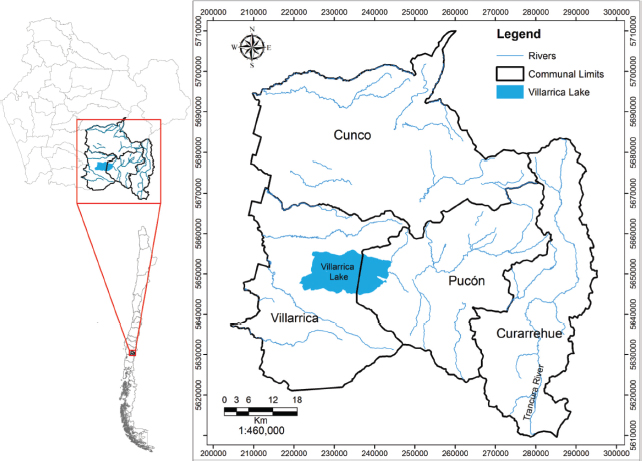
Lake Villarrica is located to the south-east of the region of La Araucanía. Its basin includes the municipalities of Villarrica, Pucón, Curarrehue and part of Cunco (Figure 1). It has a surface area of 176 km2 and a maximum depth of 165 metres34. Its main tributary is the River Trancura, which contributes almost 90% of the flow entering the lake35. The lake is part of the Araucarias Biosphere Reserve.
Figure 1. Map of Lake Villarrica
Source: authors.
Lake Villarrica has been the subject of general studies36 and technical studies37, which allow the recognition of phosphorus and nitrogen pollution caused by social and economic activities such as urbanisation, fish farming and tourism38. These problems of human origin are complemented by natural processes, such as water generated by volcanic activity in the area39.
Since the implementation of the Sanitary Standard for the Environmental Quality of Lake Villarrica, there is evidence of changes in the quality of its waters, with no certainty about the impact of nitrogen and phosphorus loads. According to studies by the Instituto Nacional de Ecología y Cambio Climático and Ortega Bravo et al.40, the diffuse contributions in the Lake Villarrica basin come from land use and infiltration related to the septic tanks of the summer houses41. In terms of point sources, the nutrient load comes from the inadequate sewerage system between the municipalities of Pucón and Villarrica42, aquaculture activities43, the Pucón wastewater treatment plant44, and wastewater discharges from the town of Curarrehue45.
These problems have led to Lake Villarrica having the first decontamination plan in Chile46. This is not an isolated case, as the Araucanía region is currently experiencing several socio-environmental conflicts related to water and the contamination of important ecosystems47. This has led to the intensification of strong socio-environmental conflicts in the region, which over time have escalated to regional, interregional and international manifestations48. However, although scientific research has been carried out, studies have not addressed some relevant social variables in socio-environmental conflicts of this type, especially trust and its related dimensions49.
In this context, where water stress is a relevant issue on an international scale50, the pollution of Lake Villarrica emerges as an important case to be studied. Therefore, to fill the gaps around the social dimensions of lake pollution, this research provides a model that allows us to investigate, from a social science perspective, the trust around the pollution management of Lake Villarrica.
This case becomes relevant when considering the socio-environmental situation of Chile’s North Patagonian lakes. The eutrophic condition of Lake Villarrica, while not representative of all American lakes, serves as an example of the health status of numerous water bodies in the central-southern region of Chile. This underscores the need to examine social factors such as trust in the degradation of freshwater ecosystems, especially given the apparent regulatory deficiencies in the development around important lakes such as Villarrica. Despite their significant economic, social, and environmental importance to the country, these lakes face unresolved socio-environmental conflicts. Although the current focus in lake and watershed studies is on environmental governance and water-related issues51, fundamental aspects related to the economic, cultural, and socio-political origins of pollution are neglected, where trust emerges as a critical dimension. In this context, Lake Villarrica proves to be a fertile ground for a comprehensive qualitative analysis.
This case was selected for the following reasons: 1) the prominence that the problem has reached at the legislative level in Chile, being the first lake in the country to be declared a saturated zone; 2) the high level of intervention that it has undergone since the 1960s, mainly due to activities such as tourism, second homes and economic activities around its banks; and 3) the fact that it is part of a very fragile ecosystem in southern Chile.
Methodological design
Theoretically, we build on the contributions of Bulloch52. For him, trust has a moral and a strategic dimension. The moral aspect of trust is based on the belief in the goodness of human nature in general, while the second component focuses on the strategic vision of trust. For the purposes of this paper, we consider the strategic modality, which can be divided into a) individuals trusting because it is reasonable to do so; b) trust as a possibility as long as it has a custodian; and c) information and experience as critical elements53. Trust is necessary to: a) act every day without always asking about social operations; b) reduce complexity and social uncertainty; and c) be observed and tested through dimensions and variables that explain its performance at different levels of society54.
At the analytical level, some authors have developed a model that combines interpersonal trust (i.e. towards people, whether ordinary citizens or people in institutions) with institutional trust (i.e. towards institutions as such)55. These works allow us to propose an analytical framework that consolidates institutional and interpersonal trust in two dimensions: 1) technical, consisting of variables such as competence, capacity, efficiency, coherence, knowledge and experience of experts; and 2) affective, characterised by variables such as objectivity/impartiality, honesty, goodwill, concern for health and the common good, integrity and commitment to the interests of others. The consolidated construct is shown in Table 1.
Table 1. General and specific dimensions of trust.
General dimensions |
Specific dimensions |
|
Technical |
Affective |
|
1. Capacity/ability |
-Experience (what has been done) -Efficiency (how it has been done) -Capacities (financial, technical, human resources, infrastructure) -Competences (technical and legal) |
- |
2. Benevolence |
- |
-Concern for health and the common good -Goodwill |
3. Integrity |
- |
-Honesty -Transparency |
4. Sense of justice |
- |
-Objectivity/impartiality |
5. Fulfillment of commitments |
- |
-Commitment to the interest of others |
6. Behavioral consistency |
-Consistency/predictability of behaviors and arguments |
- |
Source: Own elaboration based on Espluga et al.; Majluf et al.; Rodriguez; Rodríguez & Majluf 56.
We developed a combined-intentional sampling57, using the chaining strategy to identify participants58. This means that the selection criteria are determined by relevance, generating an initial list of interviewees for the case study, and some more are added as the fieldwork is developed59. 24 participants from different areas were interviewed: 1) local and regional government, 2) civil society, and 3) the private company developing activities around the lake (Table 2). This classification corresponds to that proposed by Espluga et al.60 for the study of trust in socio-environmental problems and conflicts.
Table 2. Actors interviewed, roles and areas.
Interview |
Id* |
Position/role |
Sphere |
1 |
PA |
Mayor |
Communal government |
2 |
CH |
Councilor |
Communal government |
3 |
DQ |
Councilor |
Communal government |
4 |
OC |
Councilor |
Communal government |
5 |
LG |
Councilor |
Communal government |
6 |
FQ |
Environmental management professional |
Communal government |
7 |
PS |
Community Environmental Committee |
Communal government |
8 |
AR |
Regional authority |
Regional government |
9 |
FG |
Regional authority |
Regional government |
10 |
LM |
Regional authority |
Regional government |
11 |
RD |
Regional authority |
Regional government |
12 |
CJ |
Environment manager at school |
Civil society |
13 |
JD |
Environment manager at school |
Civil society |
14 |
SL |
Environment manager at school |
Civil society |
15 |
JP |
Environment manager at school |
Civil society |
16 |
AR |
Researcher |
Civil society |
17 |
CL |
Citizen |
Civil society |
18 |
C1 |
Consultant |
Civil society |
19 |
VD |
Member of an NGO |
Civil society |
20 |
MA |
Member of a local citizen organization |
Civil society |
21 |
RE |
Business Association Representative |
Private company |
22 |
C2 |
Tourist businessman |
Private company |
23 |
MM |
Tourist businessman |
Private company |
24 |
G |
Tourist businessman |
Private company |
* Name initials.
Source: Own elaboration.
We used the semi-structured interview technique to collect testimonies on the identification of the impacts, as well as the causes and consequences of the pollution of the lake61. In addition, this technique allowed for gathering information on the perception of trust in public, private, and civil society institutions regarding the management of lake pollution, exploring the dimensions and variables that have been identified as important in the literature (Table 1). The interviews were conducted under conditions of anonymity, and all procedures followed during the interviews were by ethical standards. The protocols were reviewed and approved by the Scientific Ethics Committee of the University of La Frontera in May 2021, according to Act N° 038_21. At the beginning of each interview, the subjects who agreed to participate were asked to read and sign a consent form, in which they were informed that participation was voluntary and that they could withdraw at any time without any consequences or damages. They were also informed that the data’s confidentiality and anonymity would be guaranteed. Once these procedures were completed, the interviews were conducted.
The interviews were conducted between the months of August and September 2019. With the obtained material, we developed a categorical content analysis62, classifying relevant thematic patterns63. The procedure consisted of 1) recording and transcribing the interviews, including them as hermeneutic units in the RQDA software64; 2) creating a content analysis protocol, developing a system of categories constituted in the same software; and 3) coding the segments of the interviews of the case study65.
Results
Trust in public institutions
Civil society’s trust in public institutions
Civil society actors show trust in the role of the regional public institutions responsible for the administrative management of the lake. This is reflected in the technical dimensions, such as “capabilities/skills” and “consistency of behaviour”.
For civil society, the work of the regional institutions provides certainty to the population, given the existence of concrete actions aimed at decontaminating the lake. For example, the decontamination plan is seen as “a good sign” (E16, also E19 and E20). Despite the existence of uncertainties due to the inefficiency of the local institutions, civil society would trust the technical capacities of the regional institutions and recognise the possibilities for improving management, such as obtaining “environmental certification from schools” (E12, also E17).
However, in the affective dimensions of trust, such as “benevolence” and “respect for commitments”, civil society’s mistrust of local institutions is evident. This configuration responds to the fact that several actors in this territorial segment consider that the municipalities “do not do much to improve the situation” (E18, also 13) and distance themselves from the problem, so “people do not trust them” (E12, also E16). In terms of commitments, there is a sense of mistrust, given the wide range of situations that continue to affect the lake, despite the institutional recognition of these tasks as pending. In this context, some actors affirm that “there are many second homes that are not connected to the sewage system” (E16), that “there is no control over the use of agricultural fertilisers” (E18) and that “sewage is still being discharged into the Trancura and Liucura rivers” (E17, E19 and E20). Civil society, therefore, mistrusts the institutional capacity to deal with situations that, although recognised as causing pollution, continue to be perpetuated.
Trust in public institutions by private companies
Our analysis of trust shows that business actors reveal components associated with the affective dimension of trust, specifically “benevolence”, “sense of justice” and “integrity”, with few direct references to the technical dimensions.
With regard to the actions of the local authorities, the members of the private sector have a negative perception of these issues, with statements referring to the fact that the local authorities involved in the management of the lake “do not see the impact that this has on the lake” (E24, also E21 and E22), showing inattention to a problem that affects health and the common good. These actors call for better communication on the state of the lake, and there are even pessimistic positions that recognise irreversible damage to the ecosystem, the destabilisation of which “will affect trade and the whole community” (E21). Nevertheless, community’s participatory involvement in the diagnosis and design of the decontamination plan has increased trust in the local and regional governments. In this sense, the plan requires “working with the people who live in the sector” (E23), understood as a fundamental requirement in the environmental governance processes used to manage the lake.
In summary, although there are clear elements of mistrust on the part of private companies towards public institutions in aspects related to benevolence, trust is appreciated in other variables of the affective dimension, such as the sense of justice and integrity.
Local and regional governments’ trust in public institutions
The actors of the public institution responsible for the implementation of the Villarrica Lake Decontamination Plan give an account of their actions, revealing both technical and affective dimensions of trust, as shown by the testimonies collected.
From the technical level of trust, it can be seen that the decontamination plan is crucial, both in terms of “capacity/ability” and “consistency of behaviour”. Thus, the perception of trust in a regional institution that reassures the population about decontamination measures is strengthened, with actors affirming that it is positive that “the plan is already working” (E1, also E8). It is worth noting, however, that while there is trust in the technical competence of government agents, there is also mistrust, particularly regarding the consistency of their behaviour. Indeed, several of the actors interviewed state that “the rules have not been applied strictly” (E1).
With regard to the constituent variables of the affective dimension of the problem, there is mostly a perception of trust in “benevolence”, “integrity” and “compliance with commitments”. On the part of the local authorities, it is argued that “the regional authority is committed” (E1) and that “the institutional framework is making a great effort” (E8, also E9 and E10) to open up and make the problem transparent to the community. Some officials who are better informed about the problem tend to trust the public institutions in charge of management. Thus, they show confidence in the work carried out, which implies that the problem of the lake “is being addressed” (E10) and that it is possible to “recover the quality of the water in the basin” (E9).
About the work of public institutions, “compliance with commitments” would reveal both perceptions of trust and mistrust. Mistrust is expressed by critical judgements that, although the causes of pollution in the area are clear and recognised, key issues that lead to management deficits remain to be resolved, such as the sewage system (E3, also E1 and E2). Others, however, have confidence in the work that has been done, especially for the future of the lake, as “fish farms are now being monitored” (E10) and “a better sewage system is being worked on” (E3, also E5 and E8). This shows an ambivalence in the dimension of commitment.
Trust in civil society
Public institutions’ trust in civil society
Our results show the need for a technical involvement of civil society in the lake’s issues, highlighting aspects such as “capabilities/skills” and “consistency of behaviour”. The actors of the public institutional framework affirm that the management includes “all the people who [...] have to do with the lake” (E1, also E2), especially “local actors associated with environmental issues” (E1, also E2). Civil society actors have the necessary technical-scientific capacities to get involved, so there is confidence in terms of “capabilities/skills”. According to the information collected, some are “technically very well prepared” (E5, also E2 and E8) and can “provide technical, scientific and social background to the area declared saturated” (E9, also E2).
However, some of these institutional actors affirm that civil society shows little consistency when it comes to putting into practice what it often proposes in discourse. For this reason, it is possible to imagine a lack of coherence on the part of some citizens, since they are the ones who “pollute” (E3, also E2). For this dimension, coordination between civil society actors and local governments is relevant, since it is the authorities and the citizens themselves who must bring together “people interested in the issue” (E5).
In the affective dimension, institutional actors identify trust and mistrust towards civil society in terms of “integrity” and “sense of justice”. Various institutional actors are suspicious of civil society. The distance between the concerns of many neighbours and their specific practices towards the lake makes them point out that despite the efforts “there will be no success” (E1, also E2 and E4). In this sense, many of the necessary conditions to improve the situation of the lake, such as “people [...] comply with a septic tank” (E2, also E1 and E3), are not carried out by the neighbours. On the other hand, they point out that it would be useful to be realistic about what is objectively achievable and what is not, as “there are many groups or people who would like to have an almost pristine lake” (E10). In other words, for some institutional actors, what is fair cannot lie in future conditions that are difficult to achieve but should be based on technical objectives that are achievable in the medium and long term.
Trust in civil society by the private sector
The trust that the private company places in civil society is exclusively affective, namely “benevolence”, “integrity” and “compliance with commitments”. The testimonies of these local actors allow us to recognise that the problem requires the involvement of the entire community concerned, since “all the people who live around it must take care of their beach” (E21, also E22). In other words, they appeal to a situation that calls for shared responsibility on the part of those concerned. The businessmen’s mistrust of civil society stems from their belief that the saturation of Lake Villarrica is caused by “everyone’s negligence” (E23, also E21 and E22), i.e. by the same citizens who are damaging the ecosystem: “many people do what they want” (E22).
The possibilities of solving the problem require an honest community that recognises that the situation is solvable because there is still “time to improve” (E21, also E23 and E24). Trust is based on current actions aimed at dealing with the problem. In this sense, businesspeople recognise that some people “are taking matters into their own hands to clean up the lake” (E23, also E24). There are also genuine efforts by individuals and civil society organisations who are sincerely committed to solving the problem.
This trust in civil society on the part of private sector actors is confirmed by their compliance with commitments, albeit always conditional. In other words, these actors tend to place their trust in civil society, in particular in its active involvement in the possible courses of action to be taken, independently of the technical work of the authorities: “It is the responsibility of the whole of civil society and the organisations that push for our objectives” (E21, also E24). This shows a tendency to trust actors outside governmental institutions, highlighting the affective aspects of a problem whose solutions also involve technical issues. In this way, the fact that “it is good that [the people] have taken the initiative” (E23) indicates a real commitment that is relevant when thinking about future solutions to the saturation situation that Lake Villarrica is experiencing.
Citizens’ trust in civil society
When referring to their roles, these actors show components of the affective dimension of trust. Specifically, aspects of “benevolence”, “sense of justice” and “compliance with commitments”. It is expressed through behavioural changes that could be consolidated more regularly, such as “informing young children” (E14) or “sensitising people” (E15). It is recognised that good intentions must be translated into actions for the common good. This aspect is still lacking, in particular because many people are concerned about the situation but “do nothing about it” (E14). The mistrust of the citizens themselves is one of the regional society’s difficulties in finding an effective solution to the saturation of the lake.
However, the evidence shows that the most logical thing to do is to recognise the real possibilities of achieving objective solutions that show progress in decontamination. In other words, the problem also involves affective issues of trust, since civil society requires the participation of citizens in decision-making. What is interesting about this dimension is that the involvement of the people in the problem acquires the status of an ethical imperative; the civil society actors themselves recognise that all inhabitants have a right to the lake (E12, E15) and that it is fair to “live in a healthy ecosystem” (E13). However, this right brings with it ethical and moral considerations related to meeting the specific demands associated with this right, especially for those who live near the lake. All those who are connected to the lake have a role to play, but also a responsibility to contribute to the solutions.
It is noteworthy, however, that when it comes to fulfilling commitments, there needs to be more clarity about the agent responsible for these changes. Given the mistrust of public institutions, citizens must think that the issue requires them to place their trust in other actors in regional society who are involved in or affected by the lake’s situation. However, it is unclear who this trust should be placed.
Trust in private companies
Public institutions’ trust in private companies
This trust lies in the dimensions of “compliance with commitments” and “consistency of behaviour”. In the first place, the need for the private company to fulfil its commitments implies, according to the evidence, relevant issues arising from the decontamination plan, which show parameters of both trust and mistrust about the future of the lake. Informants from public institutions are suspicious of an economy based on private investment in the basin and shores of Lake Villarrica, whether in the form of second homes or productive fishing, agriculture and forestry. The authority recognises the disadvantages of this model, as these industries “do not pay any kind of taxes that remain here” (E2, also E10). This structural condition calls into question the industry’s commitment to the public interest, which aims to decontaminate the lake.
Secondly, the institutional actors are suspicious of the lack of consistency in the behaviour of the companies with regard to the situation of the lake. This concerns industrial companies in the fish-farming, agro-forestry and forestry sectors, whose practices, which are poorly regulated (or not regulated at all), impact the lake’s eutrophication. The same officials point out that “strict regulations have not been applied” (E1), which leads to the problem being rooted in something more technical, such as the official capacity to control and supervise the polluting practices of the industries.
It therefore concerns both public actors and private industrial companies. There are regulatory shortcomings noted by the local authorities, who admit that “many companies say they cooperate, but they don’t” (E1) and that “there is a lot of contribution to the problem from agricultural practices” (E10), intensively developed by private families on the shores of the lake. Mistrust remains about aspects that have been identified for decades as the cause of the lake’s pollution, and as long as they are not addressed, it will be difficult to get out of the current state of uncertainty. The lack of consistency between corporate discourse and practice tends to undermine trust.
Civil society trust in the private sector
It shows evidence in the “capacity/ability” and “integrity” dimensions, i.e., it tends to recognise both affective and technical aspects of trust.
About the technical dimension, citizens demand capacities, with the central axis referring to the role of industrial and financial companies in the growing urbanisation. Part of the trust in the private sector implies taking into account the need to “control the urban growth of Pucón, Villarrica and Curarrehue” (E16, also E15 and E17), the main urban centres in the area. Civil society usually refers to external actors with technical skills that can be trusted, without necessarily specifying whether they are public actors or private companies. Examples of this are “improving the sewage system between Villarrica and Pucón” (E17) and “reforming the inspection of fish farms” (E17). These are technical challenges based on trust between the actors. The overlap between private companies and civil society is relevant in these cases.
Thus, civil society mistrusts private companies not only because of what they do on the ground, but also because of the responsibility of others. The evidence shows that this group’s mistrust is also directed at the shortcomings in the capacity of the public authorities to control the sources of contamination. In short, the technical mistrust of civil society actors is directed at both companies and the authorities. This is reflected in important shortcomings such as the “inability to control fish farms” (E13, also E14, E15, E17, E19 and E20), “agricultural, livestock and forestry activities” (E19, also E18), and the failure to address the increasing construction of private and commercial buildings without ensuring sanitary standards for wastewater treatment, especially “summer cottages and hotels” (E13, also E15).
However, civil society’s perceptions of trust in private companies emerge in the affective dimension. Some actors point out that “fish farms have improved their standards” (E16) and that companies in general “have an enormous economic potential for the food security of the population” (E17). This shows that a more specific tracking between actors does not always lead to a perception of mistrust on the part of actors in regional society towards the company, but that there can also be relationships of trust.
Businesses’ trust in private companies
When referring to their role in the problem, private sector actors emphasise components of the technical dimension of trust, specifically “capacity/ability” and “consistency of behaviour”. It is striking, however, that both dimensions are viewed from a position of mistrust.
Private companies in the tourism sector see the problem as a set of factors relating both to the commitment of certain types of production organisations and to the official institutional capacity to control polluting emissions. That is to say, the entrepreneurs themselves, although not belonging to the industrial sector as such, mistrust the industries, mainly because the polluting sources are “generated by fish farms” (E22, also E24) and “forestry companies that pollute with chemical products” (E23). In other words, in this dimension, the perception of the entrepreneurs themselves in terms of mistrust is in line with the assessments of other actors, such as civil society and even local and regional government representatives.
It is not surprising, therefore, that the other technical dimension highlighted by the private sector actors in the area, “consistency of behaviour”, is also accompanied by perceptions of mistrust. Our results show that these actors perceive a distance in the search for solutions from the industrialists, who are considered to be the main culprits in the pollution of the lake. This is in line with the perceptions of other actors in the area. Some point out that “as long as nothing is done [against the industries], the lake will continue to be polluted” (E22) or, more generally, that “there is no clear regulation and the companies take advantage of this” (E24, also E23). This permissiveness leads to a lack of consistency in the behaviour of companies, which perpetuates polluting production.
Discussion
Numerous studies show the current state and existing threats to freshwater biodiversity on the planet, as well as opportunities for its protection66. Others focus specifically on the environmental situation of lakes in different countries67.
In our study, the actors interviewed recognise the central role of public institutions in the problem. The results show that there is more trust in the technical expertise of regional authorities, while the affective dimension predominates in municipal authorities. However, there is a lot of mistrust in the municipalities, which are perceived to be permissive towards poorly regulated private investment and distant from local needs. Some actors mistrust authority in general, without distinction. This is in line with studies showing that mistrust is generally based on affective issues related to authority, with this dimension being more important than technical expertise68. As several studies have pointed out, this highlights the need to address the affective dimension of the Villarrica Lake issue69.
Among actors, trust seems to be related to information, as the more information, the more trust, which reduces uncertainty70. However, our results show that there are still shortcomings in the way management tasks are communicated. As a result, there is mistrust, especially towards government authorities. As pointed out in the literature, involving stakeholders can generate more trust between actors, especially in affective aspects, by creating proximity. To this end, good information management is key71. Although the affective dimension is central, scientific information -and therefore the technical expertise of managers- is a fundamental factor in building trust. In the case of Lake Villarrica, improving the communication of scientific information on the ecological status of the lake would enable the projection of socio-educational processes that are important to the community72.
Civil society actors and the tourism industry are mistrustful of the authorities and companies, mainly because of sectoral interests. Our results show that the existence of economic interests creates distance between actors, especially in affective dimensions such as benevolence73. Tourism entrepreneurs would be more trusting if the stakeholders took action and abandoned their attitude of disinterest. This shows that it is not enough to declare a freshwater protected area in order to trust its restoration74. If the context in which the risk is socially constructed is not addressed75, it will be difficult to reverse the contamination of the lake.
The dimensions of trust show, in this case study, the importance of intervening in anthropogenic sources of pollution, mainly industry, and urbanisation76. These aspects are insistently highlighted by the actors interviewed, following a wide literature that explains them, especially in terms of wastewater treatment and the quality of ecosystem services provided by the planet’s freshwater systems77.
According to the actors interviewed, those responsible for polluting entities’ control/supervision processes are inconsistent, especially in the fish farming, agroforestry, and real estate sectors. Actors from public institutions even acknowledge this mistrust. This, together with the low level of involvement of industrial companies in these sectors, creates a context that is not conducive to the emergence of relationships of trust in the sector, given the low level of regulation to which polluting agents are subject. The literature provides solid evidence of the relevance of this aspect, which is more technical than affective, in the protection of biodiversity in freshwater ecosystems. Indeed, it strongly positions the ability of expert systems in lake pollution processes to prevent disasters78.
Strengthening institutional coordination, particularly in terms of commitments, would create more trust between those responsible for the ecological management of the lake and those affected. For the civil society and business actors interviewed, this is important because it would demonstrate institutional efforts to generate a more participatory involvement of those affected by the pollution of the lake. However, the short-term vision can affect these institutional and civic efforts, which require a broader time perspective79.
The socio-economic impact of the lake’s eutrophication, reflected in a decline in the number of visitors to the area, is forcing businesses that depend on trade and tourism to establish a relationship with an authority that is notoriously mistrusted. This shows, firstly, that proximity does not always imply trust80 and, secondly, that it is a key variable in decisions on the conservation/restoration of freshwater systems. As several studies have shown, it should be given priority in the planning of environmental regulation processes, which are still inadequate in the case of Lake Villarrica81.
Conclusions
Our findings reveal a widespread mistrust of those responsible for the state of the lake. This sentiment is particularly directed at public institutions (local/regional) and the industries present and is exacerbated by limited engagement with stakeholders. The degradation of Lake Villarrica is primarily linked to inadequate risk management and irresponsible behaviour, particularly in agriculture, fish farming, second home tourism, and real estate practices. Mistrust of government agencies is linked to the technical facet of trust. Addressing this requires better communication of the actions of the Decontamination Plan to improve regulation of polluting industries and public participation. Civil society trust is anchored in increased monitoring of pollutants and environmental awareness, although doubts remain about institutional effectiveness due to perceived interests of authorities and industries and mishandling of available information. Business stakeholders expect socio-health benefits from the decontamination plan, emphasising communication and regulatory control, while mistrusting the distance of some authorities and industry regulation. While current lake conditions breed scepticism about recovery, strategic implementation of the Decontamination Plan through better communication and stricter regulation has the potential to rebuild trust, which is critical to preserving Chile’s freshwater biodiversity.
References
Abbas, Farhat; Al-Naemi, Salem; Farooque, Aitazaz; Phillips, Michael. 2023: “A review on the water dimensions, security, and governance for two distinct regions”. Water, 15 (1), 208. https://doi.org/10.3390/w15010208
Acreman, Michael; Hughes, Kathy; Arthington, Angela; Tickner, David; Dueñas, Manuel Ángel. 2019: “Protected areas and freshwater biodiversity: A novel systematic review distils eight lessons for effective conservation”. Conservation Letters, 13 (1), 1–14. https://doi.org/10.1111/conl.12684
Adonadaga, Melvin; Ampadu, Boateng; Ampofo, Steve; Adiali, Freda. 2022: “Climate change adaptation strategies towards reducing vulnerability to drought in northern Ghana”. European Journal of Environment and Earth Sciences, 3 (4), 1–6. https://doi.org/10.24018/ejgeo.2022.3.4.294
Almakaeva, Anna; Welzel, Christian; Ponarin, Eduard. 2018: “Human empowerment and trust in strangers: The multilevel evidence”. Social Indicators Research, 139 (3), 923–962. https://doi.org/10.1007/s11205-017-1724-z
Ames, April; Steiner, Victoria; Liebold, Erin; Milz, Sheryl; Eitniear, Samantha. 2019: “Perceptions of water-related environmental concerns in Northwest Ohio one year after a Lake Erie harmful algal bloom”. Environmental Management, 64 (6), 689–700. https://doi.org/10.1007/s00267-019-01217-z
Archundia, Denisse; Duwig, Celine; Spadini, Lorenzo; Uzu, Gaelle; Guédron, Stephane; Morel, Marie Christine; et al. 2017: “How uncontrolled urban expansion increases the contamination of the Titicaca Lake basin (El Alto, La Paz, Bolivia)”. Water, Air, and Soil Pollution, 228 (44), 0–17. https://doi.org/10.1007/s11270-016-3217-0
Bardin, Laurence. 1996: Análisis de contenido. Madrid, Akal.
Beck, Ulrich. 2008: La sociedad del riesgo mundial. En busca de la seguridad perdida. Barcelona, Paidos.
Brummans, Boris; Putnam, Linda; Gray, Barbara; Hanke, Ralph; Lewicki, Roy; Wiethoff, Carolyn. 2008: “Making sense of intractable multiparty conflict: A study of framing in four environmental disputes”. Communication Monographs, 75 (1), 25–51. https://doi.org/10.1080/03637750801952735
Brundtland, Gro Harlem. 1989: “Global change and our common future”. Environment: Science and Policy for Sustainable Development, 31 (5), 16–43. https://doi.org/10.1080/00139157.1989.9928941
Bruning, Mariana. 2018: Estudio de aporte de carga de nutrientes y análisis de escenarios de descontaminación mediante un modelo de calidad de aguas en el Lago Villarrica. Santiago (Chile), Universidad de Chile.
Bulloch, Sarah. 2013: “Seeking construct validity in interpersonal trust research: A proposal on linking theory and survey measures”. Social Indicators Research, 113 (3), 1289–1310. https://doi.org/10.1007/s11205-012-0139-0
Campbell, Marcia. 2003: “Intractability in environmental disputes: Exploring a complex construct”. Journal of Planning Literature, 17 (3), 360–371. https://doi.org/10.1177/0885412202239138
Cisterna, Pedro; Careau, Jaime. 2016: Propuesta de un sistema de depuración natural para tratar las aguas residuales de la comuna de Curarrehue. Concepción, Universidad del Bío-Bío.
Cooke, Dennis. 2007: “History of eutrophic lake rehabilitation in North America with arguments for including social sciences in the paradigm”. Lake and Reservoir Management, 23 (4), 323–329. https://doi.org/10.1080/07438140709354021
Derkzen, Marthe; Nagendra, Harini; Van Teeffelen, Astrid; Purushotham, Anusha; Verburg, Peter. 2017: “Shifts in ecosystem services in deprived urban areas”. Ecology and Society, 22 (1). http://www.jstor.org.iue.basesdedatosezproxy.com/stable/26270102
Elgueta, Sebastián; Gómez, Jorge; de la Maza, Cristóbal. 2011: Análisis general de impacto económico y social del anteproyecto de normas secundarias de calidad ambiental para la protección de las aguas del Lago Villarrica. Santiago (Chile). Ministerio del Medio Ambiente.
Errázuriz, Ana María; Cereceda, Pilar. 2020: Atlas universal y de Chile regionalizado. Santiago (Chile), Zig-Zag.
Espluga, Josep; Prades, Ana; Gamero, Nuria; Solá, Rosario. 2009: “El papel de la ‘confianza’ en los conflictos socioambientales”. Política y Sociedad, 46 (1), 255–273. https://revistas.ucm.es/index.php/POSO/article/view/POSO0909130255A
Fitzmaurice, Malgosia. 2021: “Biodiversity and climate change”. International Community Law Review, 23 (2–3), 230–240. https://doi.org/10.1163/18719732-12341473
Flick, Uwe. 2004: Introducción a la investigación cualitativa. Madrid, Morata.
Flitcroft, Rebecca; Cooperman, Michael; Harrison, Ian; Juffe-Bignoli, Diego; Boon, Philip. 2019: “Theory and practice to conserve freshwater biodiversity in the Anthropocene”. Aquatic Conservation: Marine and Freshwater Ecosystems, 29 (7), 1013–1021. https://doi.org/10.1002/aqc.3187
Garcia Fonseca, Tanya; Carazo Vargas, Eva. 2020: “Ambigüedad institucional y normativa en la gestión y garantía del derecho humano al agua en Costa Rica: ¿agua para quién?” Agua y Territorio, 15, 13–20. https://doi.org/10.17561/at.15.4646
Graham, Neal; Hejazi, Mohamad; Chen, Min; Davies, Evan; Edmonds, James; Kim, Son; Turner, Sean; et al. 2020: “Humans drive future water scarcity changes across all shared socioeconomic pathways”. Environmental Research Letters, 15 (1), 014007. https://doi.org/10.1088/1748-9326/ab639b
Gross, Catharine; Hagy, James. 2017: “Attributes of successful actions to restore lakes and estuaries degraded by nutrient pollution”. Journal of Environmental Management 187, 122–136. https://doi.org/10.1016/j.jenvman.2016.11.018
Guo, Tian; Gill, Devin; Johengen, Thomas; Cardinale, Bradley. 2019: “What determines the public’s support for water quality regulations to mitigate agricultural runoff?” Environmental Science and Policy, 101, 323–330. https://doi.org/10.1016/j.envsci.2019.09.008
Hackett, Rachel; Babos, Heidi; Collins, Erin; Horton, Dean; Schock, Neil; Schoen, Lee. 2017: “Researcher disciplines and the assessment techniques used to evaluate Laurentian Great Lakes coastal ecosystems”. Journal of Great Lakes Research, 43 (1), 9–16. https://doi.org/10.1016/j.jglr.2016.11.008
Hajer, Maarten. 1997: The politics of environmental discourse: Ecological modernization and the policy process. Oxford University Press. https://doi.org/10.1093/019829333X.001.0001
Host, George; Kovalenko, Katya; Brown, Terry; Ciborowski, Jan; Johnson, Lucinda. 2019: “Risk-based classification and interactive map of watersheds contributing anthropogenic stress to Laurentian Great Lakes coastal ecosystems”. Journal of Great Lakes Research, 45 (3), 609–618. https://doi.org/10.1016/j.jglr.2019.03.008
Hsieh, Hsiu Fang; Shannon, Sarah. 2005: “Three approaches to qualitative content analysis”. Qualitative Health Research, 15 (9), 1277–1288. https://doi.org/10.1177/1049732305276687
Huang, Ronggui. 2016: RQDA: R-based qualitative data analysis. http://rqda.r-forge.r-project.org/
Iglesias, María José. 2018: Informe técnico de cumplimiento de normas de calidad del agua: Norma secundaria de calidad ambiental para la protección de las aguas continentales superficiales del Lago Villarrica. Santiago (Chile), Superintendencia del Medio Ambiente.
Instituto Nacional de Derechos Humanos. 2015: Derechos humanos y conflicto intercultural: Una aproximación desde el testimonio de propietarios y agricultores no indígenas de La Araucanía. Santiago (Chile). https://bibliotecadigital.indh.cl/bitstream/handle/123456789/938/estudio.pdf?sequence=1&isAllowed=y
Instituto Nacional de Ecología y Cambio Climático. 2018: Evaluación de servicios ecosistémicos y de riesgos por cambio climático en cuencas hidrográficas de Chile y México. Ciudad de México.
Kamjunke, Norbert; Nimptsch, Jorge; Harir, Mourad; Herzsprung, Peter; Schmitt-Kopplin, Philippe; Neu, Thomas; Graeber, Daniel; Osorio, Sebastian; Valenzuela, Jose; Reyes, Juan Carlos; Woelfl, Stefan; Hertkorn, Norbert. 2017: “Land-based salmon aquacultures change the quality and bacterial degradation of riverine dissolved organic matter”. Scientific Reports, 7, 1–15. https://doi.org/10.1038/srep43739
Karthe, Daniel; Chalov, Sergey; Borchardt, Dietrich. 2015: “Water resources and their management in Central Asia in the early twenty-first century: Status, challenges and future prospects”. Environmental Earth Sciences, 73 (2), 487–499. https://doi.org/10.1007/s12665-014-3789-1
Li, Yue Peng; Liu, Hai Yan; Wang, Li Li. 2017: “Research review on the treatment of urban landscape lakes”. Journal of Groundwater Science and Engineering, 5 (2), 152–161.
Luhmann, Niklas. 1996: Confianza. Barcelona, Anthropos.
Luhmann, Niklas. 2012: “¿Puede la sociedad moderna evitar los peligros ecológicos?” Argumentos 69, 81–97.
Majluf, Nicolás; Abarca, Nureya; Mingo, Santiago. 2003: La confianza en la empresa. Santiago (Chile), Pontificia Universidad Católica de Chile.
Makanda, Koleka; Nzama, Stanley; Kanyerere, Thokozani. 2022: “Assessing the role of water resources protection practice for sustainable water resources management: A review”. Water, 14 (19), 3153. https://doi.org/10.3390/w14193153
Ministerio del Medio Ambiente. 2017: Decreto 43: Declara zona saturada por clorofila “A”, transparencia y fósforo disuelto, a la cuenca del Lago Villarrica. Santiago (Chile). http://bcn.cl/2fhxx
Norcontrol Chile S.A.; División de Medio Ambiente y Prevención de Riesgos Laborales. 2009: Antecedentes para el análisis general de impacto económico y social de la norma secundaria del Lago Villarrica. Santiago (Chile), Ministerio de Medio Ambiente.
OLCA. 2022: Agua. https://olca.cl/oca/enlista02.php?pagn=0&c_sel=4&b_op=04000000&b_dt=54
Ortega Bravo, Juan Carlos; Nistal Beleña, Mercedes; Martínez Pérez, Catalina; Abarzúa Gatica, Karla Victoria; Rubilar Rocha, Francisco. 2019: Análisis y evaluación de medidas de reducción de nutrientes (nitrógeno y fósforo) para incorporar al Plan de Descontaminación del Lago Villarrica. Temuco (Chile), Universidad de La Frontera.
Panez-Pinto, Alexander; Faúndez-Vergara, Rodrigo; Mansilla-Quiñones, Camilo. 2017: “Politización de la crisis hídrica en Chile: Análisis del conflicto por el agua en la provincia de Petorca”. Agua y Territorio, 10, 131–148. https://doi.org/10.17561/at.10.3614
Patton, Michael. 1990: Qualitative evaluation and research methods. London, Sage.
Patton, Michael. 2002: How to use qualitative methods in evaluation. California, Sage.
Pham, Huy; Ramiah, Vikash; Moosa, Imad. 2020: “The effects of environmental regulation on the stock market: The French experience”. Accounting and Finance, 60 (4), 3279–3304. https://doi.org/10.1111/acfi.12469
Quesada, Francisco; Rubio, Eduardo; Cheuquepán, Pablo; Rivera, Ninoska; Bello, Benjamín; Olate, Cecilia; Durán, Víctor. 2018: Tercer informe monitoreo ciudadano Lago Villarrica Estación Litoral Villarrica, Proyecto Vigilancia Local Lacustre. Pucón (Chile), Ministerio de Medio Ambiente.
Reid, Andrea; Carlson, Andrew; Creed, Irena; Eliason, Erika; Gell, Peter; Johnson, Pieter; Kidd, Karen; MacCormack, Tyson J.; Olden, Julian D.; Ormerod, Steve J.; Smol, John P.; Taylor, William W.; Tockner, Klement; Vermaire, Jesse C.; Dudgeon, David; Cooke, Steven J. 2019: “Emerging threats and persistent conservation challenges for freshwater biodiversity”. Biological Reviews, 94 (3), 849–873. https://doi.org/10.1111/brv.12480
Rivadeneira-Tassara, Benjamín; Valdés-González, Héctor; Fúnez-Guerra, Carlos; Reyes-Bozo, Lorenzo. 2022: “A conceptual model considering multiple agents for water management”. Water, 14 (13), 2093. https://doi.org/10.3390/w14132093
Rodríguez, Darío; Majluf, Nicolás. 2003: La confianza en Chile: Sus dificultades y posibilidades. Santiago (Chile), Pontificia Universidad Católica de Chile.
Rodriguez, Hannot. 2009: “La confianza pública en las instituciones reguladoras del riesgo: Tres modelos de confianza para tres desafíos del análisis del riesgo”. Argumentos de Razón Técnica, 12, 125–153.
Rojos, Sandra; Arteaga, Horacio; Klein, Rick; Harris, Nicole; Durán, Víctor. 2018: Tercer informe monitoreo ciudadano Lago Villarrica Estación Litoral La Poza, Proyecto Vigilancia Local Lacustre. Pucón, Ministerio de Medio Ambiente.
Salazar, Gonzalo; Fonck, Martín; Vergara, Luis. 2018: “Ciudades intermedias: Dinámicas de intermediación desde la noción de lugar. El caso de la Región de La Araucanía, Chile”. Revista de Geografia Norte Grande, 70, 109–30. https://doi.org/10.4067/S0718-34022018000200109
Sepúlveda, Elizabeth. 2017: Informe técnico de cumplimiento de normas de calidad del agua. Santiago (Chile), Ministerio de Medio Ambiente.
Shayanmehr, Samira; Porhajašová, Jana; Babošová, Mária; Sabouni, Mahmood; Mohammadi, Hosein; Henneberry, Shida; Foroushani, Naser. 2022: “The impacts of climate change on water resources and crop production in an arid region”. Agriculture, 12 (7), 1056. https://doi.org/10.3390/agriculture12071056
Song, Andrew; Temby, Owen; Kim, Dongkyu; Saavedra Cisneros, Ángel; Hickey, Gordon. 2019: “Measuring, mapping and quantifying the effects of trust and informal communication on transboundary collaboration in the Great Lakes fisheries policy network”. Global Environmental Change, 54, 6–18. https://doi.org/10.1016/j.gloenvcha.2018.11.001
Sterner, Robert; Ostrom, Peggy; Ostrom, Nathaniel; Klump, Val; Steinman, Alan; Dreelin, Erin; Vander Zanden, Jake; Fisk, Aaron. 2017: “Grand challenges for research in the Laurentian Great Lakes”. Limnology and Oceanography, 62 (6), 2510–2023. https://doi.org/10.1002/lno.10585
Strauss, Anselm; Corbin, Juliet. 2002: Bases de la investigación cualitativa. Técnicas y procedimientos para desarrollar la teoría fundamentada. Medellín, Universidad de Antioquía.
Tironi, Manuel; Pirkovic, Trajan. 2017: “Conflictos energéticos en Chile”. Documento de trabajo NUMIES. Santiago (Chile). https://figshare.com/articles/journal_contribution/Catastro_de_Conflictos_Energ_ticos_en_Chile/4887017
Universidad de La Frontera. 2018: Determinación de las concentraciones de nutrientes en los principales afluentes al Lago Villarrica: Estimación de su carga y propuesta de medidas para su reducción. Temuco (Chile), Universidad de La Frontera.
Vallejos-Romero, Arturo. 2012: “La relevancia de la confianza institucional y la comunicación en la percepción y construcción social de riesgos”. Perfiles Latinoamericanos, 39, 151–176.
Vallejos-Romero, Arturo; Boso, Alex; Zunino, Hugo. 2016: “La relevancia de la confianza en conflictos socioambientales por energía en Chile: Los casos de ‘Castilla’ e ‘Hidroaysén’”. Revista de Geografía Norte Grande, 63, 145–162. https://doi.org/10.4067/S0718-34022016000100009
Valles, Miguel. 2007: Entrevistas cualitativas. Madrid, Centro de Investigaciones Sociológicas.
Vergara, Gonzalo; Ibarra, José Tomás. 2019: “Paisajes en transición: Gradientes urbano-rurales y antropización del bosque templado andino del sur de Chile”. Revista de Geografia Norte Grande, 73, 93–111. https://doi.org/10.4067/S0718-34022019000200093
Wang, Qizhen; Wang, Shengyuan. 2022: “The impact of environmental regulation on water resources utilization efficiency”. Frontiers in Environmental Science, 10, 1022929. https://doi.org/10.3389/fenvs.2022.1022929
Wattigney, Wendy; Irvin-Barnwell, Elizabeth; Li, Zheng; Davis, Sthephanie; Manente, Susan; Maqsood, Junaid; Scher, Deanna; Messing, Rita; Schuldt, Nancy; Hwang, Syni-An; Aldous, Kenneth M.; Lewis-Michl, Elizabeth L.; Ragin-Wilsin, Angela. 2019: “Biomonitoring programs in Michigan, Minnesota and New York to assess human exposure to great lakes contaminants”. International Journal of Hygiene and Environmental Health, 222 (1), 125–135. https://doi.org/10.1016/j.ijheh.2018.08.012
Wijesekera, Sohan. 2020: “Multi criteria water allocation modelling to demonstrate the need of a comprehensive water policy for Sri Lanka”. Engineer: Journal of the Institution of Engineers, 53 (4), 65–79. https://doi.org/10.4038/engineer.v53i4.7429
Yan, Kai; Yuan, Zengwei; Goldberg, Stefanie; Gao, Wei; Ostermann, Anne; Xu, Jianchu; Zhang, Fusuo; Elser, James. 2019: “Phosphorus mitigation remains critical in water protection: A review and meta-analysis from one of China’s most eutrophicated lakes”. Science of the Total Environment, 689 (132), 1336–1347. https://doi.org/10.1016/j.scitotenv.2019.06.302
Zhao, Jian; Gao, Qiusheng; Liu, Qingqing; Fu, Guo. 2020: “Lake eutrophication recovery trajectories: Some recent findings and challenges ahead”. Ecological Indicators, 110. https://doi.org/10.1016/j.ecolind.2019.105878
Zhong, Shaozhuo; Geng, Yong; Qian, Yiying; Chen, Wei; Pan, Hengyu. 2019: “Analyzing ecosystem services of freshwater lakes and their driving forces: The case of Erhai Lake, China”. Environmental Science and Pollution Research, 26 (10), 10219–10229. https://doi.org/10.1007/s11356-019-04476-9
Zhu, Di; Liu, Chang; Dong, Yong; Hua, Junguo. 2022: “The effect of environmental regulation on corporate environmental governance behavior and its mechanisms”. Sustainability, 14 (15), 9050. https://doi.org/10.3390/su14159050
_______________________________
1 Shayanmehr et al., 2022. Fitzmaurice, 2021.
2 Archundia et al., 2017. Derkzen et al., 2017. Host et al., 2019. Beck, 2008. Hajer, 1997.
3 Luhmann, 1996, 2012. Campbell, 2003. Brummans et al., 2008.
6 Flitcroft et al., 2019. Acreman et al., 2019. Reid et al., 2019. Wattigney et al., 2019. Yan et al., 2019.
8 Reid et al., 2019. Zhao et al., 2020. Adonadaga et al., 2022.
9 Espluga et al., 2009. Guo et al., 2019. Wang; Wang, 2022.
10 Espluga et al., 2009. Ames et al., 2019. Pham et al., 2020.
11 Host et al., 2019. Hackett et al., 2017.
12 Sterner et al., 2017. Wijesekera, 2020.
15 Rivadeneira-Tassara et al., 2022.
18 Zhao et al., 2020. Gross; Hagy, 2017. Zhong et al., 2019.
20 Archundia et al., 2017. Derkzen et al., 2017. Garcia Fonseca; Carazo Vargas, 2020.
21 Song et al., 2019. Guo et al., 2019. Zhu et al., 2022.
22 Luhmann, 1996. Bulloch, 2013.
23 Espluga et al., 2009. Majluf; Abarca; Mingo, 2003.
24 Vallejos-Romero, 2012. Vallejos-Romero; Boso; Zunino, 2016.
26 Almakaeva; Welzel; Ponarin, 2018.
28 Song et al., 2019. Guo et al., 2019.
31 Espluga et al., 2009. Rodriguez, 2009. Bulloch, 2013. Majluf; Abarca; Mingo, 2003. Rodríguez; Majluf, 2003.
32 Universidad de La Frontera, 2018.
35 Elgueta; Gómez; de la Maza, 2011. Ministerio del Medio Ambiente, 2017.
36 Elgueta; Gómez; de la Maza, 2011. Norcontrol Chile S.A.; División de Medio Ambiente y Prevención de Riesgos Laborales, 2009.
37 Quesada et al., 2018. Rojos et al., 2018. Sepúlveda, 2017. Universidad de La Frontera, 2018. Iglesias, 2018.
38 Kamjunke et al., 2017. Salazar; Fonck; Vergara, 2018. Vergara; Ibarra, 2019.
39 Universidad de La Frontera, 2018. Iglesias, 2018.
40 Instituto Nacional de Ecología y Cambio Climático, 2018. Ortega Bravo et al., 2019.
41 Universidad de La Frontera, 2018.
42 Universidad de La Frontera, 2018.
46 Ministerio del Medio Ambiente, 2017.
47 Tironi; Pirkovic, 2017. OLCA, 2022.
48 Instituto Nacional de Derechos Humanos, 2015.
49 Espluga et al., 2009. Rodriguez, 2009. Bulloch, 2013. Majluf; Abarca; Mingo, 2003. Rodríguez; Majluf, 2003.
51 Wijesekera, 2020. Makanda et al., 2022.
54 Vallejos-Romero; Boso; Zunino, 2016. Almakaeva; Welzel; Ponarin, 2018.
55 Espluga et al., 2009. Rodriguez, 2009. Majluf; Abarca; Mingo, 2003. Rodríguez; Majluf, 2003.
56 Espluga et al, 2009. Majluf et al., 2003. Rodriguez, 2009. Rodríguez; Majluf, 2003.
66 Derkzen et al., 2017. Reid et al., 2019. Flitcroft et al., 2019.
67 Archundia et al., 2017. Gross; Hagy, 2017. Sterner et al., 2017. Hackett et al., 2017. Host et al., 2019. Wattigney et al., 2019. Yan et al., 2019. Ames et al., 2019. Zhong et al., 2019. Karthe; Chalov; Borchardt, 2015. Li; Liu; Wang, 2017.
72 Ames et al., 2019. Wattigney et al., 2019.
77 Karthe; Chalov; Borchardt, 2015. Archundia et al., 2017. Hackett et al., 2017.
78 Li, Liu; Wang, 2017. Sterner et al., 2017. Host et al., 2019. Yan et al., 2019.
79 Ames et al., 2019. Zhong et al., 2019. Karthe; Chalov; Borchardt, 2015.
81 Karthe; Chalov; Borchardt, 2015. Archundia et al., 2017. Host et al., 2019. Yan et al., 2019. Zhong et al., 2019.