Dossier
water and landscape
AGUA y TERRITORIO
The interaction between the State and the technocrats in the planning and implementation of irrigation works in Greece, 1914-1940
La interacción entre el Estado y los tecnócratas en la planificación y ejecución de obras de riego en Grecia, 1914-1940
Dimitris Angelis-Dimakis
Postdoctoral Researcher, University of Crete
Rethymno, Greece
dim.angelis@gmail.com
 ORCID: 0000-0002-0678-899X
Article information
Received: 29/04/2024
Revised: 09/10/2024
Accepted: 30/10/2024
Online: 30/06/2026
Published: 10/07/2026
ISSN 2340-8472
ISSNe 2340-7743
 CC-BY
© Universidad de Jaén (España)
ABSTRACT
This paper will look into the plans for irrigation works which were drawn up in Greece in the first four decades of the twentieth century and the degree of their implementation. We will examine the irrigation projects as part of the transformation of Greek agriculture, a goal expressed by political actors and agents of agricultural civil society. We will explore the evolution of the irrigation policy, detecting continuities and discontinuities, turning-points, as well as the reasons for the delay in the conversion of these plans into applied policies. In this context, we will highlight the interconnection between the State and the technocrats operating in the countryside, with the most typical example certainly being the agronomists, underlining, at the same time, the role played by the various forms of collective organisations in the planning and implementation of irrigation policies.
KEYWORDS: Irrigation works, Region of Macedonia, Co-operatives, Agronomists, Inter-war period.
RESUMEN
Este artículo analizará los planes de obras de riego que se elaboraron en Grecia durante las primeras cuatro décadas del siglo XX y el grado de su implementación. Más precisamente, examinaremos los proyectos de riego como parte de la transformación de la agricultura griega, un objetivo expresado por actores políticos y agentes de la sociedad agrícola. Exploraremos la evolución de la política de regadíos, detectando continuidades y discontinuidades, puntos de inflexión, así como los motivos del retraso en la conversión de estos planes en políticas agrarias concretas. En ese sentido, destacaremos la interrelación entre el Estado y los tecnócratas que actuaron dentro del mundo rural, prestando atención especial al caso de los agrónomos y subrayando, al mismo tiempo, el papel desempeñado por las diversas formas de organizaciones colectivas en la planificación y ejecución de las políticas de riego.
PALABRAS CLAVE: Obras de riego, Región de Macedonia, Cooperativas, Agrónomos, Periodo de entreguerra.
A interacção entre o Estado e os tecnocratas no planeamento e implementação de obras de irrigação na Grécia, 1914-1940
RESUMO
Este artigo analisará os planos de obras de irrigação elaborados na Grécia nas primeiras quatro décadas do século XX e o grau da sua implementação. Examinaremos os projectos de irrigação como parte da transformação da agricultura grega, um objectivo expresso por actores políticos e agentes da sociedade civil agrícola. Exploraremos a evolução da política de irrigação, detectando continuidades e descontinuidades, pontos de viragem, bem como as razões do atraso na conversão destes planos em políticas aplicadas. Neste contexto, destacaremos a interligação entre o Estado e os tecnocratas que operam no campo, sendo o exemplo mais típico certamente os agrónomos, sublinhando, ao mesmo tempo, o papel desempenhado pelas diversas formas de organizações colectivas no planeamento e implementação de políticas de irrigação.
PALAVRAS-CHAVE: Obras de irrigação, Região da Macedónia, Cooperativas, Agrónomos, Período entre guerras.
L'interaction entre l'État et les technocrates dans la planification et la mise en œuvre des travaux d'irrigation en Grèce, 1914-1940
RÉSUMÉ
Cet article examine les plans d’ouvrages d’irrigation élaborés en Grèce au cours des quatre premières décennies du XXe siècle et le degré de leur mise en œuvre. Nous examinerons les projets d’irrigation dans le cadre de la transformation de l’agriculture grecque, un objectif exprimé par les acteurs politiques et les agents de la société civile agricole. Nous explorerons l’évolution de la politique d’irrigation, en détectant les continuités et les discontinuités, les tournants, ainsi que les raisons du retard dans la conversion de ces plans en politiques appliquées. Dans ce contexte, nous soulignerons l’interconnexion entre l’État et les technocrates opérant dans les campagnes, l’exemple le plus typique étant certainement celui des agronomes, soulignant, en même temps, le rôle joué par les différentes formes d’organisations collectives dans la planification et la mise en œuvre des politiques d’irrigation.
MOTS-CLÉS : Travaux d'irrigation, Région de Macédoine, Coopératives, Agronomes, Entre-deux-guerres.
L'interazione tra lo Stato e i tecnocrati nella pianificazione e nell'attuazione delle opere di irrigazione in Grecia, 1914-1940
SOMMARIO
In QUESTO articolo verranno esaminati i piani per le opere di irrigazione elaborati in Grecia nei primi quattro decenni del XX secolo e il grado di attuazione degli stessi. Esamineremo i progetti di irrigazione come parte della trasformazione dell'agricoltura greca, un obiettivo espresso dagli attori politici e dagli agenti della società civile agricola. Esploreremo l'evoluzione della politica di irrigazione, individuando continuità e discontinuità, punti di svolta e le ragioni del ritardo nella conversione di questi piani in politiche applicate. In questo contesto, metteremo in evidenza l'interconnessione tra lo Stato e i tecnocrati che operano nelle campagne, di cui l'esempio più tipico è sicuramente quello degli agronomi, sottolineando, allo stesso tempo, il ruolo svolto dalle diverse forme di organizzazioni collettive nella pianificazione e nell'attuazione delle politiche irrigue.
PAROLE CHIAVE: Lavori di irrigazione, Regione della Macedonia, Cooperative, Agronomi, Periodo tra le due guerre.
Introduction
The period 1914-1940 was characterized, among other things, by the planning and implementation of several irrigation projects as part of the transformation of Greek agriculture, a goal expressed by political actors and agents of agricultural civil society. In this paper we will focus in particular on the hydraulic works carried out in Macedonia for four main reasons: first, it was the geographical region which was facing the most serious problems from the overflowing of rivers and streams. Second, this area was associated with the land reform of 1923 and the settlement of the refugee cultivators who poured into Greece after its defeat on the Asia Minor front in August 1922. It should be noted that almost two-thirds of the landless cultivators were settled in the rural areas of Macedonia. Third, the close connection between the national and the rural issue constitutes another crucial aspect of the structural transformations that took place in Macedonia. Spyros Karavas1 has referred to the efforts of the Greek governments to resolve the agricultural issue in Macedonia, after the Balkan Wars, with the ultimate goal of strengthening the national spirit of the “non-native populations that had a watery national consciousness”. After 1922, the tackling of the agricultural problem was linked to the necessity of the settlement of the refugee populations and their integration into the national whole. In addition, as Raimondos Alvanos2 notes, the settlement of refugees in Central and Eastern Macedonia was used by the Greek governments as a vehicle for the “splitting of the purely Slavic-speaking regions”. Fourth, it is worth underlining the long period of time required for the completion of these projects. It was a process with medium and long-term perspectives and therefore in order to evaluate them, we need to go well beyond the limits of the present study and approach the first post-war decades.
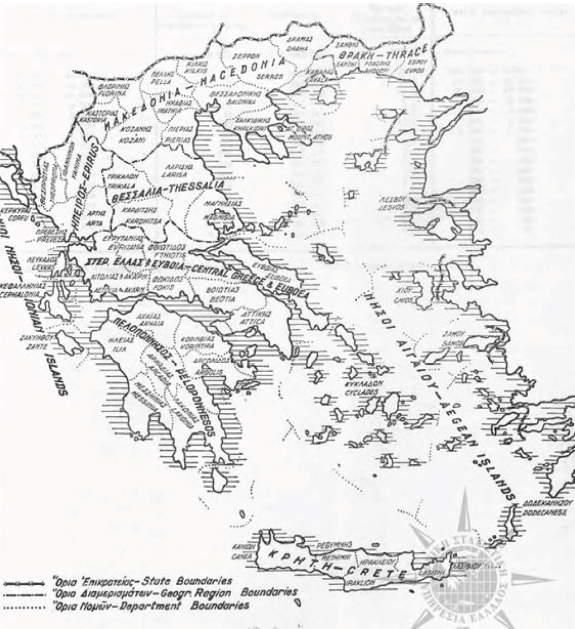
Despite the great importance of the region of Macedonia, the criticality of the specific projects, as well as their impact on local societies and economies had not been substantially studied, until recently. The present paper takes the baton from recent studies of George Vlachos, which have been carried out on land improvement projects in the rural areas of Macedonia3. It fills some of the key gaps in the literature on how land reclamation projects affected their development (Figure 1). More specifically, through the study of the cooperative and agricultural press, and the interventions by the technical services of the Agricultural Bank of Greece (thereafter ABG), it delves into the role of the technocrat agronomists and highlights the divergent views expressed in connection with the specific issue, demonstrating that the body of experts was anything but homogeneous during the first decades of the twentieth century. At the same time, it underlines how the evolution of co-operatives was linked to the more and more frequently stated goal of modernizing Greek agriculture. It also examines the contribution of the co-operatives to the transformation of the rural structures by focusing on the various aspects of their involvement in the implementation of utility- based projects and interpreting the reasons behind their failure to deliver the expected results.
Figure 1. Administrative division of Greece by geographical region
Source: Yearbook of Greece, Hellenic Statistical Authority, 1954, 17.
Following the investigation of the legislative initiatives, but also the examination of primary material from the archive of Eleftherios Venizelos, the article traces the evolution of the policy of the Greek governments from the early years of the twentieth century, when the first plans for the transformation of the Greek rural area were formulated, until the end of the 1930s. It detects continuities, discontinuities, and turning-points, revealing how the design and implementation of these projects were linked to critical national goals, such as the settlement of the refugees and the creation of a coherent national whole on the country's northern frontiers. As we have already noted, the article focuses in particular on the case of land reclamation projects in Macedonia. However, at the same time, it examines how the priority given to their execution affected the course of utility-based projects in the rest of Greek territory. Within this framework, it investigates how the collective bodies of these areas shaped their discourse and action in the face of the looming delay in the implementation of such projects. Finally, through the indicative study of the views of managers from the companies that undertook the financing and implementation of these projects, the article demonstrates how, in the turbulent interwar period, the implementation of policies in a country with a fragile economy was inextricably linked to the action of foreign companies and transnational organizations.
Towards the technical modernisation of agriculture: the role of the agronomists and of the co-operatives
The existence of a causal link between the delayed development of Greek agriculture and the slow expansion of the co-operatives and the other organisations which could contribute to the improvement of the production process represented the dominant view of the Greek agronomists of the late nineteenth century. Those agents who had studied abroad —mainly in France and Belgium— were following the international developments and considered the almost negligible spread of the co-operative idea as one of the basic reasons behind the great gap between Greek agriculture and the agrarian sectors of the so called “advanced European countries”. Until the first decade of the twentieth century, around twenty co-operatives had been set-up, through the initiatives of agronomists and other intellectuals of the countryside (school teachers, medical doctors, lawyers), but their action was limited to the granting of loans to their members and the provision of assistance in the purchase of fertilisers and machinery4. At this point, it is worth underlining that already since the end of the nineteenth century, the creation of cooperative associations and the provision of cheap credit to the small landowners, via the establishment of rural banks or other financial organizations, were crucial aspects of the agricultural policy of European countries5.
After the voting of the Greek Law on Co-operatives in 1914, their number increased rapidly and they spread throughout the country. The vast majority of them were credit organisations which acted as mediators in the supply, among other items, of seeds, sulphur and copper sulphate to their members6. As the reports of the supervisors of the co-operatives operating in the different regions of the country confirm, apart from the granting of credit to their members, the joint purchase of seeds and fertilisers for their partners was the most common function of the co-operatives during the first decades of the twentieth century. The growth of the co-operative movement, which escalated during the 1920s and 1930s, was inextricably linked with the increase of imports of agricultural machinery and their more systematic use by the cultivators. Various reports drawn up by the inspectors of co-operatives in the mid-1930s underlined the fact that the operation of these local associations was closely related to the purchase of harvesters and threshing machines, petrol-powered ploughs, as well as the installation of engine rooms. The inspector of the agricultural co-operatives of Macedonia, Petros Vasilakopoulos7, in a report which was published on 15 July 1929, stressed, for example, that the number of agricultural machines bought by the co-operatives in 1928 doubled the total of the previous years.
The action of the co-operatives should also be associated with the diffusion and more systematic use of fertilisers. Agronomists and chemists had drawn attention, from the mid-1920s, to the dangers stemming from the almost exclusive production and distribution of chemical fertilisers by a few cartels. As Dimitris Panou8, Secretary to the Minister of Agriculture, pointed out, “neither the individual farmer, not the small co-operative” could deal with this specific problem in an effective way. According to him, the solution would be the formation of a strong organisation which could possess “more material resources and qualified staff” to check fertilisers. More specifically, a central purchasing union “could get better terms for the producers, but mainly a guarantee of the real nutrient content of the fertiliser”. Furthermore, this union could sign purchasing contracts with the producers of fertilisers regulating the acceptable limits of nutrient content of the fertiliser and simplifying, in this way, the compensation process in the case of purchase of defective fertilisers Despite the failure to establish a confederation which would satisfy the maximalist expectations, there is no doubt that there existed a clear correlation between the development of the co-operative movement and the spread of fertilisers. As Socrates Petmezas9 highlights, their use fluctuated around 1 kg per cultivated hectare in 1922, exceeded 3 kg in 1927, approached 4 kg in 1936, and reached 5 kg per cultivated hectare shortly before the end of the 1930s. This upward trend should certainly be registered in the broader framework of the annexation of new territories, the doubling of the country’s area after the Balkan Wars and the subsequent increase of the cultivated lands.
The presence of the co-operatives, however, did not bring about equally satisfactory results in the development of the agricultural industries and the improvement of their facilities in the mid-1920s. In his article about the co-operative oil presses, published in the co-operative journal Synetairistis in May 1925, Socrates Kalogereas10, professor at the Averofio Agricultural School, highlighted the fact that in contrast to other countries, where great progress had been made, in Greece the isolated efforts of certain olive-growers in specific areas, as, for example, in Crete and Lesvos, had not been fruitful. The strong reactions of the olive oil-industrialists, on the one hand, and the lack of a regular assistance by the administrative services, on the other, were the main reasons behind the limited spread of the olive-oil co-operatives. It is worth mentioning that the wine-making co-operatives constituted the dominant form of production co-operatives during the inter-war period, while dairy and olive-oil co-operatives were established in the course of time.
The study of the official statistics shows a considerable increase in the number of the production co-operatives in the early 1930s. This development should be chiefly connected with the diffusion of mandatory co-operatives. Their creation was promoted by the Greek governments as a means of improving the production process. This model was adopted, among other occasions, in the cases of the wine-producers of Lefkada and Samos11, the citrus-growers of Crete12 and the mastic-producers of Chios13. We could therefore argue that even the above-mentioned increase in the number of the production co-operatives was not a conscious effort from below of the producers to form their own collective organisations, but rather a state decision imposing on farmers their integration in co-operatives. We would also like to point out that the existence of an upward trend in the statistics of this period did not necessary imply the consolidation of a co-operative movement. Socrates Petropoulos14, head of the Technical Service of ABG, stressed that despite the recording in the statistics of a large number of dairy and wine co-operatives in various parts of the country, their overwhelming majority “were in a state of latency not achieving their targets”. As he underlined, “if someone excludes primarily Crete and then Lesvos, where a blossoming of the production co-operatives was observed, in all the other places the organisation efforts were weak and piecemeal”.
Apart from contribution of the co-operatives to the technical improvement of production, their role was also decisive in the implementation of land improvement works. The realisation of hydraulic works represented a structural link in the chain of the necessary technical transformation of agriculture. Both political actors and technocrats placed particular emphasis on the carrying out of the land reclamation projects in Macedonia. According to Vasilis Christidis15, the reasons behind the immediate start of the works in Macedonia were the scarcity of land, the sanitisation of the agricultural regions infested by malaria and the flood protection of the crops. The need for refugee settlement and the homogenisation of regions with ethnic minorities constituted two further reasons not widely mentioned, but obviously connected with the imperative need to complete the projects. A few years after the annexation of the regions of Northern Greece to Greek territory with the Balkan Wars of 1912-1913 and the Great War, the agronomist Spyros Hasiotis16 emphasised that the improvement of the situation prevailing in the Macedonian countryside would derive from the immediate execution of hydraulic projects. As he pointed out, “only large companies could undertake hydraulic projects. This very profitable work would not be difficult to accomplish following the restoration of world peace, provided that in the meantime our State carries out, at its own expense, only the study as well as a draft cadastral survey of, at least, the lowland areas”. He also added that estates improved, through flood protection, drainage and irrigation projects “will be required, by law, to pay annually, for a certain period of time, an amount of money per hectare for the benefit of the contracting companies”. According to Hasiotis’s arguments, the implementation of these “highly wealth-producing” and therefore profitable projects, coupled with enhancements in the critical field of transport, would lead to the gradual attraction of agricultural capital. He further believed that the large agricultural companies could only marginally contribute to the creation of the “great wealth of Macedonia”. On the contrary, this was expected to emerge through “the support of the self-cultivation of the large number of small farmers”. He finally argued that “only with many small farmers settled on their own properties can the large agricultural entrepreneurs who cultivate the surplus lands progress, as they will have a secured number of workers living in their privately owned villages”. Some of the most serious problems troubling the Greek countryside were the “very poor hygiene of the farmers due to deadly infectious diseases near their settlements”, with the most typical example that of malaria, “the floods of the torrents that wash away the fields and the farmers’ houses”, and “the lack of hydraulic works for the irrigation of the riverside lowlands, since rivers, instead of wealth, bring disasters to the scattered farmers, the meadows and the animals”. The scarcity of funds, the difficulties of the transport network, the absence of agricultural security, the existence of a large number of landless cultivators, the debts of the farmers and their usurious transactions, the lack of a land registry and the division of agricultural properties into very small and scattered plots of land without any legislative provision were also registered on the wider spectrum of the difficulties of the Greek countryside17. During the first decades of the twentieth century, the lack of money was undoubtedly a major inhibiting factor in the execution of land improvement projects. However, the agronomists also focused on the parallel absence of plans and special studies which could attract domestic and foreign investors, “because nowhere would they find such high profit as in such wealth-producing businesses”.
Within this context, the co-operatives, which were rapidly converted into the dominant form of collective organization, were called upon to play a key role in the carrying out of these projects. Their importance is captured in an article by Vassilis Ganosis, department head of the Agricultural Bank of Greece, published in Synetairistis in early 193518. As he noted, “if the aggregation of farmers in cooperatives for the exercise of agricultural credit, the joint sale or supply of agricultural products, the execution of various tasks in general, was considered until today necessary for the interests of the producers, it now becomes an indispensable prerequisite for the carrying out of evwn the smallest hydraulic project, useful for the producer, anti-flood, drainage or irrigation”. Moreover, Ganosis emphasized the fact that in their vast majority, these projects could not be realized “if many producers do not agree among themselves”. In addition, the cost of their implementation required the participation of as many producers as possible. He concluded his argument by underlining that after their execution, monitoring for their maintenance or operation was required which presupposed the existence of some organization, “without which neither the required resources nor the necessary discipline can exist”.
Nevertheless, their impact remained minimal until the late 1920s, a fact which could be interpreted as a result of the limited implementation of land reclamation projects during this period. In this case too, certain signs of improvement were observed in the early 1930s, which, however, were not able to radically reverse the situation. As in many other countries, the mandatory participation of the farmers-landowners in the co-operatives was chosen as a means for the carrying out of these specific projects. According to Article 1 of Law 4639 on the mandatory land improvement co-operatives, published in the Government Gazette of 8 May 1930, these could be involved in the draining and sanitisation of swamps, wet soils or marshlands for “agricultural use and productivity increase”, as well as, in the direction of torrents, the cleaning and excavation of the brooks “for the protection of settlements, crops or transport networks”. Furthermore, they could undertake the collection, channelling and exploitation of flowing waters or groundwater “for soil exploitation”, the construction and maintenance of agricultural roads as well as the carrying out of hydraulic works “for electricity production” and projects “for the protection of settlements, cultivations and transport from seawaters”, as well as the mechanical treatment of soils. The owners of the estates, mines or industrial facilities located in the areas where the works would take place had the right to participate in the mandatory co-operatives for land improvement, which were legal entities governed by public law under the jurisdiction of the Ministry of Agriculture19.
By the beginning of 1935, 29 co-operatives had been established throughout the country, of which 11 were located in Central Greece and Euboea, four in Thessaly, Macedonia and the Peloponnese, respectively, three in Epirus and an equal number in Crete. Most of them were connected with the carrying out of draining and irrigation works. In this case too however, the official statistics did not seem to reflect the reality. As stated in an article published in Synetairistis in January 1935, only six out of the 29 co-operatives were operating, while the rest, as a result of either the indifference of their members or the lack of capital, were inactive. Most of the co-operatives had failed to gain the trust of the ABG, which constituted the exclusive source of finance, and hence to secure the necessary funds. According to the people in charge of the technical service of the bank, “these co-operatives, based on mandatory participation, were characterised by the great heterogeneity of their members, who had in many cases conflicting interests”. The difficulties in the management of these organisations significantly hindered their action, increased the mistrust of the farmers, and made the fulfilment of their goals impossible20. We could therefore argue that despite the unanimous acceptance of the model of the mandatory co-operatives for land improvement, their operation was problematic and hence their contribution to the implementation of public- benefit projects continued to be extremely limited. The note drawn up by the Technical Service of the ABG on 2 February 1933 on its co-operation with the Department of Water Works of the Ministry of Agriculture reveals the limited contribution of the mandatory land improvement co-operatives. Presenting the progress of a series of land improvement projects in the Peloponnese and Central Greece, the Technical Service of the ABG considered that the significant delays were due to the indifference of the co-operatives or their inability to fulfill their obligations. According to the authors of the report, “the problem is that an irregularity prevails, which is perhaps due to the insufficient monitoring of these organizations and the deficiencies of the current law on mandatory land improvement co-operatives”. The note concluded that in the cases where the Department of the Ministry of Agriculture with the financing of the ABG or the Technical Service of the bank had managed to act effectively, the mandatory co-operatives were not involved, but individual lending through promissory notes was applied21.
The evolution of the land reclamation projects in Greece during the first decades of the twentieth century
The limited spread of the land improvement co-operatives should certainly be registered within the wider framework of the few state initiatives in this direction by the mid-1920s. Nevertheless, the lack of measures did not actually imply the absence of a reformist programme for the rural space. After his victory in the elections of October 1910, Eleftherios Venizelos assumed the premiership of the country and retained it until the elections of November 1920 and the victory of the anti-Venizelos coalition, with a break from 1915 to mid-1917. His disagreement with King Constantine over the participation of the country in the First World War, the National Schism as it is referred to in the literature, created two opposing camps. The royal side, based on the capital, controlled the regions of Southern Greece, while Venizelos led the Provisional Revolutionary Government of Thessaloniki. After the military intervention of the allied forces, which supported the Venizelos side, King Constantine was deposed and Venizelos returned to the leadership of the country. During this decade, a number of crucial initiatives were taken for the Greek countryside: the voting of the Law on Agricultural Co-operatives, the creation of a legislative framework for agricultural chambers, the strengthening of agricultural credit through the granting of loans to the agricultural co-operatives by the National Bank of Greece, the establishment of the Ministry of Agriculture, as well as the enactment and implementation of the first land reforms were some of the most emblematic ones. The period of the first Venizelist term was not, however, characterized by the realization of a specific programme of land improvement interventions22. There is no doubt that the question of the availability of funds determined, to a large extent, the development of this process. In addition, we should take into account the fact that the country participated in the First World War, while from 1919 it embarked in the Asia Minor Campaign which ended with the defeat of August 1922 and the influx of about 1,500,000 refugees in Greece. In this context of a constant warfare, a domestic political polarization and an on-going uncertain effort to annex areas of the Ottoman Empire with a Christian population, it was reasonable that some reformist initiatives would recede in the agenda of domestic policies.
The carrying out of the land improvement works was thus included in the reformist agenda of Venizelos. They were, however, projects with a long-term perspective which required systematic planning and capital adequacy. It is, in my opinion, worth paying particular attention to the fact that the foundations for the realization of hydraulic works in the plain of Thessaloniki had been laid since 1919 (Figure 2). The problems, already mentioned, of river floods, malaria and the extremely low agricultural production as a result were perhaps more acute in Thessaloniki than in any other area. In May 1919, the Greek government signed a contract with the French company Société Française des Entreprises. According to this, the latter undertook the preliminary study of the hydraulic works in Macedonia, presenting and assessing the prevailing situation and at the same time proposing the measures that should be taken. The transformation of the plain of Thessaloniki into the granary of the country was the maximalist goal of the government. The short-term needs were nevertheless much more urgent and dramatic and it would certainly take a long time for such a reconstructing of the rural space of Macedonia to be achieved. As noted in the report of the French company, “many villages were surrounded by water for two or three months and could only be fed by boats. In addition, traffic in the area was often impeded by road and rail cuts”. Regarding the health situation prevailing in the area, the report underlined that “the population is suffering from malaria fevers, which are caused by the mosquitoes that hatch by the thousands in the swamps”. The author of the report added, in a rather dramatic tone, that “the race is weakening, the number of inhabitants, already reduced during the wars, tends to decrease instead of increasing. This plain, which could be so productive, is turning over time into a pestilential desert”23. The predominance of the coalition of the ant-Venizelist parties in the elections of November 1920, the broader developments on the Asia Minor front, the new demographic situation created after August 1922, as well as the social polarisation and political instability that prevailed in the early 1920s were some of the main reasons for the cancellation of this contract. In any case, it is worth focusing on the fact that the foundations for the realisation of land improvement projects had been laid from the end of the 1910s. The problems had been identified and formulated, while solutions had also been proposed. Moreover, the agent implementing these projects, i.e., a foreign company, did not diverge from the model adopted in the years which followed24.
Figure 2. The hydraulic works in the plain of Thessaloniki and in the plain of Serres
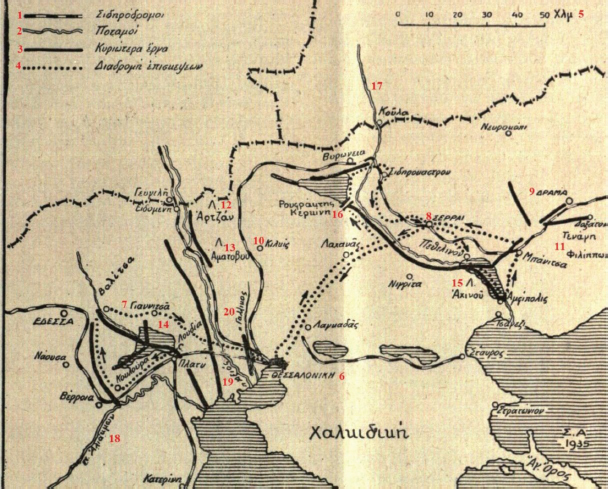
Notes: 1 Railways; 2 Rivers; 3 Main Projects; 4 Routes; 5 km; 6 Thessaloniki; 7 Giannitsa; 8 Serres; 9 Drama; 10 Kilkis; 11 The Philippi Marshes; 12 Lake Ardzan; 13 Lake Amatovou; 14 Lake of Giannitsa; 15 Lake Achinou; 16 The dam of Kerkini; 17 River Strymonas; 18 River Aliakmonas; 19 River Axios; 20 River Gallikos.
Source: Agapitos, 1935, 79.
The signing of the contract between the Greek State and the American “The Foundation Company” on 7 September 1925 for the execution of an integrated project including the construction of flood protection works, regulation of rivers, as well as drainage and irrigation works in the plain of Thessaloniki was the first step towards the transformation of the infrastructure of the rural area of Macedonia25. It also provided for the issuance of a Greek bond loan to finance the projects which were to be carried out by the contracting company. The convention, which had been passed during the years of the Pangalos dictatorship, was ratified by a new legislative decree, published in the Government Gazette on 13 November 192726. The law on the implementation of land improvement projects in the plain of Macedonia imposed an additional special taxation on the lands of the plain, either land or rent “to meet the costs of construction, expansion, improvement, maintenance, and operation of the works in general”. The canalisation of the rivers Gallikos, Axios and Aliakmonas by side embankments groynes and spurs was a key project described in the contract. As was stressed, “the embankments will be sufficiently far apart and of adequate height to prevent a serious flood from spreading over the land”. The drainage of the lakes Ardzan and Amatovou constituted a second structural axis of the Greek government’s contract with the Foundation. Finally, special emphasis was placed on the drainage of the swamps of Giannitsa, a city located in Southern Macedonia almost 50 kilometres from Thessaloniki. Regarding the construction of the works at the lake of Giannitsa from the annexation of the area to Greek territory to the imposition of the Metaxas dictatorship, we can refer to the paper by George Vlachos27. The author very aptly demonstrates how the implementation of land improvement projects was linked to the goals of forming a coherent national entity in an area with a quite strong Slavic-speaking presence and intensifying agricultural production, especially after the settlement of a large number of refugees after 1923. The directing of all the streams flowing into this area into a central basin, thus ensuring that flood waters would drain away in a few days was considered the best solution. This arrangement could ensure the cultivation in this area during the summer months. According to Nikos Settas28, 37,500 hectares were uncovered and at the same time 70,500 hectares were protected from flooding as a result of the works carried out in the plain of Thessaloniki from 1926 until the establishment of the dictatorship of Metaxas in August 1936.
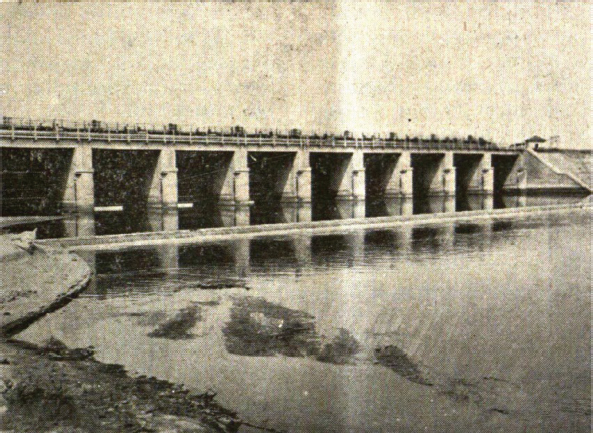
The second step for the structural transformation of the Macedonian countryside was the contract signed between the Greek government and the American companies John Monks & Sons and Ulen Company on 20 October 1928, for the carrying out of the hydraulic works in the Serres and Drama plains29. According to the first article of the contract, its scope and object was the undertaking of a general preliminary and a complete final study, as well as the carrying out of anti-flood and irrigation works, river and stream control and reclamation of lands in the plains of Serres (Figure 3) and Drama. The total budget for these projects amounted to $17,000,000 and included the procurement and transport of materials, machinery and tools, the wages of workers, technicians, foremen and drivers for the transport of materials and tools, the doctors’ salaries, the staff hospitalisation expenses, the workers’ insurance cost, as well as the construction costs of temporary or permanent houses for the workers. By the mid-1930s, the uncovered area from the drying of Lake Achinou and the marshlands of the Serres plain had reached 17,500 hectares, while the area protected against flooding was approaching 25,000 hectares. The irrigable area was 6,000 hectares, although the initial plan provided for about 25,000 hectares. As Nikos Settas30, pointed out, the technical works that had been carried out proved insufficient owing to the torrential flow of the Strymonas and its tributaries, thus making the need for reconstruction and supplementation imperative. According to Settas, the main cause of this inadequacy was the limited execution of mountainous hydrological works in both Greece and Bulgaria, where the Strymonas largely flowed. From 1928 to 1936, an area of 8,000 hectares of marshland was also drained at Philippi, Drama, and at the same time flood control works were carried out on an area of about 4,000 hectares. However, the reclamation of the drained area remained incomplete, while neither a coherent programme of irrigation improvements was formulated nor were a series of anti-erosion works to improve the soil carried out.
Figure 3. The hydraulic works in the plain of Serres, The dam of Lake Kerkini
Source: Agapitos, 1936, 87.
The article by George Vlachos31, takes a new look at the land reclamation works of the Philippi marshes. The author demonstrates that their implementation was not a simple technical plan drawn up by technocrats and shows how the realisation of hydraulic works was linked to a wider effort to modernise agriculture and increase production. At the same time, he underlines how in this specific region, as well as more widely throughout Macedonia, the creation of new land areas and the settlement of cultivators were inextricably related with the goal of national homogenization and the parallel marginalisation of ethnic minorities. Focusing on the environmental transformation that occurred in the region, Vlachos argues that, contrary to the prevailing view at the time, the Philippi marshes, and other similar ecosystems, could be beneficial to the local communities, “providing them with game, crafting and building materials, all of which were completely lost after the land reclamation”.
During the inter-war years, several criticisms were expressed about the way the land reclamation works were implemented. The argumentation of Dimitris Tsoungos32 in an article published in 1932 is revealing. According to his view, the productive projects that had begun in Macedonia since the end of the previous decade constituted a typical example of “new Greek grandiosity and inherent frivolity”. He focused his criticism on the fact that the execution of the projects “had been entrusted to foreign companies without examining with due care their costs and the way of finding the required colossal resources, without considering the issue of their exploitation and economic efficiency”. In many cases there was some kind of response to these criticisms either from the government and the political authorities or from the officials of the companies. We can mention indicatively the report of Roy Gausmann, General Manager of the John Monks & Sons Ulen Company, on the progress of the hydraulic works in the plains of Serres and Drama up to September 1932. Gausmann initially noted that “much has been written and said about the efficiency of the hydraulic works in the plains of Serres and Drama and especially in the region of Lake Achinou”. As a practical demonstration of the efficiency of these lands, the contracting companies “cultivated a section of marsh backfilled with excavation waste from the bottom of the lake”. He pointed out that the results were “surprisingly favourable”, while some of the products were presented at the exhibition in Thessaloniki, where everyone could see with their own eyes, the productivity of these lands33. Vasilis Christidis34 in his study, which was received an award from the Academy of Athens, expressed a similar view. As he reported, mechanical and chemical analyses had been carried out there from 1926 onwards, which, however, did not give a clear picture of the soil texture. This fact created in many agents the false impression that the largest part of the revealed lands was saline and consequently unfit for cultivation. Christidis focused on the heterogeneity of nearby territories regarding the salt content, while at the same time stressing that the samples which had been used in the studies were covered by waters and hence after their removal the results would be completely different. According to Tsoungos35, the lands uncovered in the early 1930s “not only could not be immediately given over to exploitation, but were, as a cursory study of the soil proved, completely unfit for cultivation”. Therefore, he argued that the State should start with the implementation of small land improvement projects and then turn to the implementation of large productive projects. On this basis, he underlined the crucial role that could be played by the mandatory land improvement co-operatives, which had been positively received by the peasants and were showing quite notable activity. Limiting their action to the execution of only some small projects, they had contributed to the construction of irrigation works in the Peloponnese and Macedonia, while at the same time they had participated in the carrying out of anti-flood works in Thessaly, which had managed to effectively protect production from bad weather conditions. Nevertheless, this view of the co-operatives seemed to be rather idealistic, since, as we have already mentioned, their contribution to the land reclamation works remained negligible until the late 1930s.
The imposition of Metaxas’s dictatorship on 4 August 1936, put the course of land improvement works in the region of Macedonia on a new basis. Two months later, on 6 October 1936, the Special Fund for Hydraulic Works in Macedonia (thereafter ETYEM), which undertook the completion, improvement and maintenance of projects in the plains of Thessaloniki, Serres and Drama, was created by Mandatory Law 204. In addition, it was assigned the exploitation of the recovered areas in the plains, and was called upon to have a guiding role in the prudent agricultural exploitation of the lands and their intensive cultivation by those who were to settle there36. Most of the works had been actually completed by August 1936. As Socrates Petmezas37 notes, the works began to be delivered after the early 1930s, the first practical results were seen in the mid-1930s, while the settlement of the first cultivators in the uncovered lands was carried out following a decision of the Metaxas government. The realisation of the land reclamation works should undoubtedly be connected with the increase of the cultivated lands. Table 1 reveals the much greater expansion of the cultivated areas in Macedonia, in comparison with the other regions of the country, during the whole inter-war period.
Table 1. Cultivated areas in selected regions, as percentage of the country’s total, 1917-1938
Year |
1917 |
1922 |
1927 |
1930 |
1932 |
1934 |
1936 |
1938 |
Macedonia |
13,22 |
22,08 |
27,18 |
28,17 |
28,13 |
29,96 |
30,11 |
31,93 |
Thessaly |
15,85 |
12,90 |
14,97 |
13,90 |
13,53 |
13,91 |
13,64 |
12,97 |
Central Greece |
20,42 |
20,87 |
18,29 |
17,11 |
17,78 |
17,42 |
17,16 |
17,57 |
Peloponnese |
30,88 |
20,57 |
19,13 |
19,48 |
18,24 |
17,97 |
17,98 |
18,23 |
Source: Annual Statistics of Agricultural Production of Greece, Hellenic Statistical Authority, 1917-1938.
From 1937 to 1941, only 2,000 hectares were uncovered in the plain of Thessaloniki, a very small number given the long period of the operation of the foreign company. In addition, 10,000 hectares were recovered in the plain of Serres, 8,000 hectares were protected from the floods, and along with the irrigation works approximately 10,000 hectares were consolidated. Finally, in the Plain of Drama, the land discovered amounted to 3,000 hectares, while irrigation improvements created a new area of 3,000 hectares. Despite the change in the organisational model and the replacement of foreign contractors by a public-law legal entity, we could say that, as in the case of other axes of its agricultural policy, the Metaxas regime did not deviate from the basic principles which had been crystallized during the inter-war period. The speech Metaxas gave during his visit in Drama in March 1938 is typical. He described ETYEM as the “great economic organisation”, which would ensure “in perpetuity the maintenance of the works and their expansion with other necessary ones”. The dictator considered that the mission of the nation had, to a large extent, been accomplished, as it had made the “necessary financial sacrifices to carry out the magnificent works in the plains of Drama, Serres and Thessaloniki”38. At the same time, he pointed out that the farmers of these areas should repay this debt to the Greek people by cultivating intensively, on the one hand, and turning to polyculture, on the other. As Metaxas emphasized, the farmers of the plains of Macedonia should intensively cultivate the land “which the Greek people gave you, so that, through intensive cultivation, the national income will increase and, as a result, the State will be able to carry out projects of a similar nature in other Greek regions and especially in those of the Old Greece, which, although in great need of them, willingly accepted the delay for the sake of the inhabitants of Northern Greece”. The development of different types of crops and the avoidance of the tobacco monoculture should be the main objectives of Macedonian producers39.
The support of production and the increase of cultivated lands were the main priorities of the 4th of August regime in terms of agricultural policy. It should be highlighted that in the case of Metaxas’s dictatorship, the production increase was inextricably linked to the achievement of the national goal of self-sufficiency, which certainly acquired an additional importance in the heat of the impending war. This relation seems to become even more intense after the end of 1938, when the cultivation of the land was presented as a national duty. As Metaxas emphasized in a circular to all the competent authorities on 9 September 1939, “cultivating the land is today a national duty similar to the duty of military service. Hence, the Greek land should be intensively cultivated not only to produce what it has been producing until now, but much more”. Depicting the agricultural world as the “army of the economic life of the country”, Metaxas drew the attention of farmers to leaving “no piece of land uncultivated” and no space without producing something. According to his argument, all varieties of crops should be brought into use, as this would lead to the nutritional sufficiency and well-being of the Greek people40.
During the dictatorship of Metaxas, emphasis was also placed on the realisation of hydraulic works in Thessaly as this was a constant request of the Thessalian agricultural co-operatives from the end of the 1920s. It is worth pointing out that the negligence of the state authorities in carrying out the hydraulic works in Thessaly was contrasted with the much more decisive steps that had been taken in the case of Macedonia. As, for example, it was highlighted in the resolution of a rally held in Trikala on 11 March 1928, “the non-completion of the hydraulic works makes the provision of the agricultural estates almost a waste of money, since no lands, which were in scarcity, as most of them were covered by water and marshes, could be spared”. In addition, “neither the floods can be prevented, nor the waters can be used for the benefit of the farmers”, while malaria, “which plagues all the Thessalian people”, could not be eradicated. Demonstrating, on the one hand, the necessity for the completion of the hydraulic works, the resolution emphasized that the government was more interested in the execution of the hydraulic works in the plains of Serres and Drama because of to the settlement of “about a million” refugees in Macedonia and the subsequent great scarcity of land in the area41. In addition, there was a feeling that the works in Thessaly “would be less efficient” and therefore it would be preferable to carry out the hydraulic works at Strymonas and Philippi rather than in Thessaly42. This perception turned out to be correct, since, as we have pointed out, a few months later the contract for the implementation of the hydraulic works in the plains of Drama and Serres was voted.
Protests continued over the next few years and escalated in cases of flooding. We could refer, for example, to the demonstrations that took place in Karditsa and Trikala in April and May. As noted in the local press, “the floods that hit Western Thessaly, i.e., the prefecture of Trikala, and threatened with extinction the entire production, led the desperate farmers to the idea of holding a protest rally and demanding the start of the hydraulic works in Thessaly”43. The argument about the problems and risks stemming from the delay in their implementation were similar to those stated ten years earlier. It is worth underlining that in 1929 the Venizelos government had signed a contract with the foreign Boot company for the realization of the hydraulic works in Thessaly. The case of the Boot company, which attempted to undertake the execution of various land improvement projects in Greece, is of great interest. As we learn through the study of letters and memoranda of its managers, the company had submitted, in the middle of 1928, a proposal for the implementation of such projects in Strymonas and Thessaly. However, despite the fact that the Ministers of Public Works and Transport had accepted Boot's offer, the government, under pressure from the American Ambassador, was forced to accept the offer of American companies to carry out the hydraulic works at Strymonas. It is worth noting that the choice of the American companies, despite the lower offer of the English Boot company, had provoked the reaction of the British government, which asked Prime Minister Eleftherios Venizelos to give preference to this company for the projects in Thessaly and Epirus. In fact, the contract between the Greek government and the British Boot company for the realization of hydraulic works in Thessaly, Epirus and Crete, was signed at the end of 1929. In his letter to Venizelos, the company's President, Charles Boot, expressed his deep gratitude “for the manner in which, in spite of many difficulties, Your Excellency has steadfastly pursued the intention of launching this contract”44. However, the hydraulic works in Thessaly were never implemented because of the difficult economic situation of the country in the early 1930s and the decision of the Greek governments to focus on the execution of the Macedonian projects. The “complete abandonment by the State of the Thessalian plains and the peasants who lived there, at the mercy of destructive floods”, the “inconsistent tactics of the State in the whole issue of the execution of the hydraulic works in Thessaly”, and the “interruption of the operation of the Pan-Thessalian Mandatory Co-operative”, which was assigned the carrying out of the anti-flood works in Pinios45, capture the climate of discontent of the Thessalian agricultural organizations shortly before the imposition of the Metaxas dictatorship46. As the implementation of the land improvement works in Macedonia had been largely completed and while the settlement of the first cultivators had begun, the 4th of August regime concentrated on implementing a similar programme for Thessaly. The commencement of the hydraulic works in Thessaly took place on 19 December 1936. Metaxas criticized the tactics of the previous political authorities, who made promises that were never fulfilled. By emphasizing the marked difference between them and his own government, which went beyond talk and did the work, the dictator stressed the large sum that was to be allocated to the realization of these plans. He noted, at the same time, that this project was a long-term one and that it could not be carried out overnight in the whole of Thessaly. Wanting to promote the connection of the regime with the agricultural world, Metaxas added that the successful completion of the projects depended on the work of the farmers of the Thessalian countryside. In the speech he delivered at the inauguration of the hydraulic works of Thessaly, Metaxas deplored, for example, the fact that every year 30 % of Thessalian land, i.e., approximately 100,000 hectares, was left uncultivated47. The determination of the 4th of August regime, as opposed to the inactivity of the previous governments, the long-term dynamics of the land improvement projects and the personal effort of the farmers, who were essentially depicted as collaborators of the regime in the implementation of the agricultural policy, remained steady pillars of Metaxas’s discourse. The speech of Metaxas to the people of Arta on 16 June 1937 is revealing. The dictator was talking about the need of implementing the appropriate projects in order to change the land. As he emphasized, “we cannot let the rivers bring down what they bring down, ravage all this wonderful marshland and leave it unproductive. Rivers are reined in by man”. He focused, once again, on the fact that these were projects which could not be completed within a week or in a few months. Finally, he requested, on the one hand, the personal work of the peasants —he was sure that it would be gladly offered— and, on the other, the preservation of the forests around the rivers. He even noted that “without afforested mountain areas the rivers and their tributaries spring from, the projects could not be maintained”48.
Conclusions
In evaluating over all the efforts made from the mid-1920s to carry out land improvement projects in Greece, we should first underline the emphasis placed on the region of Macedonia. The need to settle the refugees combined with the national reasons that imposed the creation of new lands and their colonization with Greek-speaking inhabitants explain to a large extent the preference for the specific geographical zone. In many cases, the priority given by the state authorities to the execution of land improvement projects in Macedonia called forth the reactions of agricultural organisations and social actors from other regions whose countryside was facing similar problems from river overflows, floods and swamps. The starting-point of the design of these policies can be traced back to the beginning of the twentieth century, when agronomists, the majority of whom had studied abroad, pointed out the need to implement structural transformations in the Greek countryside. The collective organizations, with the most characteristic example certainly that of the co-operatives, were key levers of pressure to speed up the implementation of these technical projects. In some cases, co-operatives, mainly mandatory ones, were involved in the realization of the projects, with, however, poor results mainly due to the lack of financial resources.
In many cases, the co-operatives’ leaders were represented, by the banking and government sources, as reluctant partners, who in fact undermined the execution of the public utility projects. This depiction fits the general pattern of describing the rural world as uneducated, indifferent and backward, and the co-operatives as a typical reflection of this situation. Signing contracts with foreign companies was the vehicle to deal with these difficulties. The implementation of these projects was a field of intra-capitalist competition among foreign companies. The interventions of governments and foreign ambassadors in Greece demonstrate the importance attached by the country’s officials to the implementation of these projects. The inter-war period marked the beginning of the implementation of a programme of land improvement projects. The great productive projects of Macedonia represented the most emblematic, but certainly not the only, reformist plan in the rural space of Greece. The change in the organisational model during the Metaxas dictatorship, with the creation of an organszation, in the form of a public-law legal entity, fully controlled by the regime, did not change the overall nature of the policy that had been designed since the 1910s and began to be implemented after the mid-1920s. Following the end of the Balkan Wars and the doubling of the area and the population of the country and especially after the defeat on the Asia Minor front and the influx of a large number of refugees, the need to support national production through the increase of the cultivated areas, the improvement of farming methods, the better exploitation of lands and the uncovering of new ones, was a common goal of all the bourgeois governments during the first decades of the twentieth century. After the 4th of August, the insistence on the creation of new lands through the realisation of land improvement projects, was linked to the central slogan, that of self-sufficiency, of the Metaxas dictatorship.
The settlement of the first cultivators on the lands that had been uncovered in the plains of Greek Macedonia took place during the years of the Metaxas regime. This long-term plan continued in the subsequent years despite the World War and the Civil War of 1946-1949. The first post-war decade marked the escalation of initiatives and only in the 1960s does the wider transformational process of the Macedonian agricultural area seem to have been completed. The increase of cultivated land and the rise of yields per hectare in the region should be considered, to a large extent, a result of the land improvement projects that had been carried out. In evaluating, however, these improvements as reflected in the official sources, it is worth focusing on two critical parameters: first, the productivity of the lands was not always high, as can be seen from the frequent criticisms about the effectiveness of the projects. Second, their ecological footprint remains an issue under investigation. The changes that took place in land use from 1920 to 1960 undoubtedly affected the ecological balance of the areas, leading to the disappearance of fauna species, while, in some cases, ecological disasters that occur nowadays can be interpreted in the light of the way the projects were carried out decades ago.
Sources
Archive of Eleftherios Venizelos: folders 50~65-66; 127~67; 205~9; 207~51; 210~28; 336~58; 425~016. National Research Foundation “ELEFTHERIOS K. VENIZELOS”, Benaki Museum, Athens (Greece).
Hellenic Statistical Authority. 1917-1938: Annual Statistics of the Agricultural Production of Greece, 1917-1938. Digital Library. Athens (Greece).
Hellenic Statistical Authority. 1954: Yearbook of Greece, 1954. Digital Library. Athens (Greece).
Newspaper Anagennisis, 12 March 1928, 42, 1.
Newspaper Tharros, 1 May 1936, 8632, 1. 25 May 1936, 8655, 1.
Bibliography
Agapitos, Spilios. 1935: The major productive hydraulic projects of Macedonia, vol. I. Archimedes, 10, 78-84.
Agapitos, Spilios. 1936: The major productive hydraulic projects of Macedonia, vol. II. Archimedes, 2, 85-90.
Alvanos, Raimondos. 2019: Slavic-speaking and refugees. Athens (Greece), Epikentro.
Angelis-Dimakis, Dimitris. 2021: Mundos rurales en movimiento. Un análisis comparado del asociacionismo agrario en España y Grecia, 1881-1936, tesis doctoral. Madrid (España), Universidad Autónoma de Madrid.
Carmona-Zabala, Juan; Panagiotopoulos, Dimitris. 2022: Agricultural productivism, cosmopolitan plant-breeding, and the severed roots of agroecological thought. Agroecology and Sustainable Food Systems, 46(1), 133-158. https://doi.org/10.1080/21683565.2021.1962476
Christidis, Vasilis. 1933: The exploitation of the new territories of Macedonia. Thessaloniki (Greece).
Ganosis, Vasilis. 1935: The hydraulic works and the cooperatives. Synetairistis, 1, 45-47.
Government Gazette. 8 May 1930: 1221-1222.
Government Gazette. 6 May 1931: 375.
Government Gazette. 26 February 1934: 497.
Government Gazette. 6 October 1936: 439, 2307-2314.
Government Gazette. 10 October 1938: 2399-2401.
Guinnane, Timothy. 1993: Cooperatives as Information Machines: The Lending Practices of German Agricultural Credit Cooperatives, 1883-1914. Center Discussion Paper. New Haven, CT (USA), Yale University, Economic Growth Center, 699.
Hasiotis, Spyros. 1915: The agricultural situation in Macedonia. Nea Geoponika, 11, 153-157.
Hasiotis, Spyros. 1916: The development of our agricultural wealth. Nea Geoponika, 6-7, 83-99.
Kalogereas, Socrates. 1925: Olive oil co-operatives. Synetairistis, 9, 133-134.
Karavas, Spyros. 2010: Blessed those who possess the earth. Athens (Greece), Vivliorama.
Martínez Soto, Ángel Pascual. 2003: El cooperativismo de crédito en España, 1890-1934. Modelos, Sistemas de gestión y balance de su actuación. Historia Agraria, 30, 119-150.
Metaxas, Ioannis. 1969: Discourses and thoughts, vol. I, 1936-1939. Athens (Greece), Ikaros.
Metaxas, Ioannis. 1970: Discourses and thoughts, vol. II, 1939-1941. Athens (Greece), Govosti.
Muzzioli, Giuliano. 2001: El crédito agrícola en Italia desde la unidad nacional a la Segunda Guerra Mundial (1861-1949). Áreas, 21, 17-37.
Panou, Dimitris. 1925: The purchase of chemical fertilisers and the co-operatives. Synetairistis, 8, 116-117.
Petmezas, Socrates. 2012: Introduction to the history of the Greek agrarian economy of the interwar period. Athens (Greece), Alexandria.
Petropoulos, Socrates. 1935: Production co-operatives and technical progress. Synetairistis, 1, 62.
Settas, Nikos. 1961: The major productive projects of Macedonia. Athens (Greece).
Sotiropolos, Dimitris; Panagiotopoulos, Dimitris. 2008: Specific intellectuals and the rise of emancipation culture in the mid-war Greece: agriculturists, architects and civil engineers in the program of rural and civic modernization. Mnimon, 29, 121-150.
Tsoungos, Dimitris. 1932: Why our agricultural effort failed. Arxeion Oikonomikon kai Koinonikon Epistimon, 12(4), 432-454.
Vasilakopoulos, Petros. 1929: The co-operative movement in Central and Western Macedonia during 1928. Synetairistis, 6-7, 121-124.
Vlachos, George. 2022: Agricultural Cooperatives as Social-Engineering Mechanisms: Fragments of Evidence from Two Case Studies from the Interwar Greek Macedonia. Hiperboreea, 9(1), 69-94. https://doi.org/10.5325/hiperboreea.9.1.0069
Vlachos, George. 2023: A Lost Macedonian Ecosystem: The Land Reclamation and Politicisation of the Philippi Marshes in Interwar Greece. Environment and History, https://doi.org/10.3197/096734023X16869924234831
_______________________________
1 Karavas, 2010, 224-229.
2 Alvanos, 2019, 75.
3 Vlachos, 2022, 46-63; 2023, 1-23.
4 Sotiropolos; Panagiotopoulos, 2008, 132-135. Carmona-Zabala; Panagiotopoulos, 2022, 139-149.
5 Guinnane, 1993. Muzzioli, 2001, 17-37. Martínez Soto, 2003, 57-104.
6 Angelis-Dimakis, 2021, 475-479.
7 Vasilakopoulos, 1929, 121-123.
8 Panou, 1925, 116-117.
9 Petmezas, 2012, 254.
10 Kalogereas, 1925, 133.
11 Government Gazette, 26 February 1934, 497.
12 Government Gazette, 6 May 1931, 375.
13 Government Gazette, 10 October 1938, 2399-2401.
14 Petropoulos, 1935, 62.
15 Christidis, 1933, 20.
16 Hasiotis, 1915, 153-155.
17 Hasiotis, 1916, 89-90.
18 Ganosis, 1935, 45.
19 Government Gazette, 8 May 1930, 1221-1222.
20 Ganosis, 1935, 47.
21 Archive of Eleftherios Venizelos (thereafter AEV), folder 210-228.
22 We use the term “first Venizelos term of office” as Venizelos took over the leadership of the country again in 1928. He triumphed in the August 1928 elections and remained in government until 1932.
23 AEV, folder 205-209.
24 According to Vassilis Ganosis’ argumentation, the financing by foreign companies was not an exclusively Greek phenomenon. This solution had also been adopted by other countries, "either due to the lack of money, or in order to avoid scams, or even because they believed that companies could work better free of administrative formalities and government bureaucracy" (Ganosis, 1935, 46).
25 The plain of Thessaloniki was defined as the area west of Thessaloniki which was traversed by the rivers Gallikos, Axios, Loudias and Aliakmonas, including their estuaries to the sea.
26 The dictatorship of General Pangalos lasted from June 1925 to August 1926. Its imposition should be seen in the wider context of the political instability of the period and the rapid succession of governments. The army was the main ally of Pangalos, while the basic ideological axes of the dictatorial regime were the protection of traditional values, the maintenance of social order and national security. The opposition of all political parties to his person and his failures in critical areas, such as those of finance and foreign policy, led to the overthrow of the Pangalos dictatorship. After the elections which took place in November 1926, the first all-party government was formed with Alexandros Zaimis as Prime Minister and the participation of five parties from both the Venizelist and anti-Venizelist sides.
27 Vlachos, 2022, 46-64.
28 Settas, 1961, 52.
29 At this point, we should note that the way the specific projects were carried out is inextricably linked to the poor economic situation of the country after the defeat on the Asia Minor Front and especially after the bankruptcy of 1932. In other words, since the Greek Treasury was financially excluded from the international money markets during the inter-war period, one of the main criteria of the Greek governments in deciding to sign a contract for extensive land improvement works with one or another foreign company was their contractual commitment to facilitate the financing of the project.
30 Settas, 1961, 53.
31 Vlachos, 2023, 1-23.
32 Tsoungos, 1932, 443-447.
33 AEV, folder 207-251.
34 Christidis, 1933, 14-19.
35 Tsoungos, 1932, 443-447.
36 Government Gazette, 6 October 1936, 439, 2307-2314.
37 Petmezas, 2012, 213-215.
38 It is particularly interesting that Metaxas underlines his contribution to the realization of these projects, since as Minister of Transport in 1928, in the all-party government that was formed; he managed to get the State to decide upon “the execution of the Strymonas and Philippi projects”.
39 Metaxas, 1969, 339-343.
40 Metaxas, 1970, 138-139.
41 Anagennisis, 12 March 1928, 42, 1.
42 The resolution emphasized that the Thessalian people had already paid as a result of the prevailing legislation, “one billion drachmas through the Hydraulic Fund, to which all the Thessalians paid a duty for every item entering Thessaly, and the special Thessalian Fund, to which they paid a special tax on wheat leaving Thessaly”. The leaders of the agricultural organizations added that although the money from these taxes was in the state treasury, the State was essentially telling the citizens of Thessaly that it was not going to carry out these projects.
43 Tharros, 1 May 1936, 8632, 1.
44 AEV, folder 50-65-66, 336-358, 425-416.
45 AEV, folder 127-167.
46 Tharros, 25 May 1936, 8655, 1.
47 Metaxas, 1969, 170-173.
48 Metaxas, 1969, 208-211.