La percepción del profesorado sobre la enseñanza del deporte en la enseñanza secundaria obligatoria
DOI:
https://doi.org/10.17561/jump.n2.6Palabras clave:
Enseñanza del deporte, valores, educación físicaResumen
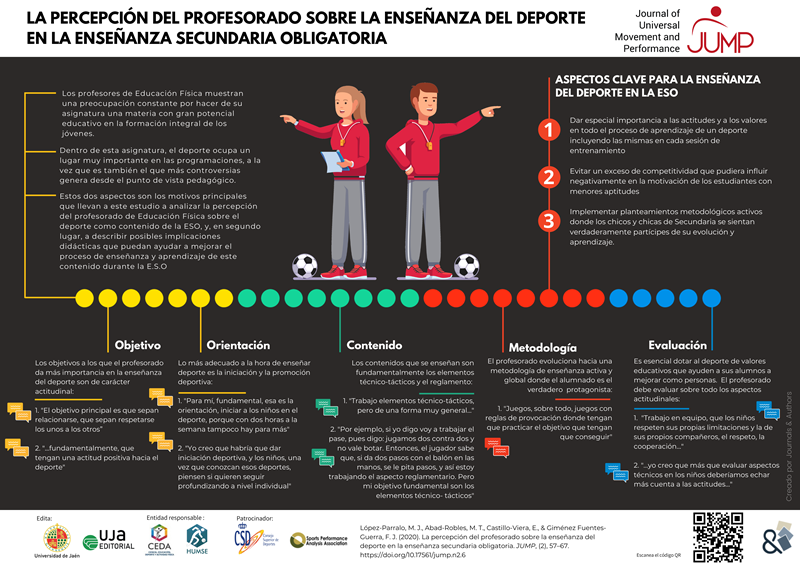
Los profesores de Educación Física muestran una preocupación constante por hacer de su asignatura una materia con gran potencial educativo en la formación integral de los jóvenes. Dentro de esta asignatura, el deporte ocupa un lugar muy importante en las programaciones, a la vez que es también el que más controversias genera desde el punto de vista pedagógico. Estos dos aspectos son los motivos principales que nos llevan a estudiar cómo se aborda el proceso de enseñanza de este contenido durante la Enseñanza Secundaria Obligatoria (E.S.O.). Por ello, los objetivos principales de este estudio han sido: analizar la percepción del profesorado de educación física sobre el deporte como contenido de la ESO; y, en segundo lugar, describir posibles implicaciones didácticas que puedan ayudar a mejorar el proceso de enseñanza y aprendizaje de este contenido durante la E.S.O. Dentro del paradigma de investigación cualitativo, el diseño del estudio es fenomenológico, utilizando la entrevista semiestructurada como instrumento de investigación. Dicha entrevista fue aplicada en un grupo focal compuesto por 9 profesores: 8 hombres y 1 mujer; todos Graduados en Ciencias del Deporte; con una edad comprendida entre 28 y 32 años; y entre 4 y 6 años de experiencia docente. Como resultados más destacados, se puede indicar que los objetivos didácticos principales planteados por los profesores eran de carácter actitudinal y también de motivación del alumnado. Además, la orientación del deporte era de iniciación y promoción; los contenidos más desarrollados eran los técnico-tácticos y reglamentarios; y se aboga por una metodología activa en la que se incluyan valores como la colaboración o el respeto. En la evaluación destaca lo actitudinal sobre lo procedimental.
Referencias
Águila, C. & Casimiro A. (2001). Iniciación a los deportes colectivos. En F. Ruiz; A. García; A. Casimiro. La iniciación deportiva basada en los deportes colectivos. Madrid: Gymnos.
Álamo, J. M., Amador, F. & Pintor, P. (2002). Función social del deporte. El entrenador del deporte escolar. Lecturas Educación Física y Deportes, 45.
Alarcón, F., Cárdenas, D., Miranda, M.T. & Ureña, N. (2010). Metodología de enseñanza de los deportes de equipo. Revista de Investigación en Educación, 7, 91–103.
Almond, L. (1986). Reflecting on themes: a games classification. En R. Thorpe, D. Bunker & L. Almond (Eds). Rethinking Games Teaching (pp.71–72). Loughborough University.
Arnold, P. J. (2001). Sport, moral development, and the role of the teacher: Implications for research and moral education. Quest, 53, 135–150. https://doi.org/10.1080/00336297.2001.10491734
Calzada, A. (2004). Deporte y educación. Revista de Educación, 335, 45–60. http://www.revistaeducacion.educacion.es/re335/re335_06.pdf
Castejón, F. J. (2003). Iniciación deportiva. La enseñanza y el aprendizaje comprensivo en el deporte. Sevilla: Wanceulen SL.
Castejón, F.J., Giménez, F.J., Jiménez, F. & López, V. (2013). Formación deportiva como eje central de la enseñanza del deporte. En F.J. Castejón, F.J. Giménez, F. Jiménez & V. López (Eds). Formación deportiva (pp. 15–37). Sevilla: Wanceulen.
Cohen, J. (1960). A coefficient of agreement for nominals scales. Educational and Psychological measure-ment, 20, 37–46. https://doi.org/10.1177/001316446002000104
Cohen, L. & Manion, L. (1990). La entrevista. En Cohen, L. & Manion, L. Métodos de investigación educativa. Madrid: La Muralla. Devís, J. y Peiró, C. (2011). Sobre el valor educativo de los contenidos de la educación física. Tándem, 35, 68–74.
Devís, J. y Sánchez, R. (1996). La enseñanza alternativa de los juegos deportivos: antecedentes, modelos actuales de iniciación y reflexiones finales. en Moreno, J.A. y Rodríguez, P. L.: Aprendizaje deportivo (pp. 159–181). Murcia: Universidad de Murcia.
Espada, M., Clemente, A.L., Santacruz, J.A. & Gallardo, J.M. (2013). La enseñanza del deporte escolar en educación secundaria según la formación inicial del profesorado. Apunts. Educación Física y Deportes, 112, 72–81. https://doi.org/10.5672/apunts.2014-0983.es.(2013/2).112.06
Feu, S. (2002). Factores a tener en cuenta para una iniciación deportiva educativa: el contexto. Lecturas: Educación Física y Deportes, 5, 1–10.
Fraile, A. (1996). Reflexiones sobre la presencia del deporte en la escuela. Revista de Educación Física, 64, 5–10.
García, M. (1990). Aspectos sociales del deporte. Madrid: Alianza Editorial.
Gaviria, F. & Castejón, F.J. (2013). El proceso didáctico en educación física como generador de valores y actitudes. Qualitative Research in Education, 2(2), 161–186.
Giménez, F. J. (2003). El deporte en el marco de la Educación Física. Sevilla: Wanceulen.
Giménez, F.J. & Rodríguez, J.M. (2006). Buscando el deporte educativo, ¿Cómo formar a los maestros? Retos. Nuevas Tendencias en Educación Física, Deporte y Recreación, 9, 40–45.
Ginsburg, K. R. (2007). The importance of play in promoting healthy child development and maintaining strong parent-child bonds. Pediatrics, 119, 182–191. https://doi.org/10.1542/peds.2006-2697
González, S., García, L. M., Contreras, O. & Sánchez-Mora, D. (2009). El concepto de iniciación deportiva en la actualidad. Retos. Nuevas Tendencias en Educación Física, Deporte y Recreación, 15, 14–20. https://recyt.fecyt.es/index.php/retos/article/view/34992/
Green, T. & Gabbard, C. (1999). Do we need sportsmanship education in secondary school athletics? Physical Educator, 56(2), 98–104. https://js.sagamorepub.com/pe/article/view/2223
Gutiérrez, M. (1995). Valores sociales y deporte. Madrid: Gymnos.
Hernández, R., Fernández, C. & Batista, P. (2006). Metodología de la investigación. México: McGraw Hill.
Jiménez, A. C. (2006). Intervención en contextos desfavorecidos a través del baloncesto. Wanceulen: Educación Física Digital, 2, 1–10.
Kemmis, S. & Mctaggart, R. (1982). The action research planner. Vitoria: Deakin University Press.
Lee, M.J., Whitehead, J. & Balchin, N. (2000). The measurement of values in youth sport: Development of the Youth Sport Values Questionnaire. Journal of Sport & Exercise Psychology, 22(4), 307–326. https://doi.org/10.1123/jsep.22.4.307
Méndez, A. (1999). Modelos de enseñanza deportiva. Análisis de dos décadas de investigación. Lecturas, Educación Física y Deportes, 13.
Méndez, A. & Fernández, J. (2011). Análisis y modificación de los juegos y deportes tradicionales para su adecuada aplicación en el ámbito educativo. Retos. Nuevas Tendencias en Educación Física, Deporte y Recreación, 19, 54–58.
Ortega, G., Giménez, F.J., Jiménez, A.C., Franco, J., Durán, L.J. & Jiménez, P.J. (2012). Por una Educación REAL: Valores y Deporte. Iniciación al valorcesto. Madrid: Ediciones Gráficas Fundación Real Madrid.
Ortega, G., Abad, M. T., Durán, L. J., Franco, J., Giménez, F. J., Jiménez, P. J. & Jiménez, A.C. (2015). Por una Educación REAL: Valores y Deporte. Entrenando Fútbol: Enseñando Valores. Madrid: Ediciones Gráficas Fundación Real Madrid.
Palacios, L. (2000). La entrevista. En G. Edel. Manual teóricopráctico de investigación social (pp. 99–108). Buenos Aires: Espacio editorial.
Pérez-Pueyo, A. (2016). El estilo actitudinal en educación física. Evolución en los últimos 20 años. Retos, Nuevas Tendencias en Educación Física, Deporte y Recreación, 29, 207–215. https://recyt.fecyt.es/index.php/retos/article/view/38720
Ramos, R., Valdemoros, M.A., Sanz, E. & Ponce, A. (2007). La influencia de los profesores sobre el ocio activo de los jóvenes. Percepción de los agentes educativos más cercanos a ellos. Profesorado. Revista de Currículum y Formación del profesorado, 11(2), 1–18.
Renzi, G.M. (2009). Educación Física y su contribución al desarrollo integral de los niños en la primera infancia. Revista Iberoamericana de Educación, 50(7), 1–14.
Robles, J., Giménez, F.J. & Abad, M.T. (2010). Motivos que llevan a los profesores de educación física a elegir los contenidos deportivos en la E.S.O., Retos, Nuevas Tendencias en Educación Física, Deporte y Recreación, 18, 5-8. https://recyt.fecyt.es/index.php/retos/article/view/34642
Silverman, S. (2005). Thinking long term: Physical education’s role in movement and mobility. Quest, 57, 138–147. https://doi.org/10.1080/00336297.2005.10491847
Taylor, S. & Bogdan, R. (1990). Introducción a los métodos cualitativos en educación. Barcelona: Paidos.
Thomas, K. T., Lee, A. M. & Thomas, J. R. (2003). Physical education methods for elementary teachers (2nd ed., pp. 3-12). Champaign, IL: Human Kinetics.
Trepat, D. (1995). La educación en valores a través de la iniciación deportiva. En Blázquez, D. (Dir.). La iniciación deportiva y el deporte escolar (pp. 95–114). Barcelona: Inde.
Ureña, N, Alarcón, F. & Ureña, F. (2009). La realidad de los deportes colectivos en la Enseñanza Secundaria. Cómo planifican e intervienen los profesores de Murcia. Retos. Nuevas Tendencias en Educación Física, Deporte y Recreación, 16, 9–15.
Valero, A. (2006). La iniciación al deporte del atletismo: del modelo tradicional a los nuevos enfoques metodológicos. Kronos: Revista Universitaria de la Actividad Física y el Deporte, 9, 34–44.