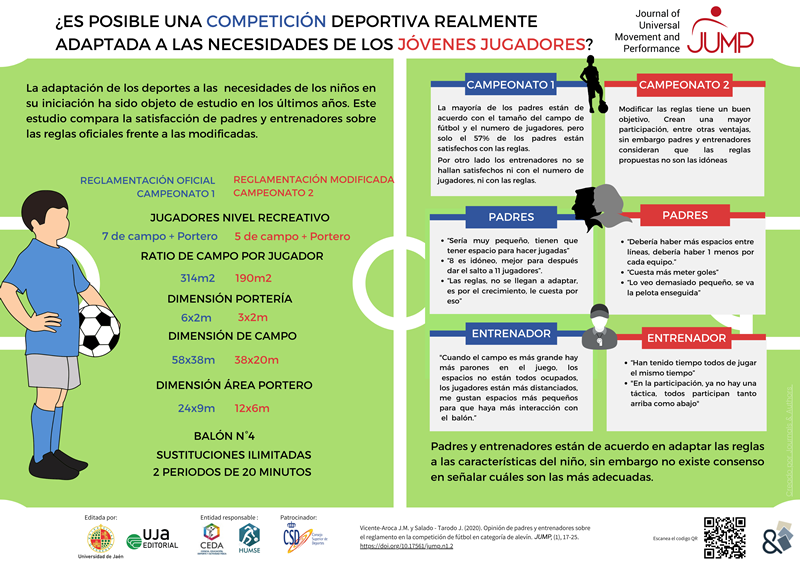
Parents and coaches opinions' about the rules in football competition in the under 12 category
DOI:
https://doi.org/10.17561/jump.n1.2Keywords:
Football, rules, parents, coaches, satisfactionAbstract
The objective of this study was to know the parents and coaches opinion about the rules and the current competition system in football in under 12 category. A qualitative design was developed, in which semi-structured interviews were carried out in which the opinion of parents and coaches was recorded, first of a tournament with the official rules (Tournament 1) and a subsequent tournament with modified rules (Tournament 2). The sample consisted of 33 parents and 4 football coaches. The following results were obtained from the analysis of the interviews: a) only 57% of the parents are satisfied with the effectiveness of the current rules in the game; b) the group of coaches is not at all satisfied with the number of players (8vs8) and with the effectiveness of these rules in the game (25%); c) 90% of the parents interviewed in the second championship agree that the modification of the rules leads to an increase in player participation; d) the parents consider that the changes in the number of players and reduction of space are not adapted to this category, and would not use them; and e) 75% of the coaches prefer the new modified rules in terms of field dimensions and reduction of the number of players to 5vs5.
References
Brito, J., Krustrup, P. & Rebelo, A. (2012). The influence of the playing surface on the exercise intensity of small-sided recreational soccer games. Human Movement Science 31,946-956. http://dx.doi.org/10.1016/j.humov.2011.08.011
Buszard, T., Reid, M., Masters, R. & Farrow, D. (2016). Scaling the equipment and play area in children’s sport to improve motor skill acquisition: A systematic review. Sports medicine, 46(6), 829-843.
Calderón, A., Palao, J.M. & Ortega, E. (2005). Incidencia de la forma de organización sobre la participación, el feedback impartido, la calidad de las ejecuciones y la motivación en la enseñanza de habilidades atléticas. Cultura, ciencia y deporte, 1(3), 145-155.
Cañadas, M. & Ortega, E. (2017). Modificación de reglas y competición en baloncesto: opinión de padres y entrenadores. Revista de psicología del deporte, 26(1), 23-26.
Casamichana, D. & Castellano, J. (2010). Time-motion, heart rate, perceptual and motor behaviour demands in small-sides soccer games: effects of pitch size. Journal of sports sciences, 28(14), 1615–1623. http://dx.doi.org/10.1080/02640414.2010.521168
Dellal, A., Hill-Haas, S., Lago-Penas, C. & Chamari, K. (2011). Smallsided games in soccer: amateur vs. professional players’s physiological responses, physical, and technical activities. Journal of strength & conditioning research, 25(9), 2371–2381. http://dx.doi.org/10.1519/JSC.0b013e3181fb4296
Dishman, R., Molt, R., Saunders, R., Felton, G., Ward, D., Dowda, M.,... Pate, R.R. (2005). Enjoyment mediates effects of a schoolbased physical-activity intervention. Medicine & Science in
Sports & Exercise, 37(3), 478-487.
Garn, A. C. & Cothran, D. J. (2006). The fun factor in physical education. Journal of Teaching in Physical Education, 25(3), 281-297.
González, G., Tabernero, B. & Márquez, S. (2000). Análisis de los motivos para participar en fútbol y en tenis en la iniciación deportiva. Motricidad, 6, 47-66.
Gutiérrez, D. & García-López, L.M. (2012). Evaluación de la toma de decisiones por parte de alumnos de primaria en relación a contextos tácticos. New Approaches In Educational Research, 1, 2254-7339.
Hill-Haas, S. V., Coutts, A., Rowsell, G. & Dawson, B. (2008). Variability of acute physiological responses and performance profiles of youth soccer players in small- sided games. Journal of science and medicine in sport, 11, 487–490. http://dx.doi.org/10.1016/j.jsams.2007.07.006
Hill-Haas, S. V., Rowsell, G. J., Dawson, B. T. & Coutts, A. J. (2009). Acute physiological responses and time-motion characteristics of two small-sided training regimes in youth soccer players.
Journal of strength & conditioning research, 23(1), 111–115. http://dx.doi.org/10.1519/JSC.0b013e31818efc1a
Hugo Sarmento, Filipe Manuel Clemente, Liam David Harper, Israel Teoldo da Costa, Adam Owen & António J. Figueiredo (2018): Small sided games in soccer – a systematic review, International Journal of Performance Analysis in Sport. http://dx.doi.org/10.1080/24748668.2018.1517288
Joo, C. H., Hwang-Bo, K. & Jee, H. (2016). Technical and physical activities of small-sided games in young Korean soccer players. Journal of strength and conditioning research, 30(8), 2164-2173. http://dx.doi.org/10.1519/JSC.0000000000001319
Keith, D., Duarte A., Vanda C. & Luís, V. (2013). How small-sided and conditioned games enhance acquisition of movement and decision-making skills. Exercise & Sport Sciences Review, 41, 154-161. http://dx.doi.org/10.1097/JES.0b013e318292f3ec
Kjønniksen, L., Anderssen, N. & Wold, B. (2009). Organized youth sport as a predictor of physical activity in adulthood. Scandinavian Journal of Medicine & Science in Sports, 19(5), 646-654.
MacDonald, D., Côté, J., Eys, M. A. & Deakin, J. (2011). The role of enjoyment and motivational climate in relation to the personal development of team sport athletes. The Sport Psychologist, 25(1), 32-46.
Marcén, C., Gimeno, F., Gómez, C., Gutiérrez, H., Sáenz, A. & Lacambra, D. (2011). La influencia de los padres en la práctica deportiva competitiva. (Material no publicado). Departamento de Psicología y Sociología: Universidad de Zaragoza.
Marrero, G., Martín-Albo, J. & Núñ ez, J. L. (1997). Motivos motivación y deporte. Las Palmas de Gran Canaria: Tesitex
Mateo, M. T., Miranda, M. T. & Cárdenas, D. (2016). La línea de tres puntos y su influencia sobre la dinámica de juego en minibasket, el grado de satisfacción individual y competencia percibida de niños y niñas de la Región de Murcia. Sport Tk, 5, 89-102.
Montoya, D., De Paz, J.A., Fernández, R., Mercé, J. & Yagüe, J. M. (2010). Variabilidad de la carga fisiológica en los pequeños juegos de fútbol en función del espacio. Apunts: Educación física y deportes, 102, 70-77.
Ørntoft, C., Larsen, M. N., Andersen, T. B., Rasmussen, L. S., Póvoas, S. C., Randers, M. B. & Krustrup, P. (2016). Technical actions, heart rate, and locomotor activity in 7v7 and 8v8 games for female youth soccer players. The Journal of Strength & Conditioning Research, 30(12), 3298-3303. http://dx.doi.org/10.1519/JSC.0000000000001434
Ortega, E. (2006q). Autoeficacia y deporte. Sevilla: Wanceulen. Ortega, E. (2006b). La competición como medio formativo en el baloncesto. Sevilla: Wanceulen.
Ortega, E., Piñar, M. I., Salado, J., Palao, J. M. & Gómez, M. A. (2012). Opinión de expertos y entrenadores sobre el reglamento de la competición infantil en baloncesto. Ricyde, 8(28), 142-150.
Ortega-Toro, E., Cañadas, M. & Giménez-Egido, J.M. (2017). Incidencia de la modificación de reglas y sistema de competición sobre los niveles de satisfacción en jugadores de baloncesto under 14. Revista de psicología del deporte, 26(1), 59-64.
Ortega-Toro, E., García-Angulo, A., Giménez-Egido, J., García-Angulo, F. and Palao, J. (2018). Effect of modifications in rules in competition on participation of male youth goalkeepers in soccer. International Journal of Sports Science & Coaching, 13(6), 1040-1047.
Rampinini, E., Impellizzeri, F. M., Castagna, C., Abt, G., Chamari, K., Sassi, A. & Marcora, S. M. (2007). Factors influencing physiological responses to small-sided soccer games. Journal of sports sciences, 25(6), 659–66. http://dx.doi.org/10.1080/02640410600811858
Sáenz-López, P., Jiménez, A. C., Giménez, F. J. & Ibáñ ez, S. J. (2007). La auto percepción de la jugadoras de baloncesto expertas respecto a sus procesos de formación. Cultura Ciencia y Deporte, 7(3), 35-41.
Sampaio, J. & Maçãs, V. (2012). Measuring tactical behaviour in football. International Journal Sports Medicine, 33(5), 395-401. http://dx.doi.org/10.1055/s-0031-1301320
Sampaio, J., Garcia, G., Macas, V., Ibanez, J., Abrantes, C. & Caixinha, P. (2007). Heart rate and perceptual responses to 2 x 2 and 3 x 3 small-sided youth soccer games. Journal of sports science
and medicine, 6(Suppl 10), 121-122.
Santos, S.D., Memmert, D., Sampaio, J. (2006). The spawns of creative behavior in team sports: a creativity developmental framework. Frontier in Psychology, 7, 1282
Supaporn, S. & Griffin, L. L. (1998). Undergraduate students report their meaning and experiences of having fun in physical education. Physical Educator, 55(2), 57-67.
Tessitore, A., Meeusen, R., Piacentini, M., Demarie, S. & Capranica, L. (2006). Physiological and technical aspects of ‘‘6-a-side’’ soccer drills. Journal of sports medicine and physical fitness, 46, 36–43.