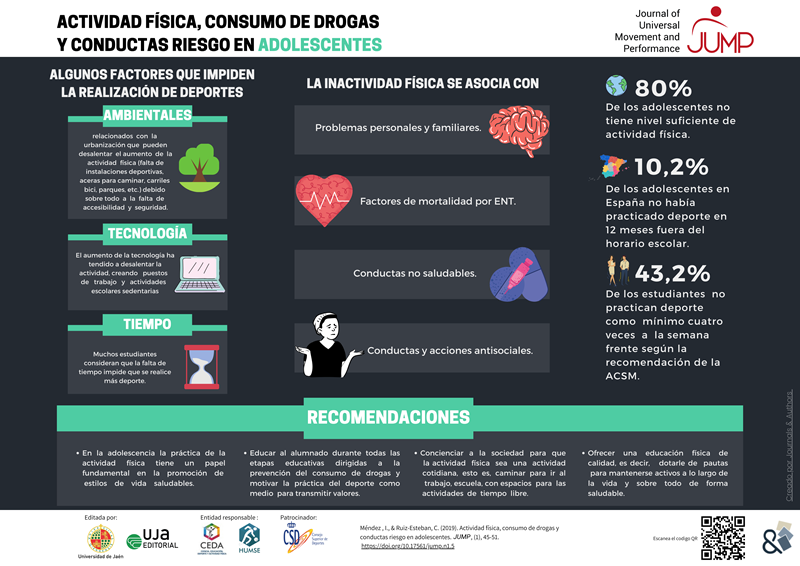
Physical activity, drugs comsuption and Risk behavior in adolescents
DOI:
https://doi.org/10.17561/jump.n1.5Keywords:
Secondary education, adolescence, physical activity, drugs consumption, risk behaviors, healthAbstract
There is a widespread concern about the low level of physical activity in the adolescent population, which may be associated with the consumption of substances harmful to health or the involvement in other unhealthy actions. The objective of the study was to analyze the association between the practice of physical activity as well as the performance of unhealthy behaviors such as drug use or other risk actions in adolescents. Participants were 1222 students (51.9% female), aged between 12 and 16, from different educational centers in the Region of Murcia. The APAL-Q instrument was used to measure physical activity and health and to assess the consumption of drugs and other problematic behaviors in adolescence, a survey was used based on one prepared by the Government Delegation for the National Drug Plan. The results of the study showed that the main reason why schoolchildren do not practice physical activity is due to lack of time. About 50% of the students practiced sports according to the recommendations of the ACSM. Among students who practiced sports was a lower consumption of tobacco, hashish/marijuana. The consumption of alcohol and other drugs did not show significant differences between sedentary students and those who practiced sports. Similarly, among sedentary people there was a greater involvement in family fights and conflicts. The study raises the need to promote and facilitate the practice of physical activity at all educational levels to prevent the development of harmful behaviors for health.
References
Becoña, E., Martínez, Ú., Calafat, A., Fernández-Hermida, J.R., Juan, M., Sumnal, H., Mendes, F. & Gabrhelík, R. (2013). Parental permissiveness, control, and affect and drug use among adolescents. Psicothema, 25, 292-298. http://dx.doi.org/10.7334/psicothema2012.294
Campo-Ternera, L., Herazo-Beltrán, Y., García-Puello, F., Suarez-Villa, M., Orlando Méndez, O., & Vásquez-De la Hoz, F. (2017). Estilos de vida saludables de niños, niñas y adolescentes. Salud Uniorte. Barranquilla, 33 (3), 419-428. http://dx.doi.org/10.14482/sun.33.3.10931
Cardol, C.K., Escamilla, C. I., Winifred A. Gebhardt, W.A. & Perales, J.C. (2019). Exploring the direct or inverse association of physical activity with behavioral addictions and other self-regulation problems. Adicciones, 31(1), 18-32. http://dx.doi.org/10.20882/adicciones.926
Cerezo, F., Méndez, I. & Ato, M. (2013). Moderating role of family and friends’ factors between dissocial behavior and consumption in adolescents. International Journal of Clinical and Health Psychology, 13, 171-180. http://dx.doi.org/10.1016/S1697-2600(13)70021-8.
Ceschini, F. L., Florindo, A. A. & Benicio, M. H. (2007). Nível de atividade física em adolescentes de uma regiao de elevado índice de vulnerabilidade juvenil. Revista Brasileira de Ciência e Movimento, 15(4), 67-78.
Delegación del Gobierno para el Plan Nacional sobre Drogas (DGPNSD) (2016). Encuesta sobre uso de drogas en Enseñanzas Secundarias en España (ESTUDES) 2016. Madrid: Secretaría de Estado de Servicios Sociales e Igualdad. Recuperado desde: http://www.pnsd.mscbs.gob.es/pnsd/Introduccion/home.htm
Delegación del Gobierno para el Plan Nacional sobre Drogas (DGPNSD) (2018).Estadísticas 2018. Alcohol, tabaco y drogas ilegales en España. Madrid: Secretaría de Estado de Servicios Sociales. Recuperado desde: http://www.pnsd.mscbs.gob.es/pnsd/Introduccion/home.htm
Galán, I., Boix, R., Medrano, M. J., Ramos, P., Rivera, F. & Moreno, C. (2014).Individual factors and school-based policies related to adherence to physical activity recommendations in Spanish adolescents. Prev. Sci. 15, 588–599. http://dx.doi.org/10.1007/s11121-013-0407-5
Gázquez, J.J., Pérez-Fuentes, M.C., Carrión, J.J., Luque, A. & Molero, M.M. (2015). Interpersonal value profiles and analysis to adolescent behavior and social attitudes. Revista de Psicodidáctica, 20, 321-337. http://dx.doi.org/10.1387/RevPsicodidact.12978
Gil-Madrona, P. Prieto-Ayuso, A., Dos Santos Silva, S.A., Serra-Olivares, J., Aguilar Jurado, M.A. & Díaz-Suárez, A. (2019). Hábitos y comportamientos relacionados con la salud de los adolescentes en su tiempo de ocio. Anales de psicología, 35(1), 140-147. http://dx.doi.org/10.6018/analesps.35.1.301611
González, A. J.I., Zurita-Ortega, F., Garófano, V.V., Martínez-Martínez, A., García Sánchez, S. & Estévez Díaz, M. (2016). Actividad física de adolescentes: implicación de sustancias nocivas, modalidad practicada y familia. Psicología Escolar e Educacional, 20 (1), 13-22. http://dx.doi.org/10.1590/2175-3539/2015/0201908
Guillén, N., Roth, E., Alfaro, A. & Fernández, E. (2015). Youth alcohol drinking behavior: Associated risk and protective factors. Revista Iberoamericana de Psicología y Salud, 6(2), 53-63. http://dx.doi.org/10.1016/j.rips.2015.03.001
Haskell, W.L., Lee, I.M., Pate, R.R., Powell, K.E., Blair, S.N., Franklin, B.A.,…, & Bauman, A. (2007). Physical activity and public health: updated recommendation for adults from the American College of Sports Medicine and the American Heart Association. Circulation, 116(9), 1423-1434. http://dx.doi.org/10.1249/mss.0b013e3180616b27
Hernando, A., Oliva, A. & Pertegal, M.A. (2013). Diferencias de género en los estilos de vida de los adolescentes [Gender differences in adolescents’ lifestyles]. Psychosocial Intervention. 22, 15-23. http://dx.doi.org/10.5093/in2013a3
Inglés, C.J., Delgado, B., Bautista, R., Torregrosa, M., Espada, J., García-Fernández, J.M., Hidalgo, M. & García-López, L. (2007). Psychosocial factors related to alcohol and tobacco consumption in Spanish adolescents. International Journal of Clinical and Health Psychology, 7, 403-420.
Medeiros, E. R., Rebouças, D. G. C., Paiva, A. C. S., Nascimento, C. P. A., Silva, S. Y. B. & Pinto, E. S. G. (2018). Studies evaluating of.health interventions at schools: an integrative literature review. Rev. Lat. Am. Enfermagem 26:e3008. http://dx.doi.org/10.1590/1518-8345.2463.3008
Méndez, I., Cerezo, F. & Pina, J.A. (2017). Psychometric study of an adolescent substance use scale. Health and addictions, 17(2), 151-157.
Méndez, I., Ruiz-Esteban, C. & Ortega, E. (2019) Impact of the Physical Activity on Bullying. Front. Psychol. 10:1520. http://dx.doi.org/10.3389/fpsyg.2019.01520
Palomino-Devia, C., Reyes-Oyola, F.A. & Sánchez-Oliver, A. (2018). Niveles de actividad física, calidad de vida relacionada con la salud, autoconcepto físico e índice de masa corporal: un estudio en escolares colombianos. Biomédica, 38, 224-31. http://dx.doi.org/10.7705/biomedica.v38i0.3964
Pelegrín, A., Garcés, E. J. & Catón, E. (2010). Estudio de conductas prosociales y antisociales. Comparación entre niños y adolescentes que practican y no practican deporte. Información psicológica, 99, 64-78.
Pérez-Fuentes, M.C., Molero, M.M. & Gázquez, J.J. (2019). Expectations and Sensation-Seeking as predictors of Binge 274 Drinking in adolescents. Anales de psicología, 35(1), 124-130. http://dx.doi.org/10.6018/analesps.35.1.308511
Polo-Gallardo, R., Rebolledo Cobos, R., Mendinueta-Martinez, M. & Reniz Acosta, K (2017). Drug use and the practice of physical activity in teenagers: a narrative review. Revista Facultad Ciencias de la Salud. Universidad del Cauca, 30(2), 29-37.
Portolés, A. & González, J. (2015). Rendimiento académico y correspondencias con indicadores de salud física y psicológica. Sportis, 1(2), 164–181. http://dx.doi.org/10.17979/sportis.2015.1.2.1409
Ramos, P., Jiménez-Iglesias, A., Rivera, F. & Moreno, C. (2016) Evolución de la práctica de la actividad física en los adolescentes españoles. Revista Internacional de Medicina y Ciencias de la Actividad Física y el Deporte, 16(62), 335-353. http://dx.doi.org/10.15366/rimcafd2016.62.010
Tercedor, P., Martín-Matillas, M., Chillón, P., Pérez López, I., Ortega, F., Wärnberg, J., ..., Delgado, M. (2007). Incremento del consumo de tabaco y disminución del nivel de práctica de actividad física en adolescentes españoles: Estudio AVENA. Nutrición Hospitalaria, 22(1), 89-94.
World Health Organization (WHO) (2018). Physical activity. Disponible en: https://www.who.int/news-room/fact-sheets/detail/physical-activity
Zaragoza, J., Generelo, E., Aznar, S., Abarca, A., Julián, J.A. & Mota, J. (2012). Validation of a short physical activity recall questionnaire completed by Spanish adolescents. European Journal of Sport Science, 12(3), 283-291. http://dx.doi.org/10.1080/17461391.2011.56635
Zavala, M.A. & López, I. (2012). Adolescentes en situaciones de riesgo psicosocial: ¿qué papel juega la inteligencia emocional?. Psicología Conductual, 20, 59-75.
Zurita, F. & Álvaro, J. I. (2014). Repercusión del tabaco y alcohol sobre factores académicos y familiares en adolescentes. Health and Addictions, 14(1), 59-70.
Zurita-Ortega, F., Salvador-Pérez, F., Knox, E., Gámiz-Sánchez, V.M., Chacón-Cuberos, R., Rodríguez-Fernández, S. & Muros, J.J. (2018). Physical activity and health-related quality of life in schoolchildren: structural equations analysis. Anales de Psicología, 34(2), 385-390. http://dx.doi.org/10.6018/analesps.34.2.299781