Benefits of a Sport Education Season on Gender Relations
DOI:
https://doi.org/10.17561/jump.n3.4Keywords:
Sport Education, gender stereotypes, equity, Physical EducationAbstract
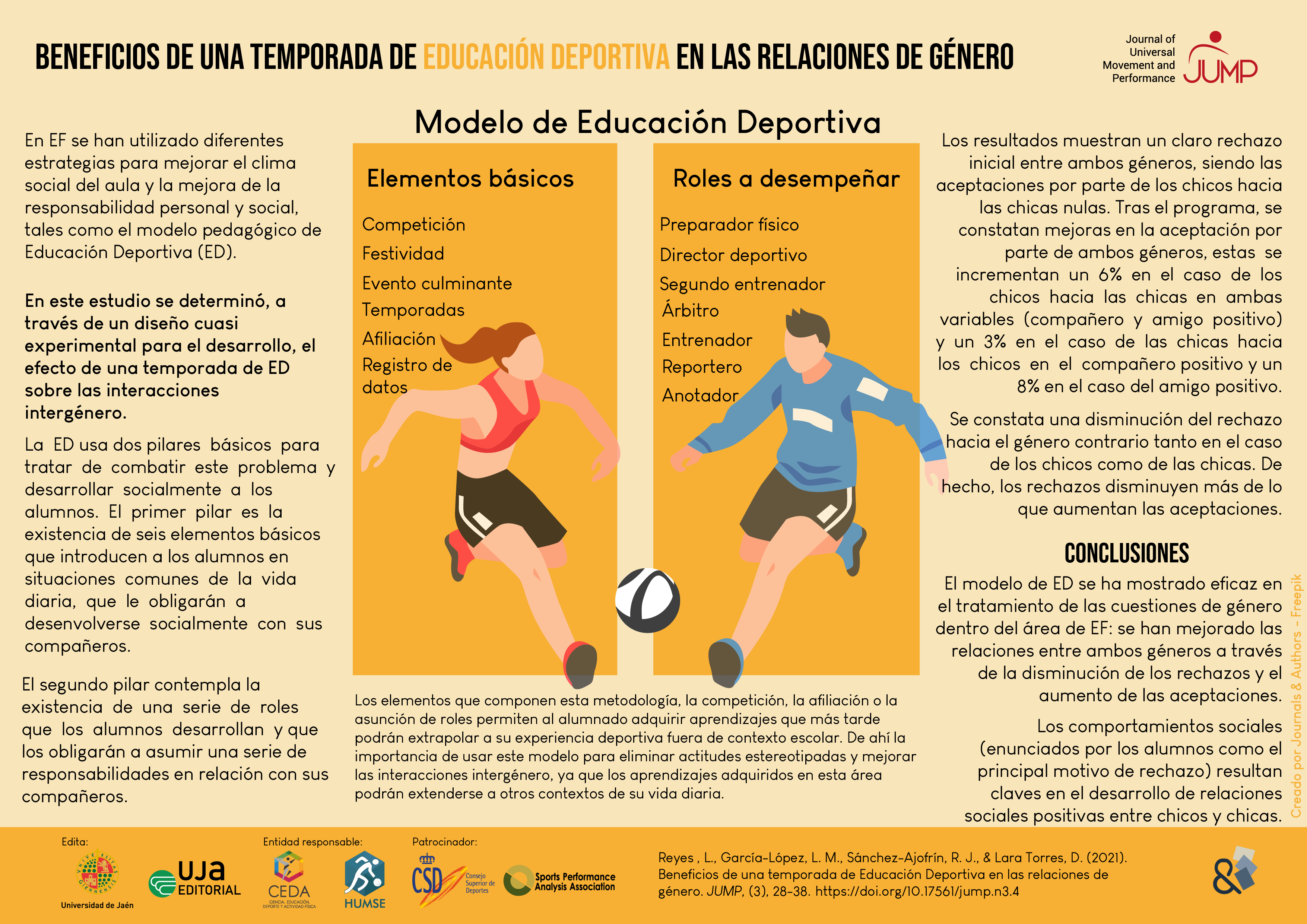
Peer relationships are a key factor in the social development of tweens thus this study dealt with social relations, paying special attention to relations between genders. In addition, we also studied the possible repercussion of the implementation of a unit which uses as methodology, the sport education pedagogical model with year-6 Primary School students. For the implementation of this unit, a ten sessions program structured according to SE and three complementary activities was designed. In the same way, we used sociometric tests and interviews to analyze differences between the initial and the final situation. The results obtained showed a marked rejection between boys and girls. After the implementation of the program, findings reflected a slight improvement in terms of acceptance of the opposite gender and the reduction of its rejection, to which basic pillars of SE, such as affiliation and festivity contributed to. The motives that the students enunciate to accept or reject the opposite sex can be classified into five categories (behavior, friendship, companionship, dominance, lack of competence and others). Likewise, social relationships are improved and negative behaviour in the classroom is reduced. To improve these results, it is important that the model be reinforced with the use of other complementary techniques, which foster social relations.
References
Bryman, A. (2016). Social Research Methods. Oxford University Press.
Burgueño, R., Martín, B., Morales, E., & Medina-Casaubón, J. (2019). Influence of sport education on high school students’ motivational response: A gender perspective. Retos. Nuevas tendencias en Educación Física, Deporte y Recreación, 37(37), 546-555. https://doi.org/10.47197/retos.v37i37.70880
Chen, Y., & Curtner-Smith, M. D. (2015). Hegemonic masculinity in sport education: case studies of pre-service physical education teachers with teaching orientations. Sport, Education & Society, 20(4), 546-563. https://doi.org/10.1080/13573322.2013.775116
Cohen, L., & Manion, L. (1990). La entrevista. En Cohen, L. & Manion, L. Métodos de investigación educativa. La Muralla. Connell, R.W., & Messerschmidt., J. W. (2005). Hegemonic masculinity: Rethinking the concept. Gender & Society 19(6), 829–859. https://doi.org/10.1177/0891243205278639
Ennis, C. D., Solmon, M. A., Satina, B., Loftus, S. J., Mensch, J., & McCauley, M. T. (1999). Creating a Sense of Family in Urban Schools Using “Sport for Peace” Curriculum. Research Quarterly for Exercise & Sport, 70(3), 273-285. https://doi.org/10.1080/02701367.1999.10608046
Farias, C., Hastie, P. A., & Mesquita, I. (2017). Towards a more equitable and inclusive learning environment in sport education: Results of an action research-based intervention. Sport, Education and Society, 22(4), 460-476. https://doi.org/10.1080/13573322.2015.1040752
Fernández-Río, J., & Méndez-Giménez, A., (2016). El Aprendizaje Cooperativo: Modelo Pedagógico para Educación Física. Retos. Nuevas tendencias en Educación Física, Deporte y Recreación, 29, 201-206. https://doi.org/10.47197/retos.v0i29.38721
Frosh, S., Phoenix, A., & Pattman R. (2002). Young Masculinities: Understanding Boys in Contemporary Society. Palgrave. Garaigordobil, M., y Aliri, J. (2013). Relaciones del sexismo con justificación de la violencia, y con otras formas de prejuicio como la dominancia social y el autoritarismo. Estudios de Psicología, 34(2), 127-139. https://doi.org/10.1174/021093913806751384
García- Bacete, F. J., Sureda, I. y Monjas, M. I. (2010). El rechazo entre iguales en la educación primaria: Una panorámica general. Anales de psicología, 26(1), 123-136.
García-Bacete, F. J. (2006). La identificación de los alumnos rechazados: Comparación de métodos sociométricos de nominaciones bidimensionales. Infancia y Aprendizaje, 29(4), 437-451. https://doi.org/10.1174/021037006778849585
García-Bacete, F. J., Sureda, I., y Monjas, M. I. (2008). Distribución sociométrica en las aulas de chicos y chicas a lo largo de la escolaridad. Revista de Psicología Social, 23(1), 63-74.
García-Bacete, F. J., Rubio-Barreda, A., Milan-Rojas, I., y Marande-Perrín G. (2013). El aprendizaje de la amistad en la Educación Primaria. Un procedimiento intensivo para ayudar a los niños rechazados a hacer amigos. Apuntes de Psicología, 31, 155-163.
García-López, L. M., & Gutiérrez, D. (2015). The effects of a sport education season on empathy and assertiveness. Physical Education and Sport Pedagogy, 20(1), 1-16. https://doi.org/10.1080/17408989.2013.780592
García-López, L. M., Gutiérrez, D., González-Víllora, S., & Valero-Valenzuela, A. (2012). Cambios en la empatía, la asertividad y las relaciones sociales por la aplicación del modelo de instrucción educativa deportiva. Revista de Psicología del Deporte, 21(2), 321-330.
García-López, L.M., y Gutiérrez, D. (2016). Aprendiendo a Enseñar Deporte. Modelos de Enseñanza comprensiva y Educación deportiva. INDE. Hastie, P. A. (1998). The Participation and Perceptions of Girls Within a Unit of Sport Education. Journal of Teaching in Physical Education, 17(2), 157-171.
Hellison, D. (1995). Teaching Responsibility through Physical Activity. Champaign: Human Kinetics.
Hopkins, W., Marshall, S., Batterham, A., & Hanin, J. (2009). Progressive statistics for studies in sports medicine and exercise science. Medicine Science in Sports Exercise, 41(1), 3. https://doi.org/10.1249/MSS.0b013e31818cb278
Hsieh, H. F., & Shannon, S. E. (2005). Three Approaches to Qualitative Content Analysis. Qualitative Health Research, 15(9), 1277-1288. https://doi.org/10.1177/1049732305276687
Kirk, D., & Kinchin, G. (2003). Situated learning as a theoretical framework for sport education. European physical education review, 9(3), 221-235.
Luna, P., Guerrero, J., Rodrigo-Ruiz, D., Losada, L., & Cejudo, J. (2020). Social Competence and Peer Social Acceptance: Evaluating Effects of an Educational Intervention in Adolescents. Frontiers in Psychology, 11, 1305. https://doi.org/10.3389/fpsyg.2020.01305
MacPhail, A., Kirk, D., & Kinchin, G. (2004). Sport education: Promoting team affiliation through physical education. Journal of teaching in Physical Education, 23(2), 106-122.
Metzler, M. W. (2017). Instructional models for physical education (3 ed.). Routledge.
Monjas, M. I., Sureda, I., & García-Bacete, F. J. (2008). ¿Por qué los niños y las niñas se aceptan y se rechazan?Cultura y Educación, 20(4), 479-492. https://doi.org/10.1174/113564008786542181
Moreno, J. L. (1972). Fundamentos de la sociometría. Paidós.
Navarro-Pertusa, E. (2004). Género y relaciones personales íntimas. En E. Barberá-Heredia y I. Martínez-Benlloch (Coords.), Psicología y Género (pp. 171-192). Pearson Educación.
Perry, D. G., & Pauletti, R. E. (2011). Gender and Adolescent Development. Journal of Research on Adolescence, 21(1), 61-74. https://doi.org/10.1111/j.1532-7795.2010.00715.x
Pope, C., & O’Sullivan, M. (2003). Darwinism in the gym. Journal of Teaching in Physical Education, 22, 311–327. https://doi.org/10.1123/jtpe.22.3.311
Puente-Maxera, F., Mahedero, P., Méndez-Giménez, A., & Martínez de Ojeda Pérez, D. (2020). Educación Deportiva, roles y vulnerabilidad. Influencia en la responsabilidad y la competencia interculturalidad en adolescentes (78).
Rebollo, Á., Ruiz, E., & García, R. (2017). Preferencias relacionales en la adolescencia según el género. Revista Electrónica de Investigación Educativa, 19(1), 58-72. https://doi.org/10.24320/redie.2017.19.1.1022
Shen, B., McCaughtry, N., Martin, J., Fahlman, M., & Gran, A. (2012). Urban High-School Girls’ Sense of Relatedness and Their Engagement in Physical Education. Journal of Teaching in Physical Education, 31, 231-245.
Siedentop, D. (1994). Sport education: Quality PE through positive sport experiences. Human Kinetics.
Siedentop, D., Hastie, P. A., & Van der Mars, H. (2011). Complete Guide to Sport Education (2ªed). Human Kinetics.
Sinelnikov, O. A. (2009). Sport education for teachers: Professional development when introducing a novel curriculum model. European Physical Education Review, 15, 91-114.
Soler, S. (2009). Los procesos de reproducción, resistencia y cambio de las relaciones tradicionales de género en Educación Física: el caso del fútbol. Cultura y Educación, 21(1), 31-42. https://doi.org/10.1174/113564009787531253
Tesch, R. (1990). Qualitative Research Analysis Types and Software Tools. Falmer Press.
Vidiella, J., Herraiz, F., Hernández, F., y Sancho, J. M. (2010). Masculinidad hegemónica, deporte y actividad física. Movimento, 16(4), 93-115. https://doi.org/10.22456/1982-8918.15031
Williams, J.E., & Best, D.L. (1990). Measuring Sex Stereotypes: A Multination Study. Sage.