Influence of the Environment Temperature over the Tactic, Technical and Physical Performances of National Teams
DOI:
https://doi.org/10.17561/jump.n3.5Keywords:
Soccer, Heat, Thermoregulation, World CupAbstract
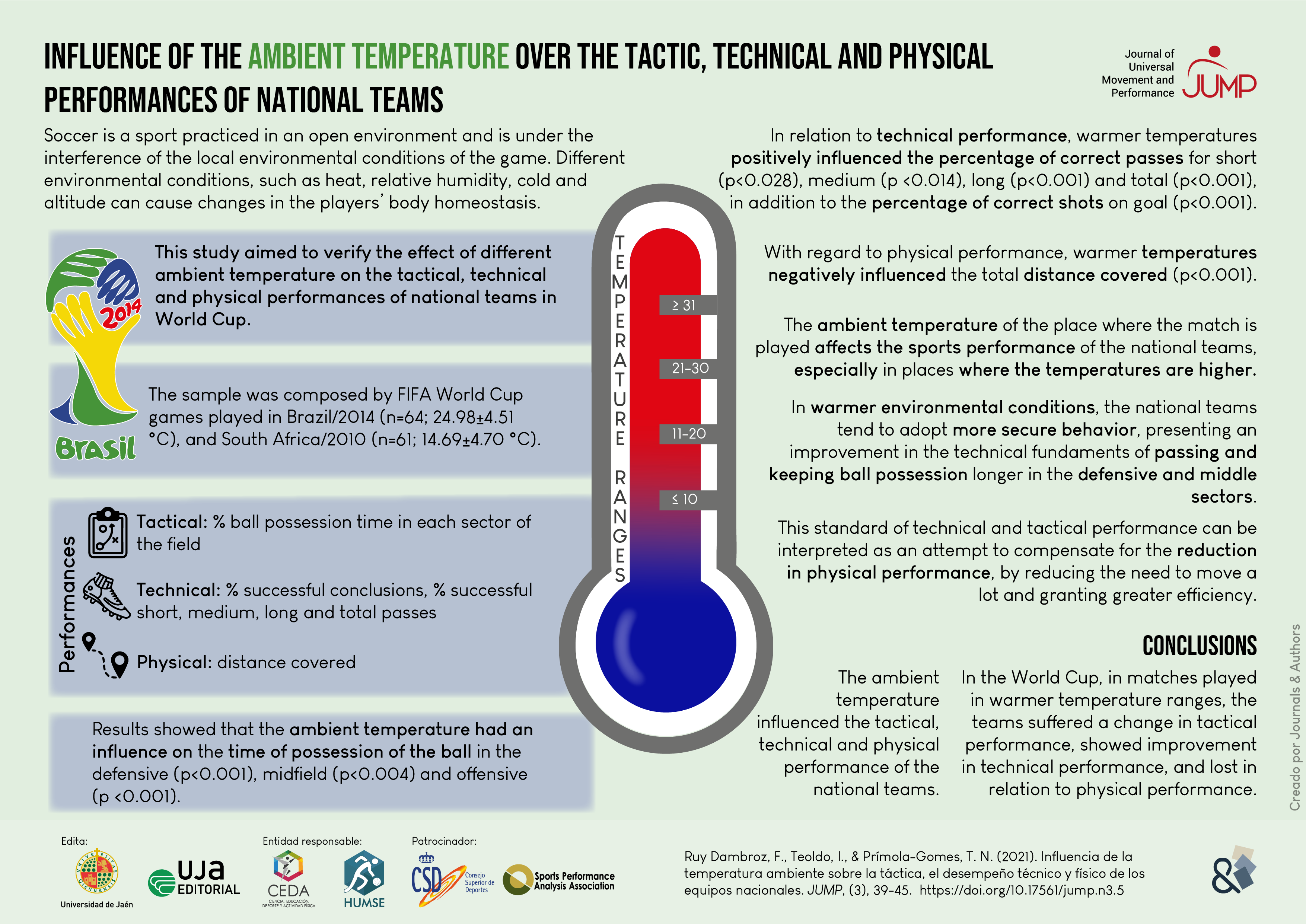
Soccer is a sport practiced in an open environment and is under the interference of the local environmental conditions of the game. Different environmental conditions, such as heat, relative humidity, cold and altitude can cause changes in the players’ body homeostasis. Thus, this study aimed to verify the effect of different ambient temperature on the tactical, technical and physical performances of national teams in World Cup. The sample was composed by FIFA World Cup games played in Brazil/2014 (n=64; 24.98±4.51°C), and South Africa/2010 (n=61; 14.69±4.70°C). The data were obtained from FIFA website. Temperature was categorized in four ranges: ≤10°C; 11–20°C; 21–30°C; ≥31°C. The tactical (% ball possession time in each sector of the field), technical (% successful conclusions, % successful short, medium, long and total passes) and physical (distance covered) performances of the teams were compared based on temperature ranges. Kolmogorov-Smirnov test, ANOVA One-Way and Kruskal-Wallis (p<0,05) were used to compare the averages by temperature range, in addition to the Tukey and Mann-Whitney tests (post-hoc). The results showed that the ambient temperature had an influence on the time of possession of the ball in the defensive (p<0.001), midfield (p<0.004) and offensive (p <0.001). In addition, in relation to technical performance, warmer temperatures positively influenced the percentage of correct passes for short (p<0.028), medium (p <0.014), long (p<0.001) and total (p<0.001), in addition to the percentage of correct shots on goal (p<0.001). On the other hand, with regard to physical performance, warmer temperatures negatively influenced the total distance covered (p<0.001). The ambient temperature influenced the tactical, technical and physical performance of the national teams. In the World Cup, in matches played in warmer temperature ranges, the teams suffered a change in tactical performance, showed improvement in technical performance, and losses in relation to physical performance.
References
Badin, O. O., Smith, M. R., Conte, D., & Coutts, A. J. (2016). Mental fatigue impairs technical performance in small-sided soccer games. International Journal of Sports Physiology and Performance, 11(8), 1100–1105. https://doi.org/10.1123/ijspp.2015-0710
Bangsbo, J., Iaia, F. M., & Krustrup, P. (2007). Metabolic response and fatigue in soccer. International Journal of Sport Physiology and Performance, 2(2), 111–127. https://doi.org/10.1123/ijspp.2.2.111
Barreira, D., Garganta, J., Machado, J., & Anguera, M. T. (2014). Effects of ball recovery on top-level soccer attacking patterns of play. Revista Brasileira de Cineantropometria e Desempenho Humano, 16(1), 36–46. https://doi.org/10.5007/1980-0037.2014v16n1p36
Bradley, P. S., Carling, C., Archer, D., Roberts, J., Dodds, A., Di Mascio, M., Paul, D., Diaz, A. G., Peart, D., & Krustrup, P. (2011). The effect of playing formation on high-intensity running and technical profiles in English FA Premier League soccer matches. Journal of Sports Sciences, 29(8), 821–830. https://doi.org/10.1080/02640414.2011.561868
Brewer, J., & Warren, L. (2014). A review of the potential implications of hot and humid environmental conditions on soccer matchplay performance. International Journal of Sciences: Basic and Applied Research, 1, 584–589.
Brocherie, F., Girard, O., Farooq, A., & Millet, G. P. (2015). Influence of weather, rank, and home advantage on football outcomes in the gulf region. Medicine and Science in Sports and Exercise, 47(2), 401–410. https://doi.org/10.1249/MSS.0000000000000408
Carling, C., Dupont, G. F., & Le Gall, F. (2011). The Effect of a Cold Environment on Physical Activity Profiles in Elite Soccer Match-Play. International Journal of Sports Medicine, 32, 542–545. https://doi.org/10.1055/s-0031-1273711
Chmura, P., Konefał, M., Andrzejewski, M., Kosowski, J., Rokita, A., & Chmura, J. (2017). Physical activity profile of 2014 FIFA World Cup players, with regard to different ranges of air temperature and relative humidity. International Journal of Biometeorology, 61(4), 677–684. https://doi.org/10.1007/s00484-016-1245-5
Cohen, J. (1992). A Power Primer. Psychological Bulletin, 112(1), 155–159. https://doi.org/10.1037/0033-2909.112.1.155
Dvorak, J., & Junge, A. (2015). Twenty years of the FIFA Medical Assessment and Research Centre: from ‘Medicine for Football’ to ‘Football for Health.’ British Journal of Sports Medicine, 49(9), 561–563. https://doi.org/10.1136/bjsports-2015-094805
Dvorak, J., & Racinais, S. (2010). Training and playing football in hot environments. Scandinavian Journal of Medicine and Science in Sports, 20(Suppl. 3), iv–v. https://doi.org/10.1111/j.1600-0838.2010.01203.x
Ekblom, B. (1986). Applied physiology of soccer. Sports Medicine, 3(1), 50–60. https://doi.org/10.2165/00007256-198603010-00005
Gandevia, S. C. (2001). Spinal and Supraspinal Factors in Human Muscle Fatigue. Physiological Review, 81(4), 1725–1789. https://doi.org/10.1152/physrev.2001.81.4.1725
Garganta, J. (2009). Trends of tactical performance analysis in team sports: bridging the gap between research, training and competition. Revista Portuguesa de Ciências Do Desporto, 9(1), 81–89. https://doi.org/10.5628/rpcd.09.01.81
Grantham, J., Cheung, S. S., Connes, P., Febbraio, M. A., Gaoua, N., González-Alonso, J., Hue, O., Johnson, J. M., Maughan, R. J., Meeusen, R., Nybo, L., Racinais, S., Shirreffs, S. M., & Dvorak, J. (2010). Current knowledge on playing football in hot environments. Scandinavian Journal of Medicine and Science in Sports, 20(SUPPL. 3), 161–167. https://doi.org/10.1111/j.1600-0838.2010.01216.x
Lago, C. (2009). The influence of match location , quality of opposition, and match status on possession strategies in professional association football. Journal Sports Sciences, 27(13), 1463–1469. https://doi.org/10.1080/02640410903131681
Link, D., & Weber, H. (2017). Effect of ambient temperature on pacing in soccer depends on skill level. Journal of Strength and Conditioning Research, 31(7), 1766–1770. https://doi.org/10.1519/JSC.0000000000001013
Maughan, R. J., Shirreffs, S. M., Özgünen, K. T., Kurdak, S. S., Ersöz, G. ., Binnet, M. S., & Dvorak, J. (2010). Living, training and playing in the heat: challenges to the football player and strategies for coping with environmental extremes. Scandinavian Journal of Medicine & Science in Sports, 20(3), 117–124. https://doi.org/10.1111/j.1600-0838.2010.01221.x
Mohr, M., Krustrup, P., Nybo, L., Nielsen, J. J., & Bangsbo, J. (2004). Muscle temperature and sprint performance during soccer matches - Beneficial effect of re-warm-up at half-time. Scandinavian Journal of Medicine and Science in Sports, 14(3), 156–162. https://doi.org/10.1111/j.1600-0838.2004.00349.x
Mohr, M, Mujika, I., Santisteban, J., Randers, M. B., Bischoff, R., Solano, R., Hewitt, A., Zubillaga, A., Peltola, E., & Krustrup, P. (2010). Examination of fatigue development in elite soccer in a hot environment: a multi-experimental approach. Scandinavian Journal of Medicine & Science in Sports, 20(3), 125–132.
https://doi.org/10.1111/j.1600-0838.2010.01217.x
Mohr, Magni, Nybo, L., Grantham, J., & Racinais, S. (2012). Physiological responses and physical performance during football in the heat. PLoS ONE, 7(6), 1–10. https://doi.org/10.1371/journal.pone.0039202
Nassis, G. P. (2013). Effect of altitude on football performance: Analysis of the 2010 FIFA World Cup data. Journal of Strengh and Conditioning Research, 27(3), 703–707. https://doi.org/10.1519/JSC.0b013e31825d999d
Nassis, G. P., Brito, J., Dvorak, J., Chalabi, H., & Racinais, S. (2015). The association of environmental heat stress with performance: Analysis of the 2014 FIFA World Cup Brazil. British Journal of Sports Medicine, 49, 609–613. https://doi.org/10.1136/bjsports-2014-094449
Özgünen, K. T., Kurdak, S. S., Maughan, R. J., Zeren, Ç., Korkmaz, S., Yazizi, Z., Ersöz, G. ., Shirreffs, S. M., Binnet, M. S., & Dvorak, J. (2010). Effect of hot environmental conditions on physical activity patterns and temperature response of football players. Scandinavian Journal of Medicine & Science in Sports, 20(3), 140–147. https://doi.org/10.1111/j.1600-0838.2010.01219.x
Reilly, T., & Williams, A. M. (2003). Science and Soccer. Routledge. https://doi.org/10.4324/9780203417553
Smith, M. R., Coutts, A. J., Merlini, M., Deprez, D., Lenoir, M., & Marcora, S. M. (2016). Mental fatigue impairs soccer-specific physical and technical performance. Medicine & Science in Sports & Exercise, 48(2), 267–276. https://doi.org/10.1249/MSS.0000000000000762
Taylor, J. B., Mellalieu, S. D., James, N., & Shearer, D. A. (2008). The influence of match location, quality of opposition, and match status on technical performance in professional association football. Journal of Sports Sciences, 26(9), 885–895. https://doi.org/10.1080/02640410701836887
Teoldo, I., Guilherme, J., & Garganta, J. (2017). Training football for smart playing: On tactical performance of teams and players. Appris.
Trewin, J., Meylan, C., Varley, M. C., & Cronin, J. (2017). The influence of situational and environmental factors on match-running in soccer: a systematic review. Science and Medicine in Football, 1–12. https://doi.org/10.1080/24733938.2017.1329589
Zhou, C., Hopkins, W. G., Mao, W., Calvo, A. L., & Liu, H. (2019). Match performance of soccer teams in the Chinese super league—effects of situational and environmental factors. International Journal of Environmental Research and Public Health, 16(21), 1–13. https://doi.org/10.3390/ijerph16214238