Presence of Women on the Boards of Football Clubs. A Case Study in the Region of Murcia (Spain)
DOI:
https://doi.org/10.17561/jump.n3.6Keywords:
Boards of directors, Participation, Football, Relevance, Region of MurciaAbstract
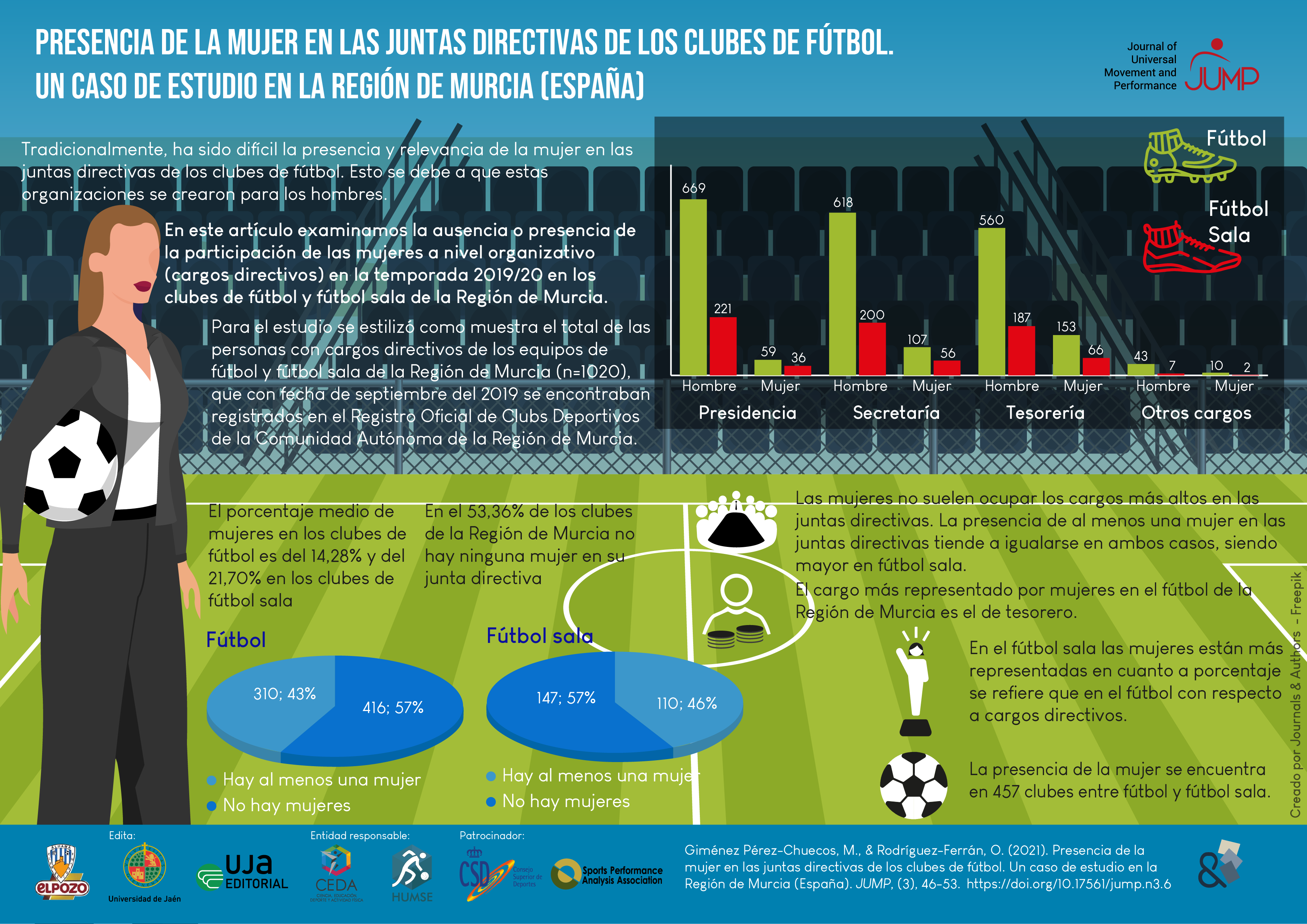
The presence of women on boards of directors is difficult because these organizations were created for men, thus making the presence and relevance of women in them difficult. The objective of the following study is to examine the absence or presence of women’s participation at the organizational level (managerial positions) in the 2019/20 season in soccer and futsal clubs in the Region of Murcia. For the study, the total of people with managerial positions of soccer and futsal teams in the Region of Murcia (n = 1020) was stylized as a sample, which as of September 2019 were registered in the Official Registry of Clubs Sports of the Autonomous Community of the Region of Murcia. An observational methodology was carried out in which the following variables were considered: a) type of club (soccer or futsal); b) gender (male or female) and; c) figure (president; 1st vice president; 2nd vice president; 3rd vice president; 4th vice president; secretary; treasurer; 1st member; 2nd member; 3rd member; 4th member; and other positions). The results show that the average percentage of women in soccer clubs is 14.28% and 21.70% in futsal clubs, in addition to that, in 53.36% of the clubs in the Region of Murcia there is no woman on its board of directors. The conclusion is drawn that women appear less than men in managerial positions, and that, in addition, the positions they occupy are of less relevance within the clubs.
References
Adriaanse, J. A. (2009). La mujer y la alta gestión deportiva: de la declaración de Brighton a Sidney 2010. Citius, Altius, Fortius: humanismo, sociedad y deporte: investigaciones y ensayos (CAF), 2(1), 109-128.
Alfaro, É., Mayoral, Á., y Vázquez, B. (2018). Factores que condicionan el acceso de las mujeres a los puestos de responsabilidad en el deporte. Consejo Superior de Deportes.
Alfaro, É., Vázquez, B., Gallardo, J. M., y Ferro, S. (2012). La participación de las mujeres dentro de la Dirección General de Deportes de la Comunidad de Madrid y las federaciones deportivas madrileñas. Kronos, 11(2), 7-16.
Alfaro, É., Vázquez, B., Gallardo, J. M., y Ferro, S. (2012). Mujeres en puestos de responsabilidad dentro de las organizaciones públicas deportivas de la comunidad de Madrid. Ágora para la Educación Física y el Deporte, 15(1), 40-53.
Allison, R. (2016). Business or Cause? Gendered Institutional Logics in Women’s Professional Soccer. Journal of Sport and Social Issues, 40(3), 237-262. https://doi.org/10.1177/0193723515615349
Chantelat, P., Bayle, E., y Ferrand, C. (2004). Les représentations de l’activité des femmes dirigeantes dans les fédérations sportives françaises: effets de contexte et ambivalences. De Boeck Supérieur, 66, 143-159. https://doi.org/10.3917/sta.066.0143
Claringbould, I., y Knoppers, A. (2007). Finding a ‘normal’ woman: Selection processes for board membership. Sex Roles, 56(7), 495-507. https://doi.org/10.1007/s11199-007-9188-2
Di Cimbrini, T., Esteban, M. L., Fernandes, E., Güngör, G., y Smith, C (2019). Corporate governance in sport organizations: a gender perspective. Universidad de Zaragoza. https://doi.org/10.26754/uz.978-84-16723-80-5
Fernández-Torres, M.J., y Almansa-Martínez, A. (2011). Mujer y comunicación en el fútbol español. Revista de Comunicación Vivat Academia, 117, 826-842. https://doi.org/10.15178/va.2011.117E.826-842
FIFA (2015). La FIFA, el fútbol y las mujeres: Razones por las que las reformas deben especificar la inclusión y la inversión. https://resources.fifa.com/mm/document/affederation/footballgovernance/02/72/23/75/showdoc_es_spanish.pdf
FIFA (2016). Estrategia de fútbol femenino. https://resources.fifa.com/image/upload/women-s-football-strategy.pdf?cloudid=jor8jikrnmjulndmyoip
Gambau, V. (2002). Estudio de la organización de los clubes deportivos en Galicia: un análisis empírico. (Tesis doctoral, Universidade da Coruña). https://ruc.udc.es/dspace/handle/2183/5595
Hall, M. A., Cullen, D., y Slack, T. (1989). Organizational elites recreating themselves: the gender structure of national sport organizations. Quest, 41(1), 28-45. https://doi.org/10.1080/00336297.1989.10483906
Losada, J. L., y Manolov, R. (2015). The process of basic training, applied training, maintaining the performance of an observer. Quality & Quantity, 49(1), 339-347. https://doi.org/10.1007/s11135-014-9989-7
Mahmoud, M. (2016). El fútbol femenino en los clubes deportivos de la ciudad de Barcelona: un análisis de su gestión. (Tesis doctoral, Universidad de Barcelona). https://www.tesisenred.net/bitstream/handle/10803/405706/MARY%20MAHMOUD_TESIS.pdf?sequence=1&isAllowed=y
Moragas, M. (2014). Les dones que presideixen els clubs esportius a Catalunya. Factors que incideixen en l’accés i en l’exercici del càrrec, i estil de lideratge. (Tesis doctoral, Universidad Ramon Llull). https://www.tesisenred.net/handle/10803/145029#page=10
Pfister, G. (2015). Assessing the sociology of sport: On women and football. International Review for the Sociology of Sport Journal, 50(4-5), 563-569. https://doi.org/10.1177/1012690214566646
Pfister, G., y Radtke, S. (2009). Sport, women, and leadership: Results of a project on executives in German sports organizations. European Journal of Sport Science, 9(4), 229-243. https://doi.org/10.1080/17461390902818286
Puig, N. (2007). Mujer y deporte. Diputación general de Aragón. Tusell, J. O. (2009). Deporte y discriminación por sexo: fútbol, remo y salto de esquí. InDeret. Revista para el análisis del derecho, 2(1), 21-35.
Vega, P., Pérez-González, B., Fernández-Luna, A., y Burillo, P. (2019). Diversidad de género en las juntas directivas de federaciones deportivas: resultados económicos y operacionales. Apunts.Educación Física y Deportes, 137(3), 115-128. https://doi.org/10.5672/apunts.2014-0983.es.(2019/3).137.09