Sagittal mechanics of change of direction in female football players of different competitive levels
DOI:
https://doi.org/10.17561/jump.n4.5Keywords:
injuries, anterior cruciate ligament, injury risk factors, cutting mechanics, sidestep, knee flexion, trunk kinematics, deceleration manoeuvresAbstract
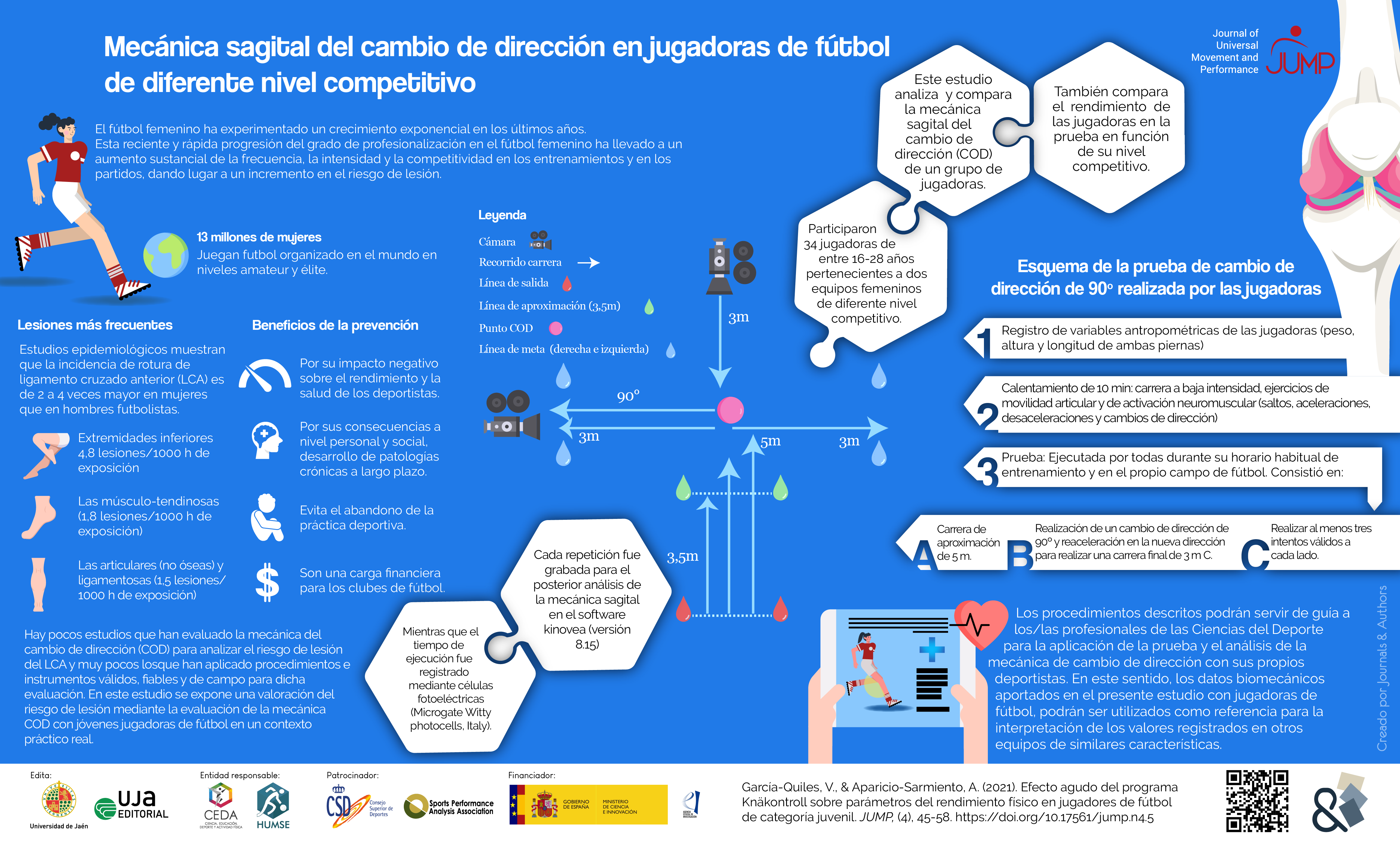
The assessment of change of direction mechanics could make an important contribution to both targeting preventive functional training and guiding the recovery processes of female players. The purpose of this study was to describe sagittal change of direction (COD) mechanics of a group of female football players and to compare the sagittal biomechanics of the COD as well as the players' performance in the test by their competitive level. Knee flexion and trunk flexion mechanics of the players were analysed during the penultimate and final contact in a 90º COD. A descriptive cross-sectional study was carried out with 34 players aged 16-28 years belonging to two female teams of different competitive levels. For the analysis of sagittal mechanics, Kinovea software was used and the execution time was recorded using photoelectric time cells. It was found that the average position of the trunk was in flexion at initial contact during the penultimate support, both to the right (7±4.8º) and to the left (6.1±5.6º) and it was also found that maximum knee flexion (DER: 94.1±21º; IZQ: 91.5±26.7º) was considerably higher (lower values) than knee flexion at initial contact (DER: 122.9±21.1º; IZQ: 122.4±24.1º). On the other hand, both initial and maximum trunk flexion during the final contact presented significantly higher values in the elite football team (initial: 12.1±6.7º vs. 5.2±6.3º; maximum: 13.4±6.8º vs. 7.3±6º). In conclusion, female football players showed a low-risk trunk flexion strategy during the final stance, however, they did not perform a clear and efficient deceleration strategy during the penultimate contact, although they did show adequate knee flexion. Elite female footballers performed the change of direction faster and more safely.
References
Alahmad, T. A., Kearney, P., & Cahalan, R. (2020). Injury in elite women’s soccer: A systematic review. The Physician and Sportsmedicine, 0(0), 1-7. https://doi.org/10.1080/00913847.2020.1720548
Aliendre Morel, C. R., & Contrera, M. (2019). La discriminación de género en el deporte. El caso del futbol femenino. ScientiAmericana, 6(2), 81-90.
Bishop, C., Turner, A., Maloney, S., Lake, J., Loturco, I., Bromley, T., & Read, P. (2019). Drop Jump Asymmetry is Associated with Reduced Sprint and Change-of-Direction Speed Performance in Adult Female Soccer Players. Sports, 7(1), 29. https://doi.org/10.3390/sports7010029
Bradley, P., & Scott, D. (2019). Análisis físico de la Copa Mundial Femenina de la FIFA Francia 2019. Fédération Internationale de Football Association. https://digitalhub.fifa.com/m/62485258e710dacf/original/pwinph2nr4snbh5u2wsq-pdf.pdf
Cardoso de Araújo, M. de, & Mießen, K. A. M. (2017). Twenty Years of the FIFA Women’s World Cup: An Outstanding Evolution of Competitiveness. Women in Sport and Physical Activity Journal, 25(1), 60-64. https://doi.org/10.1123/wspaj.2015-0047
Del Coso, J., Herrero, H., & Salinero, J. J. (2018). Injuries in Spanish female soccer players. Journal of Sport and Health Science, 7(2), 183-190. https://doi.org/10.1016/j.jshs.2016.09.002
Della Villa, F., Di Paolo, S., Santagati, D., Della Croce, E., Lopomo, N. F., Grassi, A., & Zaffagnini, S. (2021). A 2D video-analysis scoring system of 90° change of direction technique identifies football players with high knee abduction moment. Knee Surgery, Sports Traumatology, Arthroscopy. https://doi.org/10.1007/s00167-021-06571-2
Dos’Santos, T., McBurnie, A., Donelon, T., Thomas, C., Comfort, P., & Jones, P. A. (2019). A qualitative screening tool to identify athletes with «high-risk» movement mechanics during cutting: The cutting movement assessment score (CMAS). Physical Therapy in Sport, 38, 152-161. https://doi.org/10.1016/j.ptsp.2019.05.004
Dos’Santos, T., McBurnie, A., Thomas, C., Comfort, P., & Jones, P. A. (2019). Biomechanical Comparison of Cutting Techniques: A Review and Practical Applications. Strength & Conditioning Journal, 41(4), 40-54. https://doi.org/10.1519/SSC.0000000000000461
Dos’Santos, T., Thomas, C., Comfort, P., & Jones, P. A. (2019a). Role of the Penultimate Foot Contact During Change of Direction: Implications on Performance and Risk of Injury. Strength & Conditioning Journal, 41(1), 87-104. https://doi.org/10.1519/SSC.0000000000000395
Dos’Santos, T., Thomas, C., Comfort, P., & Jones, P. A. (2019b). The Effect of Training Interventions on Change of Direction Biomechanics Associated with Increased Anterior Cruciate Ligament Loading: A Scoping Review. Sports Medicine, 49(12),1837-1859. https://doi.org/10.1007/s40279-019-01171-0
DosʼSantos, T., Thomas, C., Jones, P. A., & Comfort, P. (2017). Mechanical Determinants of Faster Change of Direction Speed Performance in Male Athletes. Journal of Strength and Conditioning Research, 31(3), 696-705. https://doi.org/10.1519/JSC.0000000000001535
Faude, O., Junge, A., Kindermann, W., & Dvorak, J. (2006). Risk factors for injuries in elite female soccer players. British Journal of Sports Medicine, 40(9), 785-790. https://doi.org/10.1136/bjsm.2006.027540
Federation Internationale de Football Association (2019). Women’s Football MA’s Survey Report (p. 113). http://ac.els-cdn.com/S002175571500008X/1-s2.0-S002175571500008X-main.pdf?_tid=68fff318-30ef-11e7-afa2-00000aacb35f&acdnat=1493919227_eca904234cd6239317e02f316d6a2967
Figueres, E., Belloch, S., & Perez-Soriano, P. (2008). Poster: Estudio epidemiológico en el fútbol .
Fox, A. S. (2018). Change-of-Direction Biomechanics: Is What’s Best for Anterior Cruciate Ligament Injury Prevention Also Best for Performance? Sports Medicine, 48(8), 1799-1807. https://doi.org/10.1007/s40279-018-0931-3
Fuller, C. W., Ekstrand, J., Junge, A., Andersen, T. E., Bahr, R., Dvorak, J., Hagglund, M., McCrory, P., & Meeuwisse, W. H. (2006). Consensus statement on injury definitions and data collection procedures in studies of football (soccer) injuries. Scandinavian Journal of Medicine and Science in Sports, 16(2), 83-92. https://doi.org/10.1111/j.1600-0838.2006.00528.x
Giza, E., Mithöfer, K., Farrell, L., Zarins, B., & Gill, T. (2005). Injuries in women’s professional soccer. British Journal of Sports Medicine, 39(4), 212-216. https://doi.org/10.1136/bjsm.2004.011973
Hägglund, M., Waldén, M., Bahr, R., & Ekstrand, J. (2005). Methods for epidemiological study of injuries to professional football players: Developing the UEFA model. British Journal of Sports Medicine, 39(6), 340-346. https://doi.org/10.1136/bjsm.2005.018267
Hägglund, M., Waldén, M., Magnusson, H., Kristenson, K., Bengtsson, H., & Ekstrand, J. (2013). Injuries affect team performance negatively in professional football: An 11-year follow-up of the UEFA Champions League injury study. British Journal of Sports Medicine, 47(12), 738-742. https://doi.org/10.1136/bjsports-2013-092215
Hewett, T. E., Torg, J. S., & Boden, B. P. (2009). Video analysis of trunk and knee motion during non-contact anterior cruciate ligament injury in female athletes: Lateral trunk and knee abduction motion are combined components of the injury mechanism. British Journal of Sports Medicine, 43(6), 417-422. https://doi.org/10.1136/bjsm.2009.059162
Hewett, Timothy E., Myer, G. D., Ford, K. R., Heidt, R. S., Colosimo, A. J., McLean, S. G., van den Bogert, A. J., Paterno, M. V., & Succop, P. (2005). Biomechanical Measures of Neuromuscular Control and Valgus Loading of the Knee Predict Anterior Cruciate Ligament Injury Risk in Female Athletes: A Prospective Study. The American Journal of Sports Medicine, 33(4), 492-501. https://doi.org/10.1177/0363546504269591
Jones, P. A., Herrington, L., & Graham-Smith, P. (2016). Braking characteristics during cutting and pivoting in female soccer players. Journal of Electromyography and Kinesiology, 30, 46-54. https://doi.org/10.1016/j.jelekin.2016.05.006
Jones, P. A., Thomas, C., Dos’Santos, T., McMahon, J. J., & Graham-Smith, P. (2017). The Role of Eccentric Strength in 180° Turns in Female Soccer Players. Sports, 5(2), 42. https://doi.org/10.3390/sports5020042
Jones, P., Donelon, T., & Dos’Santos, T. (2017). A preliminary investigation into a qualitative assessment tool to identify athletes with high knee abduction moments during cutting: Cutting Movement Assessment Score (CMAS). Professional Strength & Conditioning, 37-42.
Kaneko, S., Sasaki, S., Hirose, N., Nagano, Y., Fukano, M., & Fukubayashi, T. (2017). Mechanism of Anterior Cruciate Ligament Injury in Female Soccer Players. Asian Journal of Sports Medicine, 8(1). https://doi.org/10.5812/asjsm.38205
Krustrup, P., & Krustrup, B. R. (2018). Football is medicine: It is time for patients to play! British Journal of Sports Medicine, 52(22), 1412-1414. https://doi.org/10.1136/bjsports-2018-099377
Krustrup, P., Helge, E. W., Hansen, P. R., Aagaard, P., Hagman, M., Randers, M. B., de Sousa, M., & Mohr, M. (2018). Effects of recreational football on women’s fitness and health: Adaptations and mechanisms. European Journal of Applied Physiology, 118(1), 11-32. https://doi.org/10.1007/s00421-017-3733-7
Llana, S., Soriano, P., & Figueres, E. (2010). La epidemiología en el fútbol: Una revisión sistemática. Revista Internacional de Medicina y Ciencias de la Actividad Física y el Deporte, 10(37), 22-40. http://cdeporte.rediris.es/revista/revista37/artfutbol130.htm
Lohmander, L. S., Englund, P. M., Dahl, L. L., & Roos, E. M. (2007). The long-term consequence of anterior cruciate ligament and meniscus injuries: Osteoarthritis. The American Journal of Sports Medicine, 35(10), 1756-1769. https://doi.org/10.1177/0363546507307396
López-Valenciano, A., Raya-González, J., Garcia-Gómez, J. A., Aparicio-Sarmiento, A., Sainz de Baranda, P., De Ste Croix, M., & Ayala, F. (2021). Injury Profile in Women’s Football: A Systematic Review and Meta-Analysis. Sports Medicine, 1-20. https://doi.org/10.1007/s40279-020-01401-w
López-Valenciano, A., Ruiz-Pérez, I., Garcia-Gómez, A., Vera-Garcia, F. J., De Ste Croix, M., Myer, G. D., & Ayala, F. (2020). Epidemiology of injuries in professional football: A systematic review and meta-analysis. British Journal of Sports Medicine, 54(12), 711-718. https://doi.org/10.1136/bjsports-2018-099577
Marques, J. B., Paul, D. J., Graham-Smith, P., & Read, P. J. (2020). Change of Direction Assessment Following Anterior Cruciate Ligament Reconstruction: A Review of Current Practice and Considerations to Enhance Practical Application. Sports Medicine, 50(1), 55-72. https://doi.org/10.1007/s40279-019-01189-4
McLean, S. G., Neal, R. J., Myers, P. T., & Walters, M. R. (1999). Knee joint kinematics during the sidestep cutting maneuver: Potential for injury in women. Medicine and Science in Sports and Exercise, 31(7), 959-968. https://doi.org/10.1097/00005768-199907000-00007
Montalvo, A. M., Schneider, D. K., Silva, P. L., Yut, L., Webster, K. E., Riley, M. A., Kiefer, A. W., Doherty-Restrepo, J. L., & Myer, G. D. (2019). ‘What’s my risk of sustaining an ACL injury while playing football (soccer)?’ A systematic review with meta-analysis. British Journal of Sports Medicine, 53(21), 1333–1340.
Myer, G. D., Ford, K. R., & Hewett, T. E. (2008). Tuck Jump Assessment for Reducing Anterior Cruciate Ligament Injury Risk. Athletic Therapy Today, 13(5), 39-44. https://www.ncbi.nlm.nih.gov/pmc/articles/PMC2779043/
Oja, P., Titze, S., Kokko, S., Kujala, U. M., Heinonen, A., Kelly, P., Koski, P., & Foster, C. (2015). Health benefits of different sport disciplines for adults: Systematic review of observational and intervention studies with meta-analysis. British Journal of Sports Medicine, 49(7), 434-440. https://doi.org/10.1136/bjsports-2014-093885
Ortín, F. J., Garcés de los Fayos, E. J., & Olmedilla, A. (2010). Influencia de los factores psicológicos en las lesiones deportivas. Papeles del psicólogo, 31(3), 8.
Pangrazio, O., & Forriol, F. (2016). Diferencias de las lesiones sufridas en 4campeonatos sudamericanos de fútbol femenino y masculino. Revista Latinoamericana de Cirugía Ortopédica, 1(2), 58-65. https://doi.org/10.1016/j.rslaot.2016.10.001
Peterson, L., Junge, A., Chomiak, J., Graf-Baumann, T., & Dvorak, J. (2000). Incidence of Football Injuries and Complaints in Different Age Groups and Skill-Level Groups. The American Journal of Sports Medicine, 28(5_suppl), 51-57. https://doi.org/10.1177/28.suppl_5.s-51
Prien, A., Boudabous, S., Junge, A., Verhagen, E., Delattre, B. M. A., & Tscholl, P. M. (2020). Every second retired elite female football player has MRI evidence of knee osteoarthritis before age 50 years: A cross-sectional study of clinical and MRI outcomes. Knee Surgery, Sports Traumatology, Arthroscopy, 28(2), 353-362. Scopus. https://doi.org/10.1007/s00167-019-05560-w
Prieto Andreu, J. M. (2015). Variables deportivas y personales en la ocurrencia de lesiones deportivas. Diferencias entre deportes individuales y colectivos (Sport and personal variables in the occurrence of sports injuries. Differences between individual and team sports ). Retos, 28, 21-25. https://doi.org/10.47197/retos.v0i28.34819
Quatman, C. E., Quatman-Yates, C. C., & Hewett, T. E. (2010). A «plane» explanation of anterior cruciate ligament injury mechanisms: A systematic review. Sports Medicine, 40(9), 729-746. https://doi.org/10.2165/11534950-000000000-00000
Raya-González, J., & Estévez-Rodríguez, J. (2016). Factores de riesgo asociados a la aparición de lesiones en el fútbol. Revista de Preparación física en el Fútbol, 21, 8-18 .
Robles-Palazón, F., Ruiz-Pérez, I., Oliver, J., Ayala, F., & Sainz de Baranda, P. (2021). Reliability, validity, and maturation-related differences of frontal and sagittal plane landing kinematic measures during drop jump and tuck jump screening tests in male youth soccer players. Physical Therapy in Sport, 50, 206-216.
Sasaki, S., Nagano, Y., Kaneko, S., Imamura, S., Koabayshi, T., & Fukubayashi, T. (2015). The Relationships Between the Center of Mass Position and the Trunk, Hip, and Knee Kinematics in the Sagittal Plane: A Pilot Study on Field-Based Video Analysis for Female Soccer Players. Journal of Human Kinetics, 45, 71-80. https://doi.org/10.1515/hukin-2015-0008
Secrist, E. S., Bhat, S. B., & Dodson, C. C. (2016). The Financial and Professional Impact of Anterior Cruciate Ligament Injuries in National Football League Athletes. Orthopaedic Journal of Sports Medicine, 4(8). https://doi.org/10.1177/2325967116663921
Shimokochi, Y., & Shultz, S. J. (2008). Mechanisms of Noncontact Anterior Cruciate Ligament Injury. Journal of Athletic Training, 43(4), 396-408. https://doi.org/10.4085/1062-6050-43.4.396
Sigward, S., & Powers, C. M. (2006). The influence of experience on knee mechanics during side-step cutting in females. Clinical Biomechanics, 21(7), 740-747. https://doi.org/10.1016/j.clinbiomech.2006.03.003
UEFA. (2015). Women’s Football across the National Associations 2014–15 (p. 93) [Análisis de la evolución del fútbol femenino entre las asociaciones nacionales de la UEFA]. Union of European Football Associations. Womenˇs football across the national associations (2014-15) (uefa.com)
UEFA.com. (16 de junio de 2010). Historia de la UEFA Champions League Femenina | UEFA Women’s Champions League. UEFA.com. https://es.uefa.com/womenschampionsleague/news/01e6-0e11f212c6fe-8e4476f92fe1-1000--historia-de-la-uefa-champions-league-femenina /
Valenti, M., Morrow, S., & Scelles, N. (2018). Women’s football studies: An integrative review. Sport, Business and Management: An International Journal, 8(5), 511-528. https://doi.org/10.1108/SBM-09-2017-0048
Van Mechelen, W., Hlobil, H., & Kemper, H. C. (1992). Incidence, severity, aetiology and prevention of sports injuries. A review of concepts. Sports Medicine, 14(2), 82-99. https://doi.org/10.2165/00007256-199214020-00002
Villa, F. D., Buckthorpe, M., Grassi, A., Nabiuzzi, A., Tosarelli, F., Zaffagnini, S., & Villa, S. D. (2020). Systematic video analysis of ACL injuries in professional male football (soccer): Injury mechanisms, situational patterns and biomechanics study on 134 consecutive cases. British Journal of Sports Medicine, 54(23), 1423-1432. https://doi.org/10.1136/bjsports-2019-101247
Waldén, M., Krosshaug, T., Bjørneboe, J., Andersen, T. E., Faul, O., & Hägglund, M. (2015). Three distinct mechanisms predominate in non-contact anterior cruciate ligament injuries in male professional football players: A systematic video analysis of 39 cases. British Journal of Sports Medicine, 49(22), 1452-1460. https://doi.org/10.1136/bjsports-2014-094573
Webborn, N. (2012). Lifetime injury prevention: The sport profile model. British Journal of Sports Medicine, 46(3), 193-197. https://doi.org/10.1136/bjsports-2011-090417
Weir, G., Alderson, J., Smailes, N., Elliott, B., & Donnelly, C. (2019). A Reliable Video-based ACL Injury Screening Tool for Female Team Sport Athletes. International Journal of Sports Medicine, 40(3), 191-199. Scopus. https://doi.org/10.1055/a-0756-9659
Yanguas Leyes, J., Til Pérez, L., & Cortés de Olano, C. (2011). Lesión del ligamento cruzado anterior en fútbol femenino. Estudio epidemiológico de tres temporadas. Apunts. Medicina de l’Esport, 46(171), 137-143. https://doi.org/10.1016/j.apunts.2011.02.006 11.02.006
Downloads
Published
Issue
Section
License
Copyright (c) 2021 Violeta García-Quiles, Alba Aparicio Sarmiento

This work is licensed under a Creative Commons Attribution 4.0 International License.