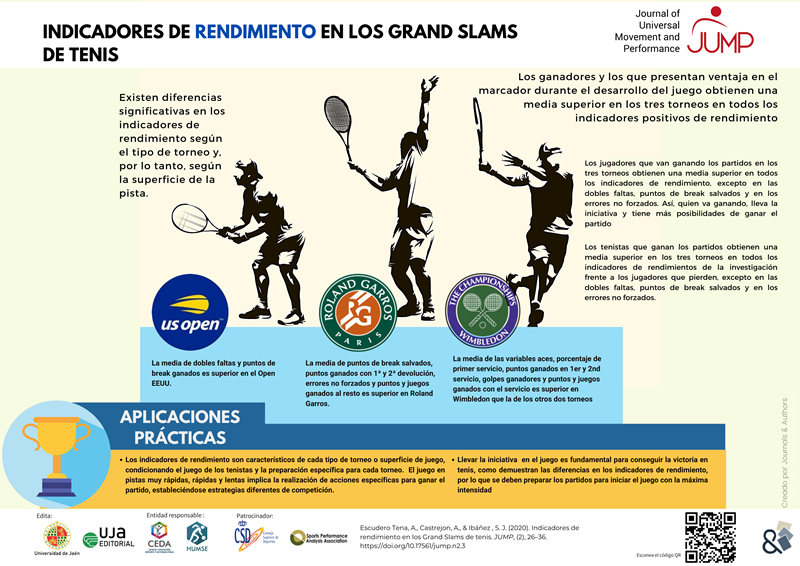
Performance Indicators in Tennis Grand Slams
DOI:
https://doi.org/10.17561/jump.n2.3Keywords:
Performance indicators, competition, playing surface, score, tennisAbstract
The objective of this research is to characterize the differences in performance indicators of Grand Slam tennis, in order to identify those technical and tactical behaviors that are more effective in real life playing situations. It is a descriptive and observational study, with a quantitative methodology. The sample was composed of 338 matches, of the absolute individual male category in the 2018 season of three Grand Slam tournaments (Roland Garros, Wimbledon and US Open). The differences in performance indicators in various situational variables (type of tournament, match result, match status and difference between sets) were analyzed through descriptive and inferential analysis. The results showed that there are significant performance indicators and differences in the analyzed tournaments in terms of tournament type, match result, match status and to a lesser extent in the difference between sets. We concluded that performance indicators are specific to each tournament or playing surface, that the importance of taking the initiative is fundamental to winning in tennis and that the form of play does not vary as the match progresses. These findings are of great interest, as they condition their setting for each tournament and the play of the players, establishing different competition strategies.
References
Afonso, J., Mesquita, I., & Palao, J. M. (2005). Relationship between the use of commit-block and the numbers of blockers and block effectiveness. International Journal of Performance Analysis in Sport, 5(2), 36–45. https://doi.org/10.1080/24748668.2005.11868326
Akpinar, S., Devrilmez, E., & Kirazci, S. (2012). Coincidenceanticipation timing requirements are different in racket sports. Perceptual and Motor Skills, 115(2), 581–593. https://doi.org/10.2466/30.25.27.PMS.115.5.581-593
Anguera, M. T., & Hernández-Mendo, A. (2016). Avances en estudios observacionales de Ciencias del Deporte desde los mixed methods. Cuadernos de Psicología del Deporte, 16(1), 17–30. https://revistas.um.es/cpd/article/view/254261
Ato, M., López, J. J., & Benavente, A. (2013). Un sistema de clasificación de los diseños de investigación en psicología. Anales de Psicología, 29(3), 1038–1059. https://doi.org/10.6018/analesps.29.3.178511
Barnett, T., & Pollard, G., (2007). How the tennis court surface affects player performance and injuries. Medicine and Science in Tennis, 12(1), 34–37.
Bloomfield, J. R., Polman, R. C. J., & O’donoghue, P. G. (2005). Effects of score-line on team strategies in FA Premier League Soccer. Journal of Sports Sciences, 23(2), 192–193.
Brown, E., & O`Donoghue, P. (2008). Efecto del género y la superficie en la estrategia del tenis de élite. Coaching and Sport Science Review, 15(46), 11–13.
Carboch, J., Siman, J., Sklenarik, M., & Blau, M. (2019). Match Characteristics and Rally Pace of Male Tennis Matches in Three Grand Slam Tournaments. Physical Activity Review, (7), 49–56. https://doi.org/10.16926/par.2019.07.06
Courel, J., Mc Robert, A., Ortega, E., & Cárdenas, D. (2014). The impact of match status on game rhythm in NBA basketball. In Comunicación presentada en el Congress of the European College of Sport Science.
Cowden, R. G., Fuller, D. K., & Anshel, M. H. (2014). Psychological predictors of mental toughness in elite tennis: an exploratory study in learned resourcefulness and competitive trait anxiety. Perceptual and motor skills, 119(3), 661–678. https://doi.org/10.2466/30.PMS.119c27z0
Cross, R., & Pollard, G. (2009). Grand Slam men’s singles tennis 1991–2009. Serve speeds and other related data. Coaching & Sport Science Review, 16(49), 8–10. http://www.physics.usyd.edu.au.
Cubo, S. (2011). La investigación experimental. En S. Cubo; B. Marín & J.L. Ramos (Eds). Métodos de investigación y análisis de datos en ciencias sociales y de la salud (pp.235–326). Madrid: Ediciones Pirámide.
Cui, Y., Liu, H., Liu, H., & Gómez, M. Á. (2019). Data-driven analysis of pointby-point performance for male tennis player in Grand Slams. Motricidade, 15(1), 49–61. http://dx.doi.org/10.6063/motricidade.16370
Fernández, J., Méndez, A., Pluim B. M., Fernández-García, B., & Terrados, N. (2006). Aspectos físicos y psicológicos del tenis en competición. Archivos de Medicina del Deporte, 13(116), 451–454.
Fernández-Fernández, J., Kinner, V., & Ferrauti, A. (2010). The physiological demands of hitting and running in tennis on different surfaces. The Journal of Strength & Conditioning Research, 24 (12), 3255–3264. https://doi.org/10.1519/JSC.0b013e3181e8745f
Fernández-García, Á. I., Blanca-Torres, J. C., Hernández-García, R., & Torres-Luque, G. (2019). Análisis de las variables estadísticas relacionadas con el servicio en tenis masculino de alto rendimiento en categoría junior y absoluto. Cultura, Ciencia y Deporte, 14(42), 289–295. http://dx.doi.org/10.12800/ccd.v14i42.1342
Fernández-García, A. I., Torres-Luque, G., Sánchez-Pay, A., & Fradua, L. (2012). Influencia del tipo de superficie en las estadísticas de competición del tenis de alto rendimiento. In Proceedings of VII Congreso Internacional de la Asociación Española de Ciencias del Deporte (pp. 412–413)
Ferrauti, A., Bergeron, M. F., Pluim, B. M., & Weber, K. (2001). Physiological responses in tennis and running with similar oxygen uptake. European Journal of Applied Physiology, 85, 27–33. https://doi.org/10.1007/s004210100425
Filipcic, A., Pers, J., & Klevisar, A. (2006). Comparison between Young male and female tennis players in terms of time and movement characteristics. In: Proceedings of 4th World Congress of Science and Racket Sports, 2006, Madrid, Spain (pp. 87–90).
Filipcic, T., Filipcic, A., & Berendijas, T (2008). Comparison of game characteristics of male and female tennis players at Roland Garros 2005. Acta Universitatis Palackianae Olomucensis. Gymica, 38(3), 21–28.
Furlong, J.D. (1995). The service in lawn tennis: how important is it?. Science and racket sports. In: T. Reilly, M. Hughes; Lees, A. (Eds) Science and Racket Sports I, (pp 266–271). London, England: E & FN Spon.
García-Rubio, J., Gómez, M. Á., Lago-Peñas, C., & Ibáñez, J. S. (2015). Effect of match venue, scoring first and quality of opposition on match outcome in the UEFA Champions League. International Journal of Performance Analysis in Sport, 15(2), 527–539. https://doi.org/10.1080/24748668.2015.11868811
Gillet, E., Leroy, D., Thouvarecq, R., & Stein, J. F. (2009). A notational analysis of elite tennis serve and serve-return strategies on slow surface. The Journal of Strength & Conditioning Research, 23 (2), 532–539. https://doi.org/10.1519/JSC.0b013e31818efe29
Gómez, M. Á., Alarcón-López, F., & Ortega-Toro, E. (2015). Analysis of shooting effectiveness in elite basketball according to match status. Revista de Psicología del Deporte, 24(3), 0037–0041. https://ddd.uab.cat/record/145126
Hughes, M., & Franks, I. (2007). The essentials of performance analysis: an introduction. Routledge. https://doi.org/10.4324/9780203938065
Ibáñez, S. J., García-Rubio, J., Rodríguez-Serrano, D., & Feu, S. (2019). Development of a Knockout Competition in Basketball: A Study of the Spanish Copa del Rey. Frontiers in psychology, 10. https://doi.org/10.3389/fpsyg.2019.02457
Ibáñez, S. J., Pérez-Goye, J. A., Courel-Ibáñez, J., & García-Rubio, J. (2018). The impact of scoring first on match outcome in women’s professional football. International Journal of Performance Analysis in Sport, 18(2), 318–326. https://doi.org/10.1080/24748668.2018.1475197
Jones, P. D., James, N., & Mellalieu, S. D. (2004). Possession as a performance indicator in soccer. International. https://doi.org/10.1080/24748668.2004.11868295
Journal of Performance Analysis in Sport, 4(1), 98–102. https://doi.org/10.1080/24748668.2004.11868295
Katić, R., Milat, S., Zagorac, N., & Đurović, N. (2011). Impact of game elements on tennis match outcome in Wimbledon and Roland Garros 2009. Collegium antropologicum, 35(2), 341–346.
Kovacs, M. (2007). Tennis physiology. Training the competitive athlete. Sport Medicine, 37(3), 189–198. https://doi.org/10.2165/00007256-200737030-00001
Lago, C., (2009). The influence of match location, quality of opposition, and match status on possession strategies in professional association football. Journal of sports sciences, 27(13), 1463–1469. https://doi.org/10.1080/02640410903131681
Lago, C., & Martín, R. (2007). Determinants of possession of the ball in soccer. Journal of sports sciences, 25(9), 969–974. https://doi.org/10.1080/02640410600944626
Lees, A. (2003). Science and the major racket sports: a review. Journal of Sports Sciences, 21(9), 707–732. https://doi.org/10.1080/0264041031000140275
Martínez-Gallego, R., Gumán, J.F., James, N., Pers, J., Ramon-Llin, J., & Vuckovic, G. (2013). Movement Characteristics of Elite Tennis Player son Hard Courts with Respet to the Direction of Ground Strokes. Journal of Sports Science and Medicine, 10(1), 275–281. https://www.ncbi.nlm.nih.gov/pmc/articles/PMC3761832/
Monteiro, R., Mesquita, I., & Marcelino, R. (2009). Relationship between the set outcome and the dig and attack efficacy in elite male Volleyball game. International Journal of Performance Analysis in Sport, 9(3), 294–305. https://doi.org/10.1080/24748668.2009.11868486
Montero, I., & León, O.G. (2007). A guide for naming research studies in Psychology. International Journal of Clinical and Health Psychology, 7(3), 847–862. http://www.redalyc.org/articulo.oa?id=33770318
Morante, S. (2006). Training Recommendations based on Match Characteristics of Professional Singles Tennis. Medicine and Science in Tennis. 11(3): 10–13.
Murias, J.M., Lanatta, D., Arcuri, C.R., & Laino, F.A. (2007). Metabolic and functional responses playing tennis on different surfaces. Journal Strength and Condition Research. 21(1): 112–117. https://doi.org/10.1519/00124278-200702000-00021
O’Donoghue, P. (2012). Break points in Grand Slam men’s singles tennis. International Journal of Performance Analysis in Sport, 12(1), 156–165. https://doi.org/10.1080/24748668.2012.11868591
O’Donoghue, P., & Ingram, B. (2001). A notational analysis of elite tennis strategy. Journal of Sports Sciences, 19(2), 107–115. https://doi.org/10.1080/026404101300036299
Piles, J., & Crespo, M. (2012). Tactics for Elite level Mens Tennis–Part 1. ITF Coaching and Sport Science Review, 56(20), 9–10.
Prieto-Bermejo, J., García-Rubio, J., & Ibáñez, S. J. (2017). Scoring coordination patterns in basketball international
championships of national teams. Revista de psicología del deporte, 26(3), 0027–32. https://ddd.uab.cat/record/171677
Reid, M., MMurtrie, D., & Crespo, M (2010). The relationship between match statistics and top 100 ranking in profesional mens’s tennis. International Journal of Performance Analysis in Sport, 10(2), 131–138. https://doi.org/10.1080/24748668.2010.11868509
Sánchez-Pay, A., Torres-Luque, G., Fernandéz-Garcia, Á. I., Sanz-Rivas, D., & Andrés, J. M. P. (2017). Differences in game statistics between winning and losing for male wheelchair tennis players in Paralympics Games. Motriz: Revista de Educação Física, 23(3). https://doi.org/10.1590/s1980-6574201700030011
Smekal, G., von Duvillard, S. P., Rihacek, C., Pokan, R., Hofmann, P., Baron, R., & Bachl, N. (2001). A physiological profile of tennis match play. Medicine and Science in Sports and Exercise, 33(6), 999–1005. https://journals.lww.com/acsm-msse/Fulltext/2001/06000/A_
Unierzyski, P., & Wieczorek, A. (2004). Comparison of tactical solutions and game patterns in the finals of two grand slam tournaments in tennis. In: A. Lees, J.F. Kahn, I.W. Maynard (Eds). Science and Racket Sports III, (pp 169–174). London and New York: Routledge; Taylor & Francis Group.