Basic Functional Assessment of Young Players from the National Badminton Sports Training Plan
DOI:
https://doi.org/10.17561/jump.n3.1Keywords:
basic functional assessment, quality of movement, Risk of injury, prevention, badmintonAbstract
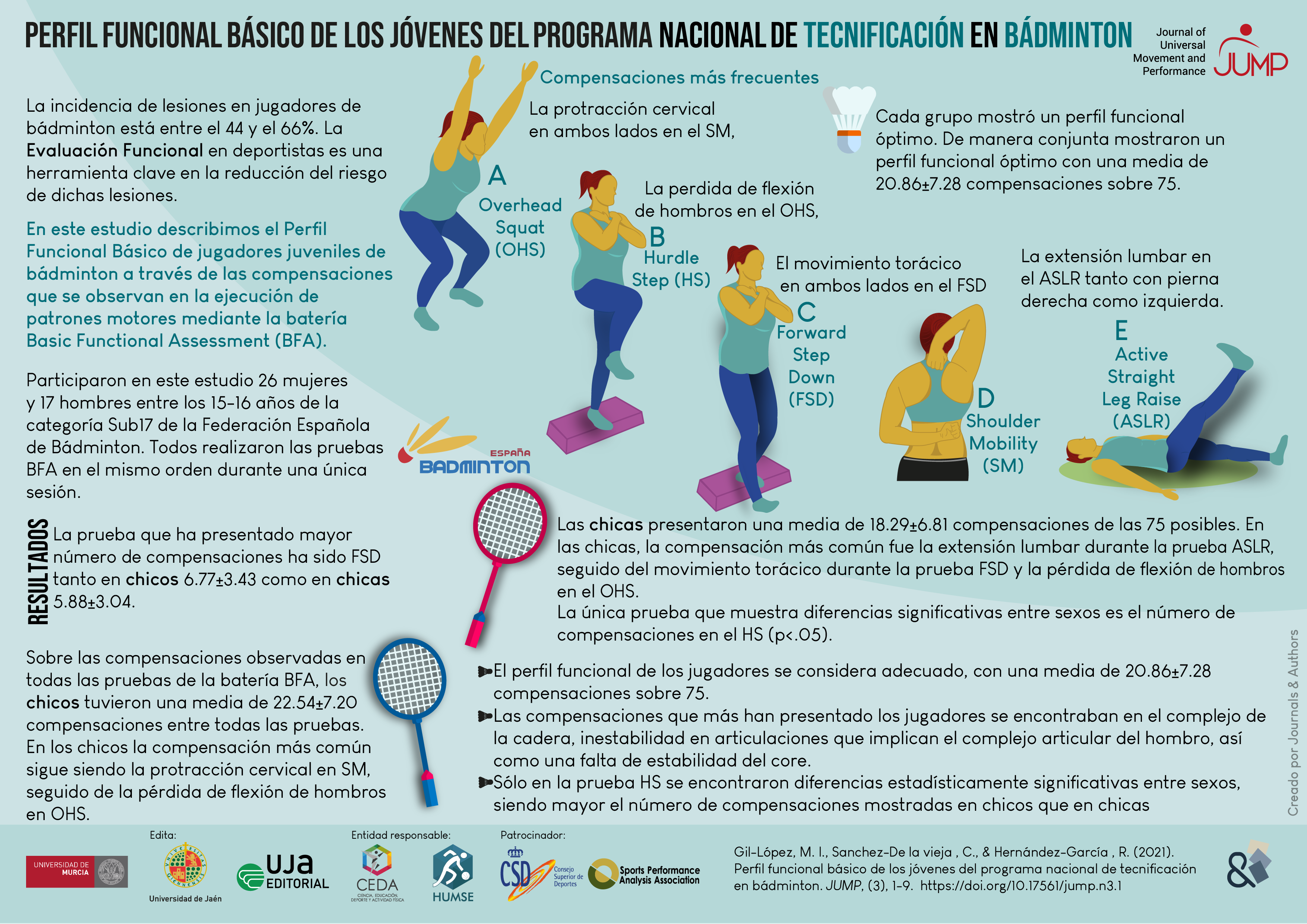
The objective of this study was to analyze the functional profile of a group of young athletes, all belonging to the national badminton technification programme. There were evaluated 43 players of badminton (26 boys and 17 girls), of between 15 and 16 years, with a minimal experience of 3 years of competitive practice. Basic motor patterns were evaluated using the "Basic Functional Assessment battery" consisting of five Overhead Squat Test (OHS), Hurdle Step (HS), Forward Step Down (FSD), Shoulder Mobility (SM), and Active Straight Leg Raise (ASLR) functional tests. The results show that the group of boys has presented a higher incidence of total compensation than the group girls. The most repeated compensation in the whole sample has been cervical protraction, seen in the SM test. Followed by loss of shoulder flexion, in the OHS test. No statistically significant differences were found between genera. Together as a badminton team without differentiation from gender obtained an average of 20,86 compensation out of 75. The compensation players have presented most was in the hip complex, in the shoulder complex, as well as a lack of core stability.
References
Andersson, S. H., Bahr, R., Clarsen, B., & Myklebust, G. (2017). Preventing overuse shoulder injuries among throwing athletes: a cluster-randomised controlled trial in 660 elite handball players. British Journal of Sports Medicine, 51(14), 1073-1080.
Ardern, C. L., Ekas, G. R., Grindem, H., Moksnes, H., Anderson, A. F., Chotel, F. & Engebretsen, L. (2018). 2018 international olympic committee consensus statement on prevention, diagnosis and management of paediatric anterior cruciate ligament (ACL) injuries. British Journal of Sports Medicine, 52, 422–438. https://doi.org/10.1007/s00167-018-4865-y
Bennett, H., Davison, K., Arnold, J., Martin, M., Wood, S., & Norton, K. (2019). Reliability of a movement quality assessment tool to guide exercise prescription (MovementSCREEN). International Journal of Sports Physical Therapy, 14(3), 424. https://doi.org/10.26603/ijspt2019024
Bishop, C., Edwards, M., & Turner, A. N. (2016). Screening movement dysfunctions using the overhead squat. Professional Strength & Conditioning, 42, 22-30.
Bishop, C., Villiere, A., & Turner, A. (2016). Addressing movement patterns by using the overhead squat. Professional Strength & Conditioning, 40, 7-12.
Cabello Manrique, D. (2000). Análisis de las características del juego en el bádminton de competición. Su aplicación al entrenamiento. Tesis Doctorales, (15). Recuperado de https://www.cafyd.com/REVISTA/ojs/index.php/bbddcafyd/article/view/123
Castropil, W., & Arnoni, C. (2014). Postural patterns and adaptations in judo athletes. Archives of Budo, 10, 23-28.
Cejudo, A., Robles-Palazón, F. J., Ayala, F., Croix, M. D. S., Ortega-Toro, E., Santonja-Medina, F., & de Baranda, P. S. (2019). Agerelated differences in flexibility in soccer players 8–19 years old. PeerJ, 7, e6236. https://doi.org/10.7717/peerj.6236
De Blaiser, C., Roosen, P., Willems, T., Danneels, L., Vanden, L., & De Ridder, R. (2018). Is core stability a risk factor for lower extremity injuries in an athletic population? A systematic review. Physical Therapy in Sport, 30, 48-56.
Dos’Santos, T., Thomas, C., Comfort, P., & Jones, P. A. (2018). The effect of angle and velocity on change of direction biomechanics: An angle-velocity trade-off. Sports Medicine, 48(10), 2235-2253. https://doi.org/10.1007/s40279-018-0968-3
García, M. (2017). La estabilidad del core y la prevención de lesiones en natación. http://redi.ufasta.edu.ar:8080/xmlui/handle/123456789/1313
Gil-López, M., Garcia-Huertado., & Hernandez-García, R. (2018). Valoración funcional básica del Judoka: un estudio piloto. Revista de artes marciales asiáticas, 13(2s), 20-22. https://doi.org/10.18002/rama.v13i2s.5500.
Guillain, J. Y. (2002). Histoire du badminton: du jeu de volant au sport olympique. Editions Publibook.
Herbaut, A., & Delannoy, J. (2020). Fatigue increases ankle sprain risk in badminton players: A biomechanical study. Journal of Sports Sciences, 1-6, 1560-1565. https://doi.org/10.1080/02640414.2020.1748337
Herbaut, A., Delannoy, J., & Foissac, M. (2018). Injuries in French and Chinese regular badminton players. Science & Sports, 33(3), 145-151. https://doi.org/10.1016/j.scispo.2018.02.001
Hernández-García, R., Aparicio-Sarmiento, A., Palao, J.M., y de Baranda, P. S. (2020b). Influencia de las lesiones previas en los patrones fundamentales del movimiento en jugadoras profesional de fútbol. RICYDE. Revista internacional de Ciencias del Deporte, 16(60), 214-235.
Hernández-García, R., Gil-López, M., Martínez-Pozo, D., Martínez- Romero, M., Aparicio-Sarmiento, A., Cejudo, A., Sainz de Baranda, P., & Bishop, C. (2020a). Validez y fiabilidad del nuevo protocolo básico de evaluación funcional (BFA). International Journal of Environmental Research and Public Health, 17(13), 4845.
Hernández-García, R., Toledo, D.; Fernández-García, I., & Torres-Luque, G. (2019). Valoración del perfil funcional en atletas de CrossFit. Estudio Piloto. Acción Motriz, 23, 100-108.
Hides, J. A., Oostenbroek, T., Franettovich Smith, M. M., & Mendis, M. D. (2016). The effect of low back pain on trunk muscle size/function and hip strength in elite football (soccer) players. Journal of Sports Sciences, 34(24), 2303-2311. https://doi.org/10.1080/02640414.2016.1221526
Hu, X., Li, J. X., Hong, Y., & Wang, L. (2015). Characteristics of plantar loads in maximum forward lunge tasks in badminton. PloS one, 10(9), e0137558. https://doi.org/10.1371/journal.pone.0137558
Huang, M. T., Lee, H. H., Lin, C. F., Tsai, Y. J., & Liao, J. C. (2014). How does knee pain a ect trunk and knee motion during badminton forehand lunges? Journal of Sports Sciences, 32, 690–700.
Hulteen, R.M., Morgan, P.J., Barnett, L.M., Stodden, D.F., Lubans, D.R. (2018). Development of Foundational Movement Skills: A Conceptual Model for Physical Activity Across the Lifespan. Sports Medicine, 48, 1533–1540. https://doi.org/10.1007/s40279-018-0892-6
Jacobson, J. A., Miller, B. S., & Morag, Y. (2005). Golf and racquet sports injuries. Seminars in Musculoskeletal Radiology, 9, 346–359.
Jeyaraman, R., District, E., & Nadu, T. (2012). Prediction of playing anility in badminton from selected anthropometrical physical and physiological characteristics among inter collegiate players. International Journal of Advanced Research and Innovation, 2(3), 11.
Kimura,Y., Ishibashi,Y., Tsuda, E.,Yamamoto,Y.,Tsukada, H.,& Toh, S.(2010). Mechanismsfor anterior cruciate ligament injuries in badminton. British Journal of Sports Medicine, 44, 1124– 1127.
Kivlan, B.R. (2012). Functional Performance Testing of the Hip in Athletes. International Journal of Sports Physical Therapy, 7(4), 402–412.
Lockie, R., Schultz, A., Callaghan, S., Jordan, C., Luczo, T., & Jeffriess, M. (2015). A preliminary investigation into
the relationship between functional movement screen scores and athletic physical performance in female team sport athletes. Biology of Sport, 32(1), 41-51. https://doi.org/10.5604/20831862.1127281
Lubans, D. R., Morgan, P. J., Cliff, D. P., Barnett, L. M., y Okely, A. D. (2010). Habilidades fundamentales de movimiento en niños y adolescentes. Medicina deportiva, 40(12), 1019-1035.
Minick, K. I., Kiesel, K. B., Burton, L. E. E., Taylor, A., Plisky, P., & Butler, R. J. (2010). Interrater reliability of the functional movement screen. The Journal of Strength & Conditioning Research, 24(2), 479-486. http://dx.doi.org/10.1136/bjsports-2016-096938
Moran, R.W., Schneiders, A.G., Mason, J., & Sullivan, S.J. (2017). Do Functional Movement Screen (FMS) composite scores predict subsequent injury? A systematic review with meta-analysis. British Journal of Sports Medicine, 51, 1661 LP – 1669.
Park, K. M., Cynn, H. S., & Choung, S. D. (2013). Musculoskeletal predictors of movement quality for the forward step-down test in asymptomatic women. Journal of Orthopaedic & Sports Physical Therapy, 43(7), 504-510. https://www.jospt.org/doi/10.2519/jospt.2013.4073
Phomsoupha, M., & Laffaye, G. (2015). The science of badminton: game characteristics, anthropometry, physiology, visual fitness and biomechanics. Sports Medicine, 45(4), 473–495. https://doi.org/10.1007/s40279-014-0287-2
Rabin, A., & Kozol, Z. (2017). Utility of the overhead squat and forward arm squat in screening for limited ankle dorsiflexion. The Journal of Strength & Conditioning Research, 31(5), 1251-1258. https://doi.org/10.1519/JSC.0000000000001580.
Reeves, J., Hume, P. A., Gianotti, S., Wilson, B., & Ikeda, E. (2015). A retrospective review from 2006 to 2011 of lower extremity injuries in badminton in New Zealand. Sports, 3(2), 77-86. https://doi.org/10.3390/sports3020077
Shin, S. H., Kang, S. R., Kwon, T. K., & Yu, C. (2017). A study on trunk muscle activation patterns according to tilt angle during whole body tilts. Technology and Health Care: Official Journal of the European Society for Engineering and Medicine, 25(1), 73-81. https://doi.org/10.3233/THC-171308.
Sjödahl, J., Gutke, A., Ghaffari, G., Strömberg, T., & Öberg, B. (2016). Response of the muscles in the pelvic floor and the lower lateral abdominal wall during the active straight leg raise in women with and without pelvic girdle pain: an experimental study. Clinical Biomechanics, 35, 49. https://doi.org/10.1016/j.clinbiomech.2016.04.007
Stodden, D. F., Goodway, J. D., Langendorfer, S. J., Roberton, M. A., Rudisill, M. E., Garcia, C., & Garcia, L. E. (2008). A developmental perspective on the role of motor skill competence in physical activity: An emergent relationship. Quest, 60(2), 290-3. https://doi.org/10.1080/00336297.2008.10483582
Thomas, J. R., Nelson, J. K., Silverman, S. J., & Silverman, S. J. (2001). Research Methods in Physical Activity 6th. Ed. Champaign, IIlinois: Human Kinetics.