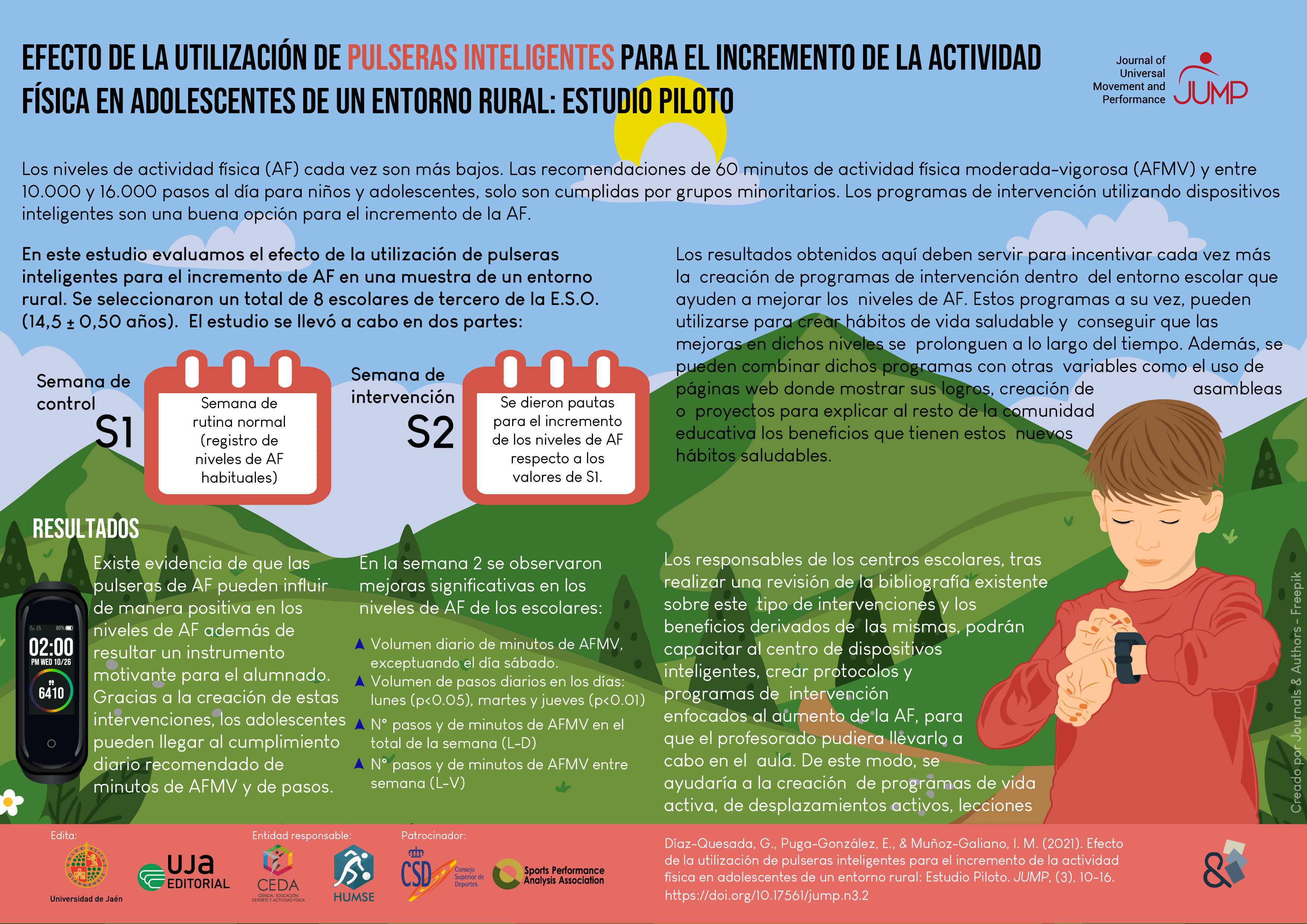
Effect of the Use of Smart Bracelets to Increase Physical Activity in Adolescents in a Rural Environment: Pilot Study
DOI:
https://doi.org/10.17561/jump.n3.2Keywords:
Health, students, education, intervention, steps, recommendationsAbstract
Physical activity (PA) levels are getting lower and lower. Recommendations of 60 minutes of moderate-to-severe physical activity (MVPA) and 10,000-16,000 steps per day for children and adolescents are only met by minority groups. Intervention programs using smart devices are a good option for increasing PA. The aim of this study was to evaluate the effect of using smart devices to increase PA in a rural setting sample. A total of eight students aged 14-16 years participated in this study. Subjects wore a Xiaomi Mi Band 4 physical activity bracelet for two weeks, where the number of steps and minutes of MVPA were recorded. The first Control Week (CW) was a week of the regular school routine. The second Intervention Week (IW) was a PA promotion intervention to increase it through challenges. The subjects showed an average of 7200 steps/day and 173 minutes/day during the first week and an average of 12300 steps/day and 212 minutes/day of MVPA during the second week, showing a significant increase during the second week, compared to the first week. Different studies show large increases of MVPA when applying for intervention programs, thus achieving the minimum daily recommendations of MVPA minutes and steps. It is found that PA bracelets positively influence PA intervention programs, and be a motivating instrument for students.
References
Andersen, L. B., Mota, J., & Di Pietro, L. (2016). Update on the global pandemic of physical inactivity. The Lancet, 388, 1255–1256. https://doi.org/10.1016/S0140-6736(16)30960-6
Banga, Y., Azhar, A., Sandhu, H., & Tang, T. S. (2020). Dance “Cultural” Revolution: Tailoring a Physical Activity Intervention for South Asian Children. Journal of Immigrant and Minority Health, 22(2), 291–299. https://doi.org/10.1007/s10903-019-00921-6
Bai, Y., Welk, G. J., Nam, y. H., Lee, J. A., Lee, J.-M., Kim, Y., Meier, N. F. & Dixon, P. M. (2016). Comparison of Consumer and Research Monitors under Semistructured Settings. Medicine & Science in Sports & Exercise, 48(1), 151–158. http://doi.org/10.1249/mss.0000000000000727
BC Ministry of Education (2011). Daily physical activity kindergarten to grade 12: program guide (updated 2011). British Columbia website: https://www2.gov.bc.ca/assets/gov/education/kindergar ten-to-grade-12/teach/pdfs/curriculum/dailyphysicalactivity/program_guide.pdf
Beets, M. W., Bornstein, D., Beighle, A., Cardinal, B. J., & Morgan, C. F. (2010). Pedometer-Measured Physical Activity Patterns of Youth. American Journal of Preventive Medicine, 38(2), 208–216. http://doi.org/10.1016/j.amepre.2009.09.045
Böhm, B., Karwiese, S. D., Böhm, H., & Oberhoffer, R. (2019). Effects of Mobile Health Including Wearable Activity Trackers to Increase Physical Activity Outcomes Among Healthy Children and Adolescents: Systematic Review. JMIR Mhealth Uhealth, 7(4), e8298. http://doi.org/10.2196/mhealth.8298
Brickwood, K.J., Watson, G., O’Brien, J., & Williams, A.D. (2019) Consumer-Based Wearable Activity Trackers Increase Physical Activity Participation: Systematic Review and Meta-Analysis. JMIR Mhealth Uhealth, 7(4), e11819. http://doi.org/10.2196/11819
Bronikowski, M., Bronikowska, M., Maciaszek, J., & Glapa, A. (2018). Maybe it is not a goal that matters: a report from a physical activity intervention in youth. The Journal of sports medicine and physical fitness, 58(3), 348–355. https://doi.org/10.23736/S0022-4707.16.06611-1
Center for Disease Control and Prevention (CDC) (2011). How much physical activity do children neeed? CDC website: https://www.cdc.gov/physicalactivity/basics/pdfs/FrameworkGraphicV9.pdf
Chillón, P., Ortega, F. B., Ferrando, J. A., & Casajus, J. A. (2011). Physical fitness in rural and urban children and adolescents from Spain. Journal of Science and Medicine in Sport, 14, 417–423. http://doi.org/10.1016/j.jsams.2011.04.004
Drehlich, M., Naraine, M., Rowe, K., Lai, S. K., Salmon, J., Brown, H., Koorts, H., Macfarlane, S., & Ridgers, N. D. (2020). Using the Technology Acceptance Model to Explore Adolescents’ Perspectives on Combining Technologies for Physical Activity Promotion Within an Intervention: Usability Study. Journal of Medical Internet Research, 22(3), e15552. https://doi.org/10.2196/15552
El-Amrawy, F., & Nounou, M. I. (2015). Are currently available wearable devices for activity tracking and heart rate monitoring accurate, precise, and medically beneficial? Healthcare Informatics Research, 21(4), 315–20. http://doi.org/10.4258/hir.2015.21.4.315
Evenson, K. R., Goto, M. M., & Furberg, R. D. (2015). Systematic review of the validity and reliability of consumer-wearable activity trackers. International Journal of Behavioral Nutrition and Physical Activity, 12, 159. http://doi.org/10.1186/s12966-015-0314-1
Galy, O., Yacef, K., & Caillaud, C. (2019). Improving Pacific Adolescents’ Physical Activity Toward International
Recommendations: Exploratory Study of a Digital Education App Coupled With Activity Trackers. JMIR mHealth and uHealth, 7(12), e14854. https://doi.org/10.2196/14854
Garriguet, D., & Colley, R. C. (2012). Daily patterns of physical activity among Canadians. Health reports, 23(2), 27–32.
Gaudet, J., Gallant, F., & Bélanger, M. (2017). A Bit of Fit: Minimalist Intervention in Adolescents Based on a Physical Activity Tracker. JMIR Mhealth Uhealth, 5(7), e92. https://doi.org/10.2196/mhealth.7647
Gauthier, A. P., Laurence, M., Thirkill, L., & Dorman, S. C. (2012). Examining School-Based Pedometer Step Counts Among Children in Grades 3 to 6 Using Different Timetables. Journal of School Health, 82(7), 311–317. http://doi.org/10.1111/j.1746-1561.2012.00704.x
Guthol, R., Stevens, G. A., Riley, L. M., & Bull, F. C. (2019). Global trends in insufficient physical activity among adolescents: a pooled analysis of 298 population-based surveys with 1·6 million participants. The Lancet Child & Adolescent Health, 4(1), 23–35. https://doi.org/10.1016/S2352-4642(19)30323-2
Hardy, L. L., Okely, A. D., Dobbins, T. A., & Booth, M. L. (2008). Physical Activity among Adolescents in New South Wales (Australia). Medicine & Science in Sports & Exercise, 40(5), 835–841. http://doi.org/10.1249/mss.0b013e318163f286
Hayes, L. B., & Van Camp, C. M. (2015). Increasing physical activity of children during school recess. Journal of Applied Behavior Analysis, 48(3), 690–695. http://doi.org/10.1002/jaba.222
Heath, G. W., Parra, D. C., Sarmiento, O. L., Andersen, L. B., Owen, N., Goenka, S., Montes, F., & Brownson, R. C. (2012). Evidencebased intervention in physical activity: lessons from around the world. The Lancet, 38(9838), 272–281. http://doi.org/10.1016/S0140-6736(12)60816-2
Hills, A. P., Dengel, D. R., & Lubans, D. R. (2015). Supporting public health priorities: Recommendations for physical education and physical activity promotion in schools. Progress in Cardiovascular Diseases, 57, 368–374. http://doi.org/10.1016/j.pcad.2014.09.010
Katzmarzyk, P. T., Denstel, K. D., Beals, K., Bolling, C., Wright, C., Crouter, S.E., Mckenzie, T. L., Pate, R. R., Saelens, B. E, Staiano, A. E., Stanish, H. I., & Sisson, S. B. (2016). Results from the United States of America’s 2016 report card on physical activity for children and youth. Journal of Physical Activity and Health, 13(2), S307-S313. http://doi.org/10.1123/jpah.2016-0321
Keadle, S. K., Shiroma, E. J., Freedson, P. S., & Lee, I.-M. (2014). Impact of accelerometer data processing decisions
on the sample size, wear time and physical activity level of a large cohort study. BMC Public Health, 14(1), 1210. http://doi.org/10.1186/1471-2458-14-1210
Kim, Y., Lumpkin, A., Lochbaum, M., Stegemeier, S., & Kitten, K. (2018). Promoting physical activity using a wearable activity tracker in college students: A cluster randomized controlled trial. Journal of Sports Sciences, 36(16), 1889–1896. http://doi.org/10.1080/02640414.2018.1423886
Kriemler, S., Meyer, U., Martin, E., Van Sluijs, E. M., Andersen, L. B., & Martin, B. W. (2011). Effect of school-based interventions on physical activity and fitness in children and adolescents: a review of reviews and systematic update. British Journal of Sports Medicine, 45(11), 923-930. http://doi.org/10.1136/bjsports-2011-090186
Lee, J.-M., Kim, Y., & Welk, G. (2014). Validity of consumerbased physical activity monitors. Medicine & Science in
Sports & Exercise, 46(9), 1840-1848. http://doi.org/10.1249/mss.0000000000000287
Martínez-Gómez, D., Veiga, O. L., Zapatera, B., Gómez-Martínez, S., Martínez, D., & Marcos, A. (2013). Physical Activity During High School Recess in Spanish Adolescents: The AFINOS Study. Journal of Physical Activity and Health, 11(6), 1194-1201. http://doi.org/10.1123/jpah.2012-0345
Mayorga-Vega, D., Casado-Robles, C., Viciana, J., & López-Fernández, I. (2019). Daily Step-Based Recommendations Related to Moderate-to-Vigorous Physical Activity and Sedentary Behavior in Adolescents. Journal of Sports Science and Medicine, 18(4), 586-595.
Migueles, J. H., Cadenas-Sánchez, C., Ekelund, U., Delisle Nyström, C., Mora-Gonzalez, J., Löf, M., Labayen, I., Ruiz, J. R., & Ortega, F. B. (2017). Accelerometer Data Collection and Processing Criteria to Assess Physical Activity and Other Outcomes: A Systematic Review and Practical Considerations. Sports Medicine, 47(9), 1821–1845. http://doi.org/10.1007/s40279-017-0716-0
Miguel-Berges, M., Santaliestra-Pasias, A., Mouratidou, T., De Miguel-Etayo, P., Androutsos, O., De Craemer, M., Galcheva, S., Koletzko, B., Kulaga, Z., Manios, Y., & Moreno, L. on behalf of the ToyBox-study group. (2019). Combined Longitudinal Effect of Physical Activity and Screen Time on Food and Beverage Consumption in European Preschool Children: The ToyBox-Study. Nutrients, 11(5), 1048. http://doi.org/10.3390/nu11051048
Nanney, L. (2014). Self-determination theory and movement technology in college physical activity classes (Master’s Thesis, East Carolina University). http://hdl.handle.net/10342/4576. Otzen, T., & Manterola, C. (2017). Sampling techniques on a population study. International Journal of Morphology, 35(1), 227-232.
Pearson, E.S. (2012). Goal setting as health behavior change strategy in overweight and obese adults: A systematic literature review examining intervention components. Patient Education and Counseling, 87, 32–42. http://doi.org/10.1016/j.pec.2011.07.018
Pittman, A. F. (2018). Effect of a School-Based Activity Tracker, Companion Social Website, and Text Messaging Intervention on Exercise, Fitness, and Physical Activity Self-Efficacy of Middle School Students. The Journal of School Nursing, 36(2), 112-120. http://doi.org/10.1177/1059840518791223
Price, K., Bird, S. R., Lythgo, N., Raj, I. S., Wong, J. Y. L., & Lynch, C. (2017). Validation of the Fitbit One, Garmin Vivofit and Jawbone UP activity tracker in estimation of energy expenditure during treadmill walking and running. Journal of Medical Engineering & Technology, 41(3), 208–215. http://doi.org/10.1080/03091902.2016.1253795
Ridgers, N. D., McNarry, M. A., & Mackintosh, K. A. (2016). Feasibility and effectiveness of using wearable activity trackers in youth: a systematic review. JMIR Mhealth Uhealth, 4(4), e129. http://doi.org/10.2196/mhealth.6540
Rote, A. E. (2016). Physical activity intervention using Fitbits in an introductory college health course. Health Education Journal, 76(3), 337–348. http://doi.org/10.1177/0017896916674505
Santaliestra-Pasías, A. M., Dios, J. E. L., Sprengeler, O., Hebestreit, A., De Henauw, S., Eiben, G., Felso, R., Lauria, F., Tornaritis, M., Veidebaum, T., Pala, V., & Moreno, L. A. (2018). Food and beverage intakes according to physical activity levels in European children: the IDEFICS (Identification and prevention of Dietary and lifestyle induced health EFfects In Children and infantS) study. Public Health Nutrition, 21(09), 1717–1725. http://doi.org/10.1017/s1368980018000046
Sperlich, B., & Holmberg, H.-C. (2017). Wearable, yes, but able…?: it is time for evidence-based marketing claims! British Journal of Sports Medicine, 51(16), 1240–1240. http://doi.org/10.1136/bjsports-2016-097295
Tremblay, M. S., Aubert, S., Barnes, J. D., Saunders, T. J., Carson, V., Latimer-Cheung, A. E., Chastin, S. F. M., Altenburg, T. M., Chinapaw, M. J. M., & on behalf of SBRN Terminology Consensus Proyect Participants. (2017). Sedentary Behavior Research Network (SBRN) - Terminology Consensus Project process and outcome. International Journal of Behavioral Nutrition and Physical Activity. 14, 75. http://doi.org/ 10.1186/s12966-017-0525-8
Tudor-Locke, C., McClain, J. J., Hart, T. L., Sisson, S. B., & Washington, T. L. (2009). Expected Values for Pedometer-
Determined Physical Activity in Youth. Research Quarterly for Exercise and Sport, 80(2), 164–174. http://doi.org/10.1080/02701367.2009.10599550
Tudor-Locke, C., Craig, C. L., Beets, M. W., Belton, S., Cardon, G. M., Duncan, S., Hatano, Y., Lubans, D. R., Olds, T. S., Raustorp, A., Rowe, D. A., Spence, J. C., Tanaka, S. & Blair, S. N. (2011). How many steps/day are enough? for children and adolescents. International Journal of Behavioral Nutrition and Physical Activity, 8, (78), 1-14. https://doi.org/10.1186/1479-5868-8-78
U.S. Department of Health and Human Services (2018). Physical Activity Guidelines for Americans, 2nd edition. U.S. website: https://health.gov/sites/default/files/2019-09/Physical_Activity_Guidelines_2nd_edition.pdf
Van Tuyckom, C., & Scheerder, J. (2010). A multilevel analysis of social stratification patterns of leisure-time physical activity among Europeans. Science & Sports, 25(6), 304–311. http://doi.org/10.1016/j.scispo.2010.04.003
Wang, L., Liu, T., Wang, Y., Li, Q., Yi, J., & Inoue, Y. (2017). Evaluation on Step Counting Performance of Wristband Activity Monitors in Daily Living Environment. IEEE Access, 5, 13020–13027. http://doi.org/10.1109/access.2017.2721098
Wijtzes, A.I., Verloigne, M., Mouton, A., Cloes, M., De Ridder, K.A., Cardon, G., & Seghers, J. (2016). Results from Belgium’s 2016 report card on physical activity for children and youth. Journal of Physical Activity and Health, 13(2), S95-S103. http://doi.org/10.1123/jpah.2016-0306
World Health Organization (WHO) (2010). Global recommendations on physical activity for health. WHO website: https://apps.who.int/iris/bitstream/handle/10665/44441/9789243599977_spa.pdf
Wyszyńska, J., Matłosz, P., Szybisty, A., Lenik, P., Dereń, K., Mazur, A., & Herbert, J. (2020). Obesity and Body Composition in Preschool Children with Different Levels of Actigraphy-Derived Physical Activity-A Cross-Sectional Study. Journal of Clinical Medicine, 9(4), 1210. https://doi.org/10.3390/jcm9041210
Zongo, P., Frayon, S., Antoine-Jonville, S., Wattelez, G., Le Roux, P.-Y., Hue, O., & Galy, O. (2017). Anthropometric Characteristics and Physical Fitness in Rural and Urban 11- to 16-Year-Old Melanesian Adolescents: A Cross-sectional Study in New Caledonian Schools. Asia Pacific Journal of Public Health, 29(7), 589–598. https://doi.org/10.1177/1010539517735414