Exploring external load variations in elite female soccer players during 6v6 small-sided games
DOI:
https://doi.org/10.17561/jump.n5.2Keywords:
GPS, acceleration, high intensity running, training taskAbstract
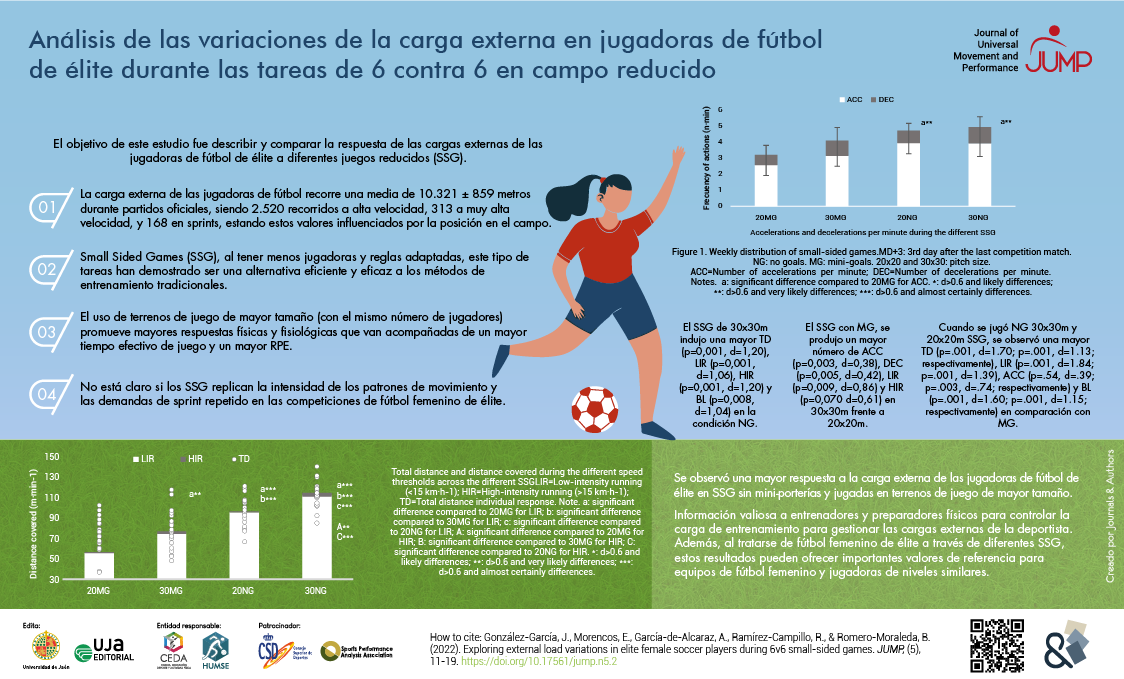
Purpose: The aim of this study was to describe and compare the external loads response of elite female soccer players to different small-sided games (SSG). Twelve elite female soccer players (26.5 ± 5.7 years, 58.6 ± 5.6 kg, 164.4 ± 5.3 cm) performed four different 6vs6 SSG: two different sizes (20x20m and 30x30m) and with minigoals (MG) and without mini-goals (NG). Methods: Total distance (TD), low-intensity running distance (LIR), high-intensity running distance (HIR), sprint distance (SD), accelerations (ACC), decelerations (DEC), repeated sprints (RS) and Bodyload (BL) was collected using a 15Hz global positioning satellite system. The variables were compared across all SSG formats using a one-way analysis of variance (ANOVA) (p<.05) and non-clinical magnitude-based inferences (Cohen´s d). Results: Compared to 20x20m SSG, the 30x30m SSG induced greater TD (p=.001, d=1.20), LIR (p=.001, d=1.06), HIR (p=.001, d=1.20) and BL (p=.008, d=1.04) in NG condition. Similarly, in SSG with MG, greater number of ACC (p=.003, d=.38), DEC (p=.005, d=.42), LIR (p=.009, d=.86) and HIR (p=.070 d=.61) occurred in 30x30m vs. 20x20m. When NG 30x30m and 20x20m SSG were played, greater TD (p=.001, d=1.70; p=.001, d=1.13; respectively), LIR (p=.001, d=1.84; p=.001, d=1.39), ACC (p=.54, d=.39; p=.003, d=.74; respectively) and BL (p=.001, d=1.60; p=.001, d=1.15; respectively) were noted compared to MG. Conclusion: greater external load response of elite female soccer players was observed in SSG without mini-goals and played in greater pitch sizes. These findings are usefulness for coaches and physical trainers to design proper training tasks according to game demands.
References
Aasgaard, M., & Kilding, A. E. (2018). Does Man Marking Influence Running Outputs and Intensity During Small-Sided Soccer Games? Journal of Strength and Conditioning Research, 34(11), 3266-3274. https://doi.org/10.1519/jsc.0000000000002668
Abade, E. A., Gonçalves, B. V., Leite, N. M., & Sampaio, J. E. (2014). Time-motion and physiological profile of football training sessions performed by under-15, under-17, and under-19 elite portuguese players. International Journal of Sports Physiology and Performance, 9(3), 463-470. https://doi.org/10.1123/IJSPP.2013-0120C
Bangsbo, J., Mohr, M., & Krustrup, P. (2006). Physical and metabolic demands of training and match-play in the elite football player. Journal of Sports Sciences, 24(7), 665-674. https://doi.org/10.1080/02640410500482529
Bujalance-Moreno, P., Latorre-Román, P. Á., Martínez-Amat, A., & García-Pinillos, F. (2022). Small-sided games in amateur players: Rule modification with mini-goals to induce lower external load responses. Biology of Sport, 39(2). https://doi.org/10.5114/biolsport.2022.105336
Casamichana, D., & Castellano, J. (2010). Time-motion, heart rate, perceptual and motor behaviour demands in small-sides soccer games: Effects of pitch size. Journal of Sports Sciences, 28(14), 1615-1623. https://doi.org/10.1080/02640414.2010.521168
Castellano, J., Casamichana, D., & Dellal, A. (2013). Influence of Game Format and Number of Players on Heart Rate Responses and Physical Demands in Small-Sided Soccer Games. Journal of Strength and Conditioning Research, 27(5), 1295-1303. https://doi.org/10.1519/JSC.0b013e318267a5d1
Coutts, A. J., & Duffield, R. (2010). Validity and reliability of GPS devices for measuring movement demands of team sports. Journal of Science and Medicine in Sport, 13(1), 133-135. https://doi.org/10.1016/j.jsams.2008.09.015
Datson, N., Drust, B., Weston, M., Jarman, I. H., Lisboa, P. J., & Gregson, W. (2017). Match Physical Performance of Elite Female Soccer Players during International Competition. Journal of Strength and Conditioning Research, 31(9), 2379-2387. https://doi.org/10.1519/JSC.0000000000001575
Drew, M. K., & Finch, C. F. (2016). The Relationship Between Training Load and Injury, Illness and Soreness: A Systematic and Literature Review. Sports Medicine, 46(6), 861-883. https://doi.org/10.1007/s40279-015-0459-8
Drust, B., Waterhouse, J., Atkinson, G., Edwards, B., & Reilly, T. (2005). Circadian rhythms in sports performance - An update. Chronobiology International, 22(1), 21-44. https://doi.org/10.1081/CBI-200041039
Ehrmann, F. E., Duncan, C. S., Sindhusake, D., Franzsen, W. N., & Greene, D. A. (2016). GPS and injury prevention in professional soccer. Journal of Strength and Conditioning Research, 30(2), 360-367. https://doi.org/10.1519/JSC.0000000000001093
Gabbett, T. J., & Mulvey, M. J. (2008). Time-motion analysis of small-sided training games and competition in elite women soccer players. Journal of Strength and Conditioning Research, 22(2), 543-552. https://doi.org/10.1519/JSC.0b013e3181635597
García‐Angulo, A., Palao, J. M., Giménez‐Egido, J. M., García‐Angulo, F. J., & Ortega‐Toro, E. (2020). Effect of the modification of the number of players, the size of the goal, and the size of the field in competition on the play actions in U-12 male football. International Journal of Environmental Research and Public Health, 17(2). https://doi.org/10.3390/ijerph17020518
Gómez-Carmona, C., Gamonales, J., Pino-Ortega, J., & Ibáñez, S. (2018). Comparative Analysis of Load Profile between Small-Sided Games and Official Matches in Youth Soccer Players. Sports, 6(4), 173. https://doi.org/10.3390/sports6040173
Halouani, J., Chtourou, H., Dellal, A., Chaouachi, A., & Chamari, K. (2014). Physiological responses according to rules changes during 3 vs. 3 small-sided games in youth soccer players: stop-ball vs. small-goals rules. Journal of Sports Sciences, 32(15), 1485-1490. https://doi.org/10.1080/02640414.2014.899707
Halouani, J., Chtourou, H., Dellal, A., Chaouachi, A., & Chamari, K. (2017a). Soccer small-sided games in young players: Rule modification to induce higher physiological responses. Biology of Sport, 34(2), 163-168. https://doi.org/10.5114/biolsport.2017.64590
Halouani, J., Chtourou, H., Dellal, A., Chaouachi, A., & Chamari, K. (2017b). The effects of game types on intensity of small-sided games among pre-adolescent youth football players. Biology of Sport, 34(2), 157-162. https://doi.org/10.5114/biolsport.2017.64589
Hammami, A., Gabbett, T. J., Slimani, M., & Bouhlel, E. (2017). Does Small-Sided Games Training Improve Physical-Fitness and Specific Skills for Team Sports? A Systematic Review with Meta-Analysis Short title: Small-Sided Game Training for Team Sports. The Journal of Sports Medicine and Physical Fitness, 58(10), 1446-1455. https://doi.org/10.23736/s0022-4707.17.07420-5
Hopkins, W. G., & Batterham, A. M. (2016). Error Rates, Decisive Outcomes and Publication Bias with Several Inferential Methods. Sports Medicine, 46(10), 1563-1573. https://doi.org/10.1007/s40279-016-0517-x
Hopkins, W. G., Marshall, S. W., Batterham, A. M., & Hanin, J. (2009). Progressive statistics for studies in sports medicine and exercise science. Medicine and Science in Sports and Exercise, 41(1), 3-12. https://doi.org/10.1249/MSS.0b013e31818cb278
López-Fernández, J., Gallardo, L., Fernández-Luna, Á., Villacañas, V., García-Unanue, J., & Sánchez-Sánchez, J. (2017). Pitch size and Game Surface in Different Small-Sided Games. Global Indicators, Activity Profile and Acceleration of Female Soccer Players. Journal of Strength and Conditioning Research, 33(3), 831-838. https://doi.org/10.1519/JSC.0000000000002090
Mallo, J., & Navarro, E. (2008). Physical load imposed on soccer players during small-sided training games. Journal of Sports Medicine and Physical Fitness, 48(2), 166-171. https://doi.org/10.1099/vir.0.19132-0
Mara, J. K., Thompson, K. G., & Pumpa, K. L. (2016). Physical and physiological characteristics of various-sided games in elite women’s soccer. International Journal of Sports Physiology and Performance, 11(7), 953-958. https://doi.org/10.1123/IJSPP.2015-0087
Martín-García, A., Gómez Díaz, A., Bradley, P. S., Morera, F., & Casamichana, D. (2018). Quantification of a professional football team’s external load using a microcycle structure. Journal of Strength and Conditioning Research, 32(12). https://doi.org/10.1519/jsc.0000000000002816
Mohr, M., Krustrup, P., Andersson, H., Kirkendal, D., & Bangsbo, J. (2008). Match activities of elite women soccer players at different performance levels. Journal of Strength and Conditioning Research, 22(2), 341-349. https://doi.org/10.1519/JSC.0b013e318165fef6
Peñas, C. L., y Álvarez, P. S. (2020). La influencia de la posesión del balón en el rendimiento físico en el fútbol profesional. Una revisión sistemática. JUMP, 2(2), 68-80. https://doi.org/10.17561/JUMP.N2.7
Rabbani, A., Kargarfard, M., Castagna, C., Clemente, F. M., & Twist, C. (2019). Associations Between Selected Training Stress Measures and Fitness Changes in Male Soccer Players. International Journal of Sports Physiology and Performance 14(8), 1050-1057. https://doi.org/10.1123/ijspp.2018-0462
Ramos, G. P., Nakamura, F. Y., Penna, E. M., Wilke, C. F., Pereira, L. A., Loturco, I., Capelli, L., Mahseredjian, F., Silami-Garcia, E., & Coimbra, C. C. (2017). Activity profiles in U17, U20 and senior women’s Brazilian National soccer teams during international competitions. Journal of Strength and Conditioning Research, 33(12), 3414-3422. https://doi.org/10.1519/JSC.0000000000002170
Rampinini, E., Impellizzeri, F. M., Castagna, C., Abt, G., Chamari, K., Sassi, A., & Marcora, S. M. (2007). Factors influencing physiological responses to small-sided soccer games. Journal of Sports Sciences, 25(6), 659-666. https://doi.org/10.1080/02640410600811858
Randers, M. B., Ørntoft, C., Hagman, M., Nielsen, J. J., & Krustrup, P. (2018). Movement pattern and physiological response in recreational small-sided football–effect of number of players with a fixed pitch size. Journal of Sports Sciences, 36(13), 1549-1556. https://doi.org/10.1080/02640414.2017.1402552
Silva, J. R., Rumpf, M. C., Hertzog, M., Castagna, C., Farooq, A., Girard, O., & Hader, K. (2018). Acute and Residual Soccer Match-Related Fatigue: A Systematic Review and Meta-analysis. Sports Medicine, 48(3), 539-583. https://doi.org/10.1007/s40279-017-0798-8
Stewart, A. A, Marfell-Jones, M., Olds, T., & Hans de Ridder, J. (2011). International standards for anthropometric assessment. Lower Hutt, New Zealand: International Society for the Advancement of Kinanthropometry.
Trewin, J. (2017). Match-running performance of elite female soccer players: The factors affecting performance and training applications. University of Victoria.
Trewin, J., Meylan, C., Varley, M. C., & Cronin, J. (2018). The match-to-match variation of match-running in elite female soccer. Journal of Science and Medicine in Sport, 21(2), 196-201. https://doi.org/10.1016/j.jsams.2017.05.009
Trewin, J., Meylan, C., Varley, M. C., Cronin, J., & Ling, D. (2018). Effect of Match Factors on the Running Performance of Elite Female Soccer Players. Journal of Strength and Conditioning Research, 32(7), 2002-2009. https://doi.org/10.1519/JSC.0000000000002584
UEFA. (2017). Women’s football across the national associations. In UEFA (pp. 1–93).
Vázquez-Guerrero, J., Ayala, F., Garcia, F., & Sampaio, J. (2020). The Most Demanding Scenarios of Play in Basketball Competition From Elite Under-18 Teams. Frontiers in Psychology, 11. https://doi.org/10.3389/FPSYG.2020.00552
Winter, E. M., & Maughan, R. J. (2009). Requirements for ethics approvals. Journal of Sports Sciences, 27(10), 985-985. https://doi.org/10.1080/02640410903178344
Published
Issue
Section
License
Copyright (c) 2022 Jaime González-García, Esther Morencos, Antonio García-de-Alcaraz, Rodrigo Ramírez-Campillo, Blanca Romero-Moraleda

This work is licensed under a Creative Commons Attribution 4.0 International License.