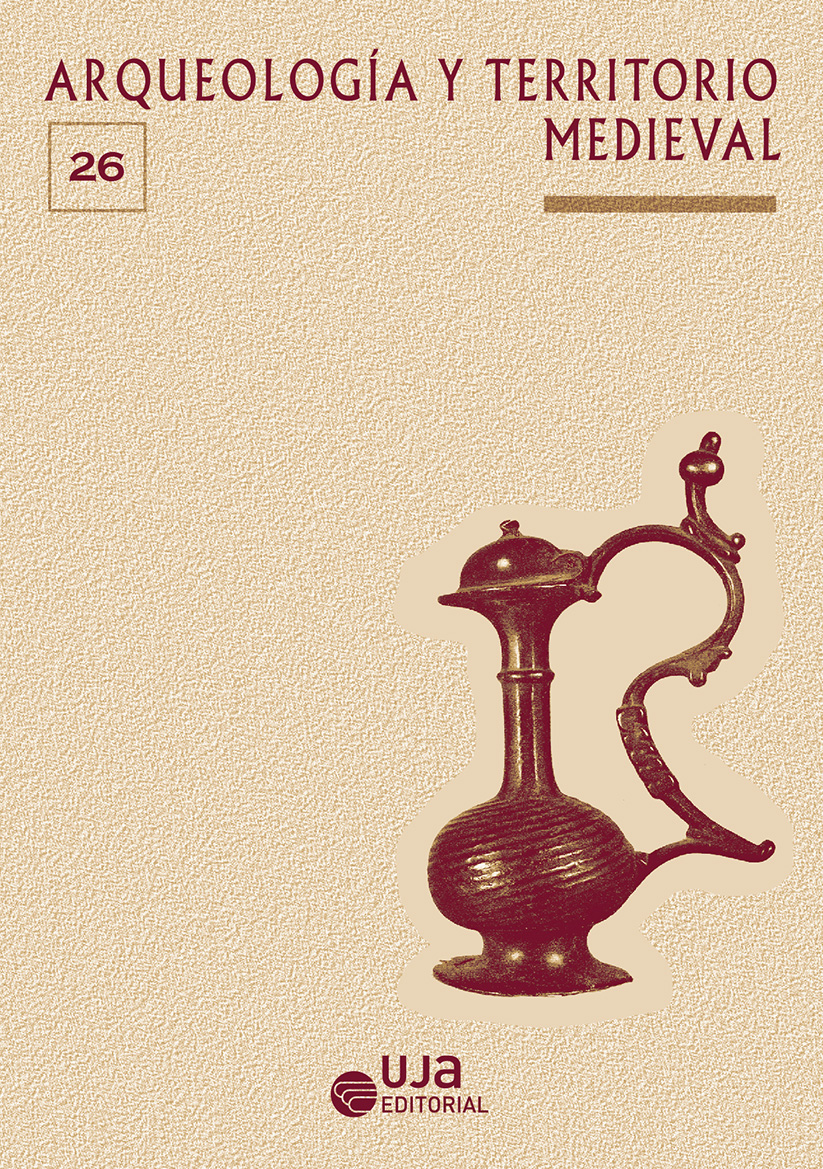
Metalic ewers with lid and angled hand from al-Andalus (12-13th centuries)
DOI:
https://doi.org/10.17561/aytm.v26.4Keywords:
Islamic, Almoravid, Almohad, Fatimid, CórdobaAbstract
Presentamos el inventario y estudio de los jarritos con tapadera aparecidos en al-Andalus. Son de tipo piriforme con asa acodada y tapadera, y presentan una decoración facetada o elipsoide. Sus precedentes son los jarritos fatimíes de tradición copta, de los siglos X-XI y son una muestra de la metalistería andalusí de los siglos XII-XIII.
Downloads
References
ALARÇAO, A. (1996): “O jarro metálico tipo Eggers 128, antecedentes, variantes e imitaçoes”, Miscellanea em Homenagen ao Profesor Bairrao Oleiro, Lisboa pp. 25-37.
ALI, W. (1999): The Arab contribution to islamic Art: from the Seventh to the Fifteenth Centuries. El Cairo: The American University in Cairo.
ALLAN, J.W. (1976): The Metalwork Industry in Iran in the early Islamic Period. Oxford. (Tesis doctoral). https://ora.ox.ac.uk/objects/uuid:278c6978-9421-46af-af61-a062a2044591, [consultada en junio 2018]
– (1976-7): “Silver: the key to bronze in early Islamic Iran”, Kunst des Orients, XI, nº 1-2, pp. 5-21.
– (1979): Persian Metal Technology 700-1300 AD, Oxford: Ithaca Press
– (1982): Nishapur: Metalwork of the early period. Nueva York: the Metropolitan Museum of Art.
– (1986): Metalwork of the Islamic World. The Aron Collection. Londres: Philip Wilson Publishers.
ALMAGRO GORBEA, M. (1966): “Nuevo Grupo de Jarritos Litúrgicos de Tipo Copto Procedentes de Cerdeña”, Boletín del Seminario Estudios de Arte y Arqueología, 32, pp. 367-380.
AURRECOECHEA, J. (1991): “Vajilla metálica de época romana en los museos de Ciudad Real, Jaén y Linares”, Espacio, tiempo y forma, serie II-Hª Antigua, 4 (Madrid), pp. 223-254.
AZUAR RUIZ, R. (2012): Los bronces islámicos de Denia (S. V HG/XI DC), Alicante: MARQ. Museo Arqueológico.
– (2017): “Los bronces Fatimíes de Denia (siglo XI D.C.)”, en Susana CALVO CAPILLA (Ed.): Las Artes en al-Andalus y Egipto. Contextos e Intercambios, Madrid, pp. 45-68.
– (2019): “La redoma islámica de bronce del Museo de Santa Clara de Murcia (s. XIII d.C.)”, Tudmîr, 5, pp. 73-83.
– (2019a): “El jarrito metálico con tapadera de la plazuela de Chirinos (Córdoba) (siglos XII-XIII d.C.)”, en AL-KITÂB. Estudios en homenaje a Juan Zozaya Stabel-Hansen, Madrid, pp. 437-441.
– (2019b): “Bronces andalusíes de época Almorávide”, Actas de las Jornadas internacionales Arqueología de al-Andalus Almorávide, Alicante: MARQ. Museo Arqueológico (e.p.).
BAER, E. (1983): Metalwork in Medieval Islamic Art, Nueva York: Suny Press.
BASS, G. F.; MATTHEWS, S. D. ; STEFFY, J. R. y VAN DOORNINCK, F. H. Jr. (2003): Serçe Limani. An Eleventh-century Shipwerck I. The Ship and Its anchorage, Crew, and Passengers, College Station: Texas A & M University Press.
BASS, G. F.; BRILL, R. H.; LLEDÓ, B. y MATTTHEWS, S. D. (2009): Serçe Limani. II The Glass of an eleventh-Century shipwreck. College Station: Texas A & M University Press.
BRISCH, K.; GLADIS, A. V.; KRÖGER, J. y NIEWHNER, E. (1986): Islamische Kunst Verborgene Schätze, Berlín: Museums für Islamische Kunst.
DAHNCKE, M. (1997): Enghalsflaschen Typologie Früislamischer Bronzen der Bumiller-Collection, Band-5, Bamberg: Bumiller-Collection.
DALTON, O. M. (1901): Catalogue of early Christian Antiquities and Objects from the Christian East, Londres: British Museum. https://ia601407.us.archive.org/11/items/catalogueofearly00brit/catalogueofearly00brit.pdf [Consultado, junio de 2018].
DELIBES DE CASTRO, G.; PÉREZ, F.; WATTENBERG, E. (1996): Guía. Colecciones Museo de Valladolid. Valladolid: Junta de Castilla y León.
ELORZA, J.C. (Dir.) (2007): El Cid, del hombre a la leyenda [Burgos, 2007]. Madrid: Junta de Castilla y León. Catálogo.
ERICE LACABE, R. (2007): “La vajilla de bronce en Hispania”, Sautuola, XIII: 197-215.
ETTINGHAUSEN, R. (1943): Metalwork from Islamic countries. Exhibition Rackham Building, Michigan: Institute of Fine Arts. Catálogo.
–(Com.) (1981): The Arts of Islam. Berlín: Staal. Museem. Catálogo.
FEHÉRVÁRI, G. (1976): Islamic Metalwork of the Eighth to the fifteenth Century in the Keir Collection. Londres: Faber & Faber.
GÓMEZ-MORENO, M. (1951): El Arte Árabe español hasta los almohades. Arte Mozárabe, Ars Hispaniae, III, Madrid: Ed. Plus-Ultra.
GONZÁLEZ CAVERO, I. (2010): “Jarrito Califal”, en M. PÉREZ et alii. (Coords): In principio erat verbum. El Reino de León y sus beatos [León, 2010)]. Madrid: Sociedad Estatal de Conmemoraciones Culturales. Catálogo.
HIRSCHFELD, Y.; UTFELD, O. (2008): Tiberias excavations in the House of Bronzes. Final Reports. Vol. I. Architecture, Stratigraphie and Small finds, QEDEM, 48, Jerusalén: The Hebrew University of Jerusalem.
KHAMIS, E. (2013): The Fatimid metalwork hoard from Tiberias. Tiberias: excavations in the house of the bronzes. Final report, vol. II. The Institute of Archaeology, QEDEM, 55. Jerusalén: The Hebrew University of Jerusalem.
KHAMIS, E. y AMIR, R. (1999): “The Fatimid Period Bronze Vessel Hoard”, Qadmoniot, XXXII/2: 108-114 (en Hebreo).
LAVIOLA, V. (2016): Metalli islamici dai territori Iranici orientali (IX – XIII sec.) La documentazione della Missione Archeologica Italiana in Afghanistan. Venecia: Universitá Ca’Foscari (Tesis Doctoral). http://dspace.unive.it/bitstream/handle/10579/8349/956008-1175887.pdf?sequence=2 [consultado, julio de 2018].
LESTER, A. (1999): “The Metal Hoard of Caesarea”, en The Richness of Islamic Caesarea, Haifa, pp. 36-41.
LESTER, A.; ARNON, Y. D. y POLAK, R. (1999): “The Fatimid Hoard from Caesarea: a Preliminary Report”, en BARROCAND, M. (Ed.): L’Egypte Fatimide son Art et son Histoire, París, pp. 233-248.
Madrid (1959): Exposición antológica del tesoro documental, bibliográfico y arqueológico de España. Madrid: Ministerio de Educación Nacional.
MAKARIOU, S. (2000-2001): “Aguamanil”, Las Andalucías de Damasco a Córdoba, (París), pp. 151 nº 168.
–(2000-2001a): Catálogo “Aguamanil”, Las Andalucías de Damasco a Córdoba, (París), pp. 152 nº 169.
MARTÍNEZ, Mª A.; ROBLES, A. (2008): “Redoma”, en Regnum Murciae: Génesis y configuración del Reino de Murcia. Murcia: 377.
MELIKIAN-CHIRVANI, A.S. (1973): Le bronze Iranien. París: Musée des Arts Décoratifs.
– (1976): Islamic Metalwork from Iranian Lands. Londres: Victoria and Albert Museum.
– (1982): Islamic Metalwork from the Iranian World. 8th-18th centuries. Londres. Victoria and Albert Museum.
MIGEON, G. (1927): Manuel d’Art Musulman. Arts Plastiques et Industrials. París: Ed. Picard. II vols.
MUÑOZ LÓPEZ, F. (1994): “Calle Cortés 13, 15 y 21” ”, V Jornadas de Arqueología Regional, Murcia: Región de Murcia, s.p.
– (1999). “Sobre la evolución de una manzana de casas andalusíes en Murcia”, Memorias de Arqueología, 8, pp. 416-436.
MUÑOZ LÓPEZ, F. y NAVARRO PALAZÓN, J. (1994): “C/ Cortés, 13-17”, IV Jornadas de Arqueología Regional, Murcia: Región de Murcia, s.p.
Murcia (2008): Regnum Murciae. Génesis y configuración del Reino de Murcia. Murcia: Museo Arqueológico. Catálogo.
NEBREDA MARTIN, L. (2017): Documentación sobre Arte y Arqueología en el Instituto Valencia de Don Juan. Análisis de la colección andalusí a través de sus documentos. Madrid: Universidad Complutense. Tesis doctoral. https://core.ac.uk/download/pdf/85158409.pdf
OCAÑA JIMÉNEZ, M. (1985): “Los supuesto bronces califales del Museo Arqueológico Provincial de Córdoba”, Actas de las II Jornadas de Cultura Árabe e Islámica (1980), Madrid, pp. 405-417.
ORSI, P. (1942): “Bicchiere–misura in rame, siglato. Vasetto”, Sicilia Bizantina, (Roma), p. 180, Lám. XII-b.
PALOL SALELLAS, P. de (1950): Bronces hispano-visigodos de origen mediterráneo: Jarritos y patenas litúrgicas. Barcelona: Consejo Superior de Investigaciones Científicas.
– (1961-1962): “Los bronces litúrgicos hispano-visigodos y sus perduraciones”, Homenaje al Prof. Cayetano de Mergelina, Murcia, pp. 699-710.
PÉREZ RODRÍGUEZ, F. (2007): “Jarrito Califal”, en ELORZA, J.C. (Dir.): El Cid, del hombre a la leyenda [Burgos, 2007]. Madrid, p. 86.
ROBINSON, C. (1992): “Jarra”, Al-Andalus. Las artes islámicas en España, Granada-Nueva York, pp. 214-5, nº 14.
ROSSELLÓ BORDOY, G. (1962): “Bronces árabes de Mallorca”, Al-Andalus, XXVII, nº1, pp. 229-233.
SANTOS JENER, S. de los (1955-1957): “Las piezas árabes de latón de la Plazuela de Chirinos”, Memorias de los Museos Arqueológicos Provinciales, XVI-XVIII, pp. 190-193, Lam. XXXV-XL.
– (1961-2): “Hallazgo arqueológico de braserillos y otras piezas. Las industrias califales y las obras salomoniegas de Córdoba”, Al-Mulk, 2, pp.183-191.
STRZYGOWSKI, J. V. (1904): Catalogüe general des antiquites egyptiennes du Musee du Caire. Koptische Kunst. Viena: Service des Antiquitès de l‘Égypte.
TORRES BALBÁS, L. (1987): Arte Hispanomusulmán hasta la caída del califato de Córdoba., V. España Musulmana, Madrid: Espasa-Calpe S.A., 5ª ed.: pp. 331-788.
WARD, R. (1993): Islamic Metalwork. Londres: British Museum Press.
WERZ, K. (2005): “Sogenanntes koptisches”. Buntmetallgeschirr: eine methodische und analytische untersuchung zu den als koptisch bezeichneten buntmetallgefäßen, Constanza: Universität Frankfurt am Main. (Tesis doctoral) https://docplayer.org/42965853-Sogenanntes-koptisches-buntmetallgeschirr.html, [consultado junio 2018].
ZIFFER, I. (1996): Islamic Metalwork. Tel Aviv: Eretz Israel Museum. Catálogo.
ZOZAYA STABEL-HANSEN, J. (1993): “Importaciones casuales en al-Andalus: las vías de comercio”, IV Congreso de Arqueología Medieval Española, I, pp. 119-138
– (2001): “Jarro/Aguamanil”, en El esplendor de los Omeyas cordobeses, Córdoba, pp.209.
–(2010): “Candiles metálicos andalusíes”, Boletín de Arqueología Medieval, 14, pp. 197-258.
Published
Issue
Section
License

The moment the article is accepted by the magazine, the author or authors must fill out a specific form where the copyright conditions of the magazine will be stated, approved by the University of Jaén.
The authors will retain the copyright and will concede to the magazine the rights for the first publication, with the work registered under the Creative Commons license that allows third parties the use of the publication as long as they mention the author and the publication in this magazine.
The authors can reach other independent contractual agreements for the non exclusive distribution of the version of the article published in this magazine (i.e include it in an institutional repository or publish it in a book) as long as they clearly indicate that the work was primarily published by this magazine.