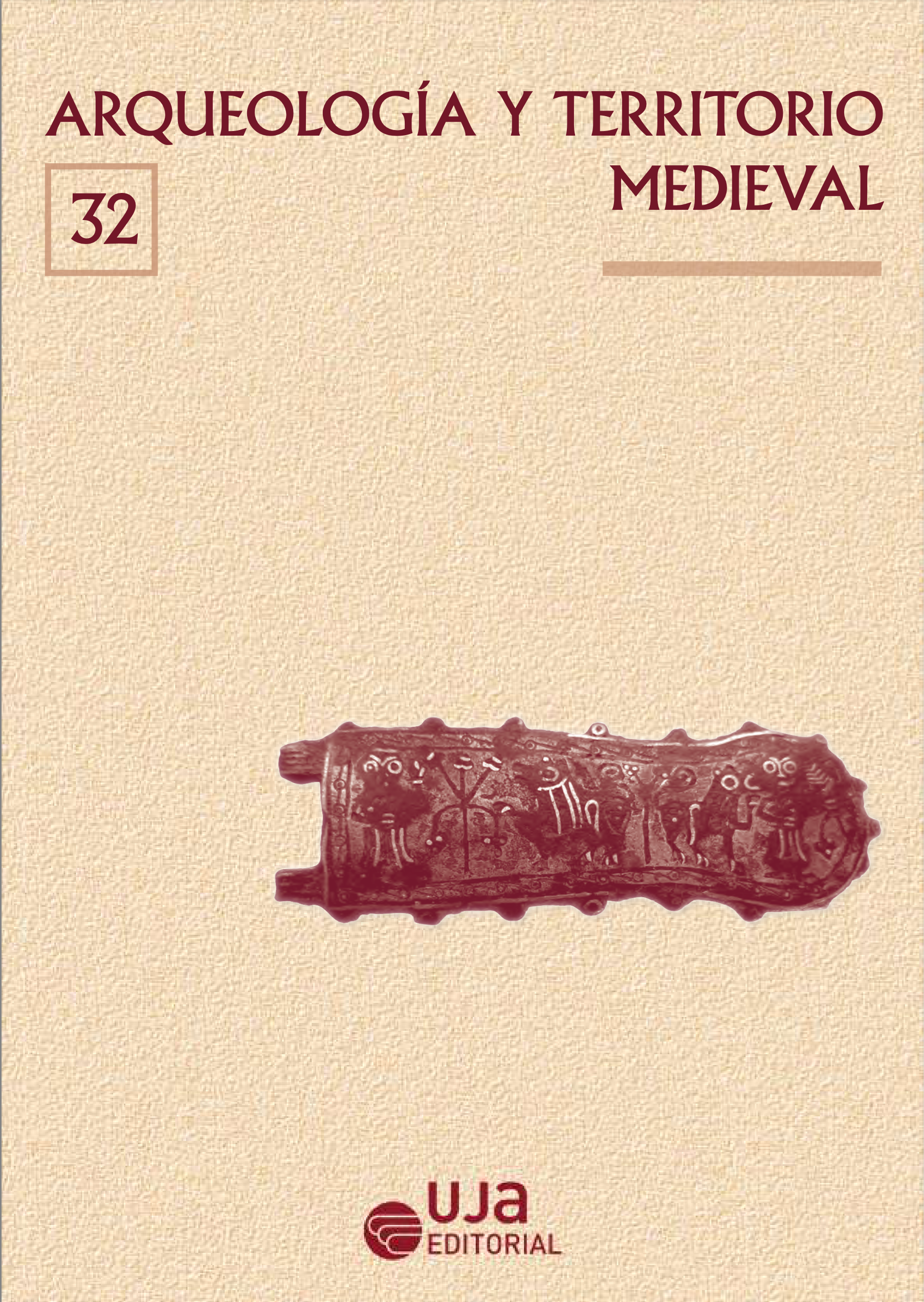
A damascened belt plate from late Visigothic period (7th-8th centuries) with a scene of martyrdom from Castellar (Jaen)
DOI:
https://doi.org/10.17561/aytm.v32.9546Keywords:
metal work, damascene, lyre-shaped, iconography, martyrdomAbstract
This paper describes a damascened belt plaque from the late Visigothic period (7th-8th centuries) found in the vicinity of Castellar (Jaén). The lyre-shaped plate, made of iron and inlaid with brass and silver, shows two sequential scenes that could be narrating the martyrdom of a person being devoured by a lion; perhaps that of Ignatius of Antioch, who died in this manner. The interpretation of the scenes as a Christian martyrdom, the identity of the figure depicted and the iconographic parallels reveal the importance of Eastern influences on late Visigothic metal work and offer possible new interpretations for other similar pieces.
Downloads
References
ADAMS, Noel (2014): Bright Lights in the Dark Ages: The Thaw Collection of Early Medieval Ornaments. Nueva York: The Morgan Library & Museum.
ARIAS CABAL, Pablo; ONTAÑÓN PEREDO, Roberto; GUTIÉRREZ CUENCA, Enrique; HIERRO GÁRATE, José Ángel; PEREDA ROSALES, Eva María (2012): “El broche de cinturón de tipo visigodo de la Galería Inferior de La Garma”, en B. Arizaga Bolumburu, D. Mariño Veiras, C. Díez Herrera, J. A. Solórzano Telechea, S. Guijarro González, J. ñíbarro Rodríguez (coords), Mundos medievales: espacios, sociedades y poder. Homenaje al Profesor José Ángel García de Cortázar, Tomo I, pp. 335-353. Santander: Universidad de Cantabria.
ARIAS SÁNCHEZ, Isabel; BALMASEDA MUNCHARAZ, Luis Javier (2017): “Observaciones sobre las excavaciones de E. Camps y J. M. de Navascués en Castiltierra”, en I. Arias Sánchez, L.J. Balmaseda Muncharaz (coords.), La Necrópolis de Época Visigoda de Castiltierra (Segovia). Excavaciones Dirigidas por E. Camps y J. M. de Navascués, 1932-1935. Materiales Conservados en el Museo Arqueológico Nacional. Tomo II: Estudios, pp. 7-101, Madrid: Ministerio de Educación, Cultura y Deporte.
BARROSO CABRERA, Rafael; MORÍN DE PABLOS, Jorge; (1994): “Dos relieves de época visigoda con representación figurada: la placa de Las Tamujas y la de Narbona”. Anales Toledanos, 31, pp. 41-64.
BISBEE, Gary A. (1988): Pre-Decian Acts of Martyrs and commentarii. Filadelfia: Fortress Press.
CARTRON, Isabelle; CASTEX, Dominique (2018): “Portes des reliques à la ceinture: la plaque-boucle du site de Saint-Martin de Bruch (Lot-et-Garonne)”. Revue belge de philologie et d´histoire, 96 (1), pp. 209-224.
CUTLER, Anthony; SEVCENKO, Nancy Patterson (2007): “A recently discovered ivory of St. Ignatios and the lions”, en A. Cutler A. Papaconstantinou (eds.), The material and the ideal. Essays in Medieval Art and Archaeology in honour of Jean-Michel Spieser, pp. 113-127. Leiden: Brill. https://doi.org/10.1163/ej.9789004162860.i-296.19
DEARN, Alan (2004): “Victory and Death: The Representation of Early Christian Martyrdom”. Australian and New Zealand Journal of Art, 5/2, pp. 70-91. https://doi.org/10.1080/14434318.2004.11432744
DOHIJO, Eusebio (2007): “La necrópolis hispanovisigoda del área foral de Termes”. Pyrenae, 38 (1), pp. 129-162.
EGER, Christoph (2009): “Ein byzantinischer Schnallenbeschlag mit Darstellung der Philoxenie aus dem Musée National de Carthage”. Römische Quartalschrift für christliche Altertumskunde und Kirchengeschichte, 104(1-2), pp. 21-27.
FEUGÈRE, Michael (2015-2016): “Plaques-boucles d´époque wisigothique conservées au Museé Episcopal de Vic”. Quaderns del Museu Episcopal de Vic, VIII, pp. 51-64. https://raco.cat/index.php/QuadernsMEV/article/view/391482
GAILLARD DE SÉMAINVILLE Henri (2010): “Les plaques-boucles mérovingiennes ornées d’une croix encadrée par deux griffons: à propos d’une découverte faite à Fleurey-sur-Ouche (Côte-d’Or)”. Revue archéologique de l’Est, 59/2, pp. 585-602. http://journals.openedition.org/rae/6354
GAILLARD DE SÉMAINVILLE, Henri (2011): “Décor chrétien des objets de parure. L’exemple des plaques-boucles mérovingiennes de Burgundia”. Antiquité tardive, 19, pp. 223-236.
GONZÁLEZ FERNÁNDEZ, Rafael; FERNÁNDEZ MATALLANA, Francisco (2007): “Nuevas placas de cinturón procedentes de la ciudad visigoda del Cerro de la Almagra (Mula, Murcia)”. Mastia, 6, pp. 165-179.
GONZÁLEZ SALAS, Saturio (1945): El Castro de Yecla, en Santo Domingo de Silos (Burgos). Madrid: Comisaría General de Excavaciones Arqueológicas.
GUTIÉRREZ CUENCA, Enrique; HIERRO GÁRATE, José Ángel (2013): “Broches cruciformes de los siglos VII-VIII en la Península Ibérica: caracterización tipo-cronológica”. Pyrenae, 44/2, pp. 109-136.
HARTMANN, Nicole (2021): “Bones Ground by Wild Beast’s Teeth. Late Ancient Imaginations of the Death of Ignatius of Antioch”, en H.O. Maier, C. Waldner (coords.), Desiring Martyrs: Locating Martyrs in Space and Time, pp. 155-176. Berlín-Boston: De Gruyter Oldenbourg. https://doi.org/10.1515/9783110682632-009
HIERRO GÁRATE, José Ángel (2018): “Los objetos de época visigoda de la cueva de Los Goros, sesenta años después”, en E. Gutiérrez Cuenca, J. A. Hierro Gárate, R. Bolado del Castillo (coords.), Septem!: Homenaje a Alberto Gómez Castanedo, pp. 177-191. Santander: Acanto.
HIERRO GÁRATE, José Ángel (2022): El uso funerario de las cuevas en época visigoda (siglos VI-VIII). Vitoria: UPV/EHU.
HIERRO GÁRATE, José Ángel; GUTIÉRREZ CUENCA, Enrique (2018): “Dos nuevos broches de cinturón damasquinados de época visigoda con decoración de tema animal”. Sautuola, 23, pp. 349-357.
KISS, Zsolt. (1989): Les ampoules de Saint Ménas découvertes à Kôm el-Dikka (1961-1981). Varsovia: PWN Editions Scientifiques de Pologne.
KOTARBA, Jérôme; CASTELLVI, Georges; MAZIÈRE, Florent (2007): Carte archéologique de la Gaule 66: Les Pyrénées-Orientales. París: Académie des Inscriptions et Belles Lettres.
MARTÍNEZ SANTA-OLALLA, Julio (1948): “Nielado y ataujía en la España visigoda”, Homenaje a José Puig y Cadafalch, pp. 179-184.
MARZINZIK, Sonja (2012): Masterpieces: Early Medieval Art. Londres: British Museum.
MATEO DONET, María Amparo (2016): La ejecución de los mártires cristianos en el Imperio Romano. Murcia: CEPOAT.
ORTEGA, Ana Isabel; NOTARIO, Belén; FERNÁNDEZ, Pilar; ÁLVARO, Ana; ORTEGA, Nuria (2017): “Broche cruciforme identificado mediante tecnología avanzada en microtomografía computarizada”, en XII Congreso Ibérico de Arqueometría, p. 34. Burgos: CENIEH. http://cir.cenieh.es/handle/20.500.12136/887
PALOL SALELLAS, Pedro (1957a): “Bronces con decoración damasquinada en época visigoda”, en V Congreso Nacional de Arqueología, pp. 292-305. Zaragoza: Universidad de Zaragoza.
PALOL SALELLAS, Pedro (1957b): “Los objetos visigodos de la cueva de Los Goros (Hueto Arriba-Álava)”. Boletín de la Institución Sancho el Sabio, 1-2/1, pp. 73-84.
PÉREZ RODRÍGUEZ-ARAGÓN, Fernando (1999): “Un broche de cinturón damasquinado de época visigoda procedente de Monte Cildá (Olleros de Pisuerga, Palencia)”. Sautuola, VI, pp. 453-456.
RIPOLL LÓPEZ, Gisela (1998): Toréutica de la Bética (siglos VI y VII d.C.). Barcelona: Reial Acadèmia de Bones Lletres.
SALOMONSON, Jan Willem (1979): Voluptatem spectandi non perdat sed mutet: observations sur l'iconographie du martyre en Afrique romaine. Ámsterdam-Nueva York: North-Holland Pub. Co.
SERNA GANCEDO, Mariano Luis; VALLE GÓMEZ, Ángeles; HIERRO GÁRATE, José Ángel (2005): “Broches de cinturón visigodos y otros materiales tardoantiguos de la cueva de Las Penas (Mortera, Piélagos)”. Sautuola, XI, pp. 247-276.
TREFFORT, Cécile (2002): “Vertus prophylactiques et sens eschatologique d'un dépôt funéraire du haut Moyen Âge: les plaques boucles rectangulaires burgondes à inscription”. Archéologie médiévale, 32, pp. 31-54. https://doi.org/10.3406/arcme.2002.1587
VAN DEN HOEK, Annewies (2013): “Execution as Entertainment: The Roman Context of Martyrdom”, en A. Van Den Hoek, J.J. Herrmann, Pottery, Pavements, and Paradise. Leiden: Brill. https://doi.org/10.1163/9789004256934_014
Published
Issue
Section
License
Copyright (c) 2025 Enrique Gutiérrez Cuenca, José Ángel Hierro Gárate

This work is licensed under a Creative Commons Attribution 4.0 International License.

The moment the article is accepted by the magazine, the author or authors must fill out a specific form where the copyright conditions of the magazine will be stated, approved by the University of Jaén.
The authors will retain the copyright and will concede to the magazine the rights for the first publication, with the work registered under the Creative Commons license that allows third parties the use of the publication as long as they mention the author and the publication in this magazine.
The authors can reach other independent contractual agreements for the non exclusive distribution of the version of the article published in this magazine (i.e include it in an institutional repository or publish it in a book) as long as they clearly indicate that the work was primarily published by this magazine.