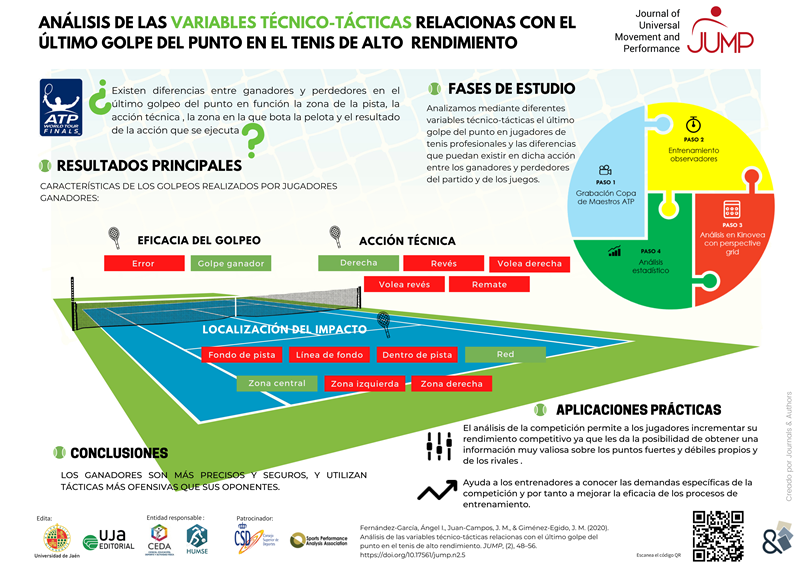
Analysis of Technical-Tactical Variables Related to the Last Stroke of the Point in High Performance Tennis
DOI:
https://doi.org/10.17561/jump.n2.5Keywords:
Racquet sports, performance indicators, match analysis, winner, errorAbstract
The aim of the present study was to analyze through different technical-tactical variables the last stroke of the point in professional tennis players, as well as to analyze the differences that may exist in this specific action between the winners and losers of the match and games. The sample analyzed were the 100% of the points (n = 1639) of the ATP Masters Cup 2014 played in indoor hard court. The variables analyzed were the last technical-tactical action, hitting area, ball landing location and stroke effectiveness, while the performance variables that considered were being the winner or loser of the match or the game. The results show that winners commit fewer errors and get more winners than the losers. In addition, they use more the forehand and net shots. Further, losers hit more frequently than the winners at the background while the latter do it more than their opponents in the net zone. Therefore, winners are more accurate and consistent, and use more offensive tactics than losers.
References
Anguera, M. T. (2003). Observational methods (general). Encyclopedia of Psychological, 2, 632–637.
Barbaros Tudor, P., Zečić, M., & Matković, B. (2014). Differences Between 2010 and 2011 Performance Indicators of Tennis Play At the Grand Slam Tournaments. Kineziologija, 46(Supplement 1), 102–107.
Brown, E., & O’Donoghue, P. (2008). Gender and Surface Effect on Elite Tennis Strategy. Coaching & Sport Science Review, 46, 9–11.
Cohen, J. (1968). Weighted kappa: Nominal scale agreement provision for scaled disagreement or partial credit. Psychological Bulletin, 70(4), 213–220. https://doi.org/10.1037/h0026256
Cui, Y., Gómez, M. Á., Gonçalves, B., Liu, H., & Sampaio, J. (2017). Effects of experience and relative quality in tennis match performance during four Grand Slams. International Journal of Performance Analysis in Sport, 17(5), 783–801. https://doi.org/10.1080/24748668.2017.1399325
Cui, Y., Gómez, M. Á., Gonçalves, B., & Sampaio, J. (2018). Performance profiles of professional female tennis players in grand slams. PLoS ONE, 13(7), 1–18. https://doi.org/10.1371/journal.pone.0200591
Cui, Y., Liu, H., Liu, H., & Gómez, M. Á. (2019). Data-driven analysis of point-by-point performance for male tennis player in Grand Slams. Motricidade, 15(1), 49–61. https://doi.org/10.6063/motricidade.16370
Fernandez-Fernandez, J., Mendez-Villanueva, A., Fernandez-Garcia, B., & Terrados, N. (2007). Match activity and physiological responses during a junior female singles tennis tournament. British Journal of Sports Medicine, 41(11), 711–716. https://doi.org/10.1136/bjsm.2007.036210
Fernandez-Fernandez, J., Sanz-Rivas, D., Fernandez-Garcia, B., & Mendez-Villanueva, A. (2008). Match activity and physiological load during a clay-court tennis tournament in elite female players. Journal of Sports Sciences, 26(14), 1589–1595. https://doi.org/10.1080/02640410802287089
Fernández-García, Á. I., Blanca-Torres, J. C., Nikolaidis, P. T., & Torres-Luque, G. (2019). Differences in competition statistics between winners and losers in male and female tennis players in Olympic Games. German Journal of Exercise and Sport Research, 49(3), 313–318. https://doi.org/10.1007/s12662-019-00608-y
Figueira, B., Gonçalves, B., Folgado, H., Masiulis, N., Calleja-González, J., & Sampaio, J. (2018). Accuracy of a basketball indoor tracking system based on standard bluetooth low energy channels (NBN23®). Sensors (Switzerland), 18(6). https://doi.org/10.3390/s18061940
Filipcic, A., Zecic, M., Reid, M., Crespo, M., Panjan, A., & Nejc, S. (2015). Differences in performance indicators of elite tennis players in the period 1991– 2010. Journal of Physical Education and Sport, 15(4), 671–677. https://doi.org/10.7752/jpes.2015.04102
Filipčič, T., Filipčič, A., & Berendijaš, T. (2008). Comparison of game characteristics of male and female tennis players at Roland Garros 2005. Sport Sciences, 38(3), 151–155. http://10.0.93.21/TSS.2017.24.4-
Fitzpatrick, A., Stone, J. A., Choppin, S., & Kelley, J. (2019). A simple new method for identifying performance characteristics associated with success in elite tennis. International Journal of Sports Science and Coaching, 14(1), 43–50. https://doi.org/10.1177/1747954118809089
Gillet, E., & Leroy, D. (2009). A notational analysis of elite tennis serve and serve-return strategies on slow surface. Journal of Strength, 23(2), 532–539.
Gimenez-Egido, J. M., Ortega-Toro, E., Palao, J. M., Verdú-Conesa, I., & Torres-Luque, G. (2020). Effect of Modification Rules in Competition on Technical–Tactical Action in Young Tennis Players (Under-10). Frontiers in Psychology, 10, 1–15. https://doi.org/10.3389/fpsyg.2019.02789
Giménez-egido, J. M., Ortega, E., Verdu-conesa, I., Cejudo, A., & Torres-luque, G. (2020). Using smart sensors to monitor physical activity and technical–tactical actions in junior tennis players. International Journal of Environmental Research and Public Health, 17(3), 12–15. https://doi.org/10.3390/ijerph17031068
Gorospe Egaña, G., Hernández-Mendo, A., Anguera, M. T., & Martínez de Santos, R. (2005). Desarrollo y optimización de una herramienta observacional en el tenis de individuales. Psicothema, 17(1), 123–127.
Grambow, R., O’Shannessy, C., Born, P., Meffert, D., & Vogt, T. (2020). Serve efficiency development at wimbledon between 2002 and 2015: A longitudinal approach to impact tomorrow’s tennis practice. Human Movement, 21(1), 65–72. https://doi.org/10.5114/hm.2020.88155
Hizan, H., Whipp, P. R., & Reid, M. (2010). Validation of Match Notation (A Coding System) in Tennis. Journal of Quantitative Analysis in Sports, 6(3). https://doi.org/10.2202/1559-0410.1223
Hizan, H., Whipp, P., & Reid, M. (2011). Comparison of serve and serve return statistics of high performance male and female tennis players from different age-groups. International Journal of Performance Analysis in Sport, 11(2), 365–375. https://doi.org/10.1080/24748668.2011.11868556
Hizan, H., Whipp, P., & Reid, M. (2015). Gender differences in the spatial distributions of the tennis serve. International Journal of Sports Science and Coaching, 10(1), 87–96. https://doi.org/10.1260/1747-9541.10.1.87
Hornery, D. J., Farrow, D., Mujika, I., & Young, W. (2007). Fatigue in Tennis. Sports Medicine, 37(3), 199–212. https://doi.org/10.2165/00007256-200737030-00002
Hughes, M. D., & Bartlett, R. M. (2002). The use of performance indicators in performance analysis. Journal of Sports Sciences, 20(10), 739–754. https://doi.org/10.1080/026404102320675602
Johnson, C. D., & McHugh, M. P. (2006). Performance demands of professional male tennis players. British Journal of Sports Medicine, 40(8), 696–699. https://doi.org/10.1136/bjsm.2005.021253
Katić, R., Milat, S., Zagorac, N., & Durović, N. (2011). Impact of game elements on tennis match outcome in Wimbledon and Roland Garros 2009. Collegium Antropologicum, 35(2), 341–346. http://www.ncbi.nlm.nih.gov/pubmed/21755700
Klaus, A., Bradshaw, R., Young, W., O’Brien, B., & Zois, J. (2017). Success in national level junior tennis: Tactical perspectives. International Journal of Sports Science and Coaching, 12(5), 618–622. https://doi.org/10.1177/1747954117727792
Kovacs, M. S. (2007). Tennis physiology: Training the competitive athlete. Sports Medicine, 37(3), 189–198. https://doi.org/10.2165/00007256-200737030-00001
Krause, L. M., Buszard, T., Reid, M., Pinder, R., & Farrow, D. (2019). Assessment of elite junior tennis serve and return practice: A cross-sectional observation. Journal of Sports Sciences, 37(24), 2818–2825. https://doi.org/10.1080/02640414.2019.1665245
Mart, R., Directores, G., Guzm, F., & Vuckovic, G. (2015). Análisis técnico-táctico y de los desplazamientos de tenistas profesionales en pista rápida. 1–205.
Martínez-Gallego, R., Guzmán, J. F., Crespo, M., Ramón-Llin, J., & Vučković, G. (2017). Technical , tactical and movement analysis of men ’ s professional tennis on hard courts courts. The Journal of Sports Medicine and Physical Fitness, 59(1). https://doi.org/10.23736/s0022-4707.17.07916-6
Martínez-Gallego, R., Guzmán, J. F., James, N., Ramón-Llin, J., Crespo, M., & Vuckovic, G. (2013). The relationship between the incidence of winners/errors and the time spent in different areas of the court in elite tennis. Journal of Human Sport and Exercise, 8(3), 2–5. https://doi.org/10.4100/jhse.2013.8.Proc3.05
Martínez-Gallego, R., Guzmán Luján, J. F., James, N., Pers, J., Ramón-Llin, J., & Vuckovic, G. (2013). Movement characteristics of elite tennis players on hard courts with respect to the direction of ground strokes. Journal of Sports Science and Medicine, 12(2), 275–281.
O’Donoghue, G. P., & Brown, E. (2008). The Importance of Service in Grand Slam Singles Tennis. International https://doi.org/10.1080/24748668.2008.11868449
Journal of Performance Analysis in Sport, 8(3), 70–78. https://doi.org/10.1080/24748668.2008.11868449
O’Donoghue, P., & Ingram, B. (2001). A notational analysis of elite tennis strategy. Journal of Sports Sciences, 19(2), 107–115. https://doi.org/10.1080/026404101300036299
O’Donoghue, Peter. (2013). Rare events in tennis. International Journal of Performance Analysis in Sport, 13(2), 535–552. https://doi.org/10.1080/24748668.2013.11868668
Pollard, G., Cross, R., & Meyer, D. (2006). An analysis of ten years of the four grand slam men’s singles data for lack of independence of set outcomes. Journal of Sports Science and Medicine, 5(4), 561–566.
Reid, M., Morgan, S., & Whiteside, D. (2016). Matchplay characteristics of Grand Slam tennis: implications for training and conditioning. Journal of Sports Sciences, 34(19), 1791–1798. https://doi.org/10.1080/02640414.2016.1139161
Sánchez-Pay, A., Palao, J. M., Torres-Luque, G., & Sanz-Rivas, D. (2015). Differences in set statistics between wheelchair and conventional tennis on different types of surfaces and by gender. International Journal of Performance Analysis in Sport, 15(3), 1177–1188. https://doi.org/10.1080/24748668.2015.11868860
Stare, M., Žibrat, U., & Filipčič, A. (2015). Stroke effectivness in professional and junior tennis = Učinkovitost udarcev v profesionalnem in mladinskem tenisu. Kinesiologia Slovenica, 21(2), 39–50.
Teresa, M., Argilaga, A., Villaseñor, A. B., Hernández, A., Luis, J., & López, L. (2011). Diseños observacionales: ajuste y aplicación en psicología del deporte. Cuadernos de Psicología Del Deporte, 11(2), 63–76.
Torres-Luque, G., Fernández-García, Á. I., Cabello-Manrique, D., Giménez-Egido, J. M., & Ortega-Toro, E. (2018). Design and validation of an observational instrument for the technicaltactical actions in singles tennis. Frontiers in Psychology, 9(DEC), 1–10. https://doi.org/10.3389/fpsyg.2018.02418
Varas Caro, I., & Gómez-Ruano, Á. M. (2016). Análisis Notacional en Jugadores de Tenis de Élite En Función de las Variables Contextuales Notational Analysis of Elite Tennis Players in Contextual Variables. Kronos, 15(151), 1–12.
Villaseñor, A. B., Losada, J. l, & Anguera, M. T. (2001). Diseños observacionales, cuestión clave en el proceso de la metodología observacional. Metodología de Las Ciencias Del Comportamiento, 3(2), 135–160. https://dialnet.unirioja.es/servlet/articulo?codigo=2809601
Whiteside, D., & Reid, M. (2017). Spatial characteristics of professional tennis serves with implications for serving aces: A machine learning approach. Journal of Sports Sciences, 35(7), 648–654. https://doi.org/10.1080/02640414.2016.1183805