Credits

ISSN: 1137-8778
ISSNe: 2341-4847
DOI: 10.17561/ae

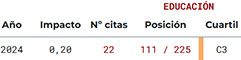

Index:


The journal Aula de Encuentro was launched in 1997 and is edited by the SAFA University Center. As Center affiliated to the University of Jaén, it is published through the Publications Service of UJA, although the edition of the magazine is under the responsibility and competence of the University Center SAFA.
Its main objective is to promote research and communication, the exchange of ideas and shared reflection among different teaching professionals, both nationally and internationally, as well as to offer didactic approaches and experiences that favor an innovative education that promotes the integral development of students in order to foster coexistence, respect for individual differences, promote equality, justice and solidarity and avoid discrimination.
Aula de Encuentro is aimed at the general public, and especially at teachers and researchers related to education.
Aula de Encuentro shares the basic principles set out in the Committee on Publication Ethics (COPE).
The refereeing process for the journal is “double blind”. Previously, the Editorial Board assesses the formal relevance of each article and its adequacy to the objectives and content of this journal.
Once the article is accepted in this first phase, it is evaluated, anonymously, by 2 external reviewers who specialise in the subject addressed in the study. In case there is a discrepancy between them, the paper will be sent to a third reviewer. All reviewers have public assessment criteria on this platform. The acceptance or rejection of each work will be based on a motivated decision according to the assessment of these reviewers.
The criteria for the formal review of the manuscripts received and the proposed criteria for the evaluation of the content by the external reviewers are shown in the section “review guidelines”.
According to the subject matter of each article, peer reviewers are selected, related to the area of research they develop.
This journal provides open access to its content, based on the principle that providing open access to research helps a greater global exchange of knowledge.
Authors who publish in this journal agree to the following terms:
a. Authors retain copyright and grant the journal the right to be the first publication of the work as licensed under a Creative Commons Attribution License that allows others to share the work with an acknowledgment of authorship of the work and initial publication in this journal.
b. Authors may separately enter into additional arrangements for non-exclusive distribution of the version of the work published in the journal (e.g., placing it in an institutional repository or publishing it in a book), with an acknowledgment of initial publication in this journal.
c. Authors are permitted and encouraged to disseminate their work electronically (e.g., in institutional repositories or on their own website) before and during the submission process, as it may lead to productive exchanges, as well as earlier and higher citation of published work (see The Effect of Open Access)
This journal does not charge authors for publishing, that is, it does not apply APC (Article Processing Charges).
This work is under a Creative Commons Attribution 4.0 International license
Aula de Encuentro publishes two issues a year, volume 1 in the first semester (January-June) and volume 2 in the second semester (July-December).
This journal uses the ORCID ® persistent digital identifier as an authorship standardization system.
Ethical guidelines for the publication of articles
Statement of publication ethics and malpractice based on Elsevier's recommendations and COPE's Best Practice Guidelines for Journal Editors
Publication of an article in peer-reviewed journals is a process of continuous knowledge improvement. It is a direct reflection of the quality of the work of the authors and the institutions that support them. Peer-reviewed articles support and embody the scientific method. Therefore, it is important to agree on the standards of ethical behavior expected for all parties involved in the act of publication: the author, the journal editor, the reviewer, the publisher, and the society behind the society-owned or society-sponsored journals.
Aula de Encuentro takes its duties of stewardship at all stages of publication very seriously and we recognize our ethical and other responsibilities.
We are committed to ensuring that advertising, reprint or other commercial revenues do not impact or influence editorial decisions. In addition, the Editorial Board will assist in communications with other journals and/or publishers when this is helpful to the editors.
Duties of authors.
Reporting standards
Authors of original research reports should present an accurate description of the work performed, as well as an objective discussion of its significance. The underlying data should be accurately represented in the paper. A paper should contain sufficient detail and references to allow others to reproduce the work. Fraudulent or deliberately inaccurate statements constitute unethical behavior and are unacceptable. Professional review and publication articles should also be accurate and factual, and editorial "opinion" papers should be clearly identified as such.
Data Access and Retention
Authors may be asked to provide raw data in connection with a paper for editorial review, and in any case should be prepared to retain such data for a reasonable time after publication.
Originality and plagiarism
Authors should ensure that they have written completely original work, and if authors have used the work and/or words of others, that these have been cited or quoted appropriately. Plagiarism takes many forms, from "passing off" another's paper as the author's own paper, to copying or paraphrasing substantial portions of another's paper (without attribution), to claiming results of research done by others. Plagiarism in all its forms constitutes unethical editorial behavior and is unacceptable.
It is reminded that Aula de Encuentro will pass through an anti-plagiarism filter with the TURNITIN software the papers submitted to it. This process will be carried out prior to the acceptance of the work for evaluation. If due to the result of the software to detect plagiarism (coincidences), the work is rejected, the report will be sent to the author.
Multiple, redundant or concurrent publication
In general, an author should not publish manuscripts describing essentially the same research in more than one journal or primary publication. Submitting the same manuscript to more than one journal at the same time constitutes unethical publication behavior and is unacceptable. In general, an author should not submit a previously published article for consideration in another journal.
Acknowledgment of sources
Proper acknowledgment of the work of others should always be given. Authors should cite publications that have been influential in determining the nature of the work reported. Information obtained privately, e.g., in conversation, correspondence, or discussion with others, should not be used or reported without explicit written permission from the source. Information obtained in the course of confidential services, such as refereed manuscripts or grant applications, should not be used without the explicit written permission of the author of the work involved in these services.
Authorship of the article
Authorship should be limited to those who have made a significant contribution to the conception, design, execution, or interpretation of the reported study. All those who have made significant contributions should be listed as coauthors. Where there are others who have participated in certain substantive aspects of the research project, they should be acknowledged or listed as contributors. The corresponding author should ensure that all coauthors have seen and approved the final version of the paper and have agreed to its submission for publication.
Disclosure and conflicts of interest
All authors must disclose in their manuscript any financial or other substantive conflicts of interest that could be interpreted to influence the results or interpretation of their manuscript. All sources of financial support for the project should be disclosed. Examples of potential conflicts of interest that should be disclosed include employment, consultancies, stock ownership, honoraria, paid expert testimony, patent applications/registrations, and grants or other funding. Potential conflicts of interest should be disclosed at the earliest possible stage.
Fundamental errors in published works
When an author discovers a significant error or inaccuracy in his or her own published work, it is the author's obligation to immediately notify the editor or publisher of the journal and to cooperate with the editor to retract or correct the paper. If the editor or publisher learns from a third party that a published work contains a significant error, it is the author's obligation to immediately retract or correct the paper or provide evidence to the editor of the correction of the original paper.
Inclusive language and gender highlighting in research source data.
Authors are requested to use inclusive language and to note and highlight whether the research source data are sex-sensitive, in order to allow for the identification of possible differences.
Duties of editors
Publication decisions
The editor of a peer-reviewed journal is responsible for deciding which of the articles submitted to the journal should be published, often working in conjunction with the relevant society (for sponsored or society-owned journals). The validation of the work in question and its importance to researchers and readers should always drive such decisions. The editor may be guided by the policies of the journal's Editorial Board and be constrained by the legal requirements that will apply in relation to libel, copyright infringement, and plagiarism. The editor may consult with other editors or reviewers (or society officers) in making this decision.
Fair play
An editor should evaluate manuscripts for their intellectual content without regard to the author's cultural background, gender, sexual orientation, religious beliefs, ethnicity, citizenship, or political philosophy.
Confidentiality
The editor and editorial staff should not disclose any information about a submitted manuscript to anyone other than the corresponding author, reviewers, potential reviewers, other editorial advisors, or the publisher, as appropriate.
Disclosure and conflicts of interest
Unpublished materials disclosed in a submitted manuscript should not be used in the editor's research without the express written consent of the author. Insider information or insights gained through peer review should be kept confidential and not used for personal gain. Editors should recuse themselves (i.e., should ask a co-editor, associate editor, or other editorial board member to review and consider in their place) to consider manuscripts in which they have conflicts of interest as a result of competitive, collaborative, or other relationships or connections with any of the authors, companies, or (possibly) institutions related to the papers. Editors should require all contributors to disclose relevant competing interests and publish corrections if competing interests are disclosed after publication. If necessary, other appropriate action, such as publication of a retraction or expression of concern, should be taken. It should be ensured that the peer review process for sponsored supplements is the same as that used for the main journal. Articles in sponsored supplements should be accepted solely on the basis of scholarly merit and interest to readers and not be influenced by commercial considerations. Non-peer-reviewed sections of the journal should be clearly identified.
Participation and cooperation in research
An editor should take reasonably responsive action when ethical complaints about a submitted manuscript or published paper have been filed with the publisher (or society). Such action will generally include contacting the author of the manuscript or paper and giving due consideration to the respective complaint(s), but may also include additional communications to relevant institutions and research bodies, and if the complaint is upheld, publication of a correction, retraction, expression of concern, or other note, as appropriate. Every act of unethical publication behavior should be considered, even if it is discovered years after publication.
Duties of reviewers
Contribution to editorial decisions
Peer review assists the editor in making editorial decisions and, through editorial communications with the author, can also help the author improve the paper. Peer review is an essential component of formal scholarly communication, and is at the heart of the scientific method. Aula de Encuentro shares the view of many that all scholars who wish to contribute to publications have an obligation to do their fair share of peer review.
Prontitud
Any selected referee who feels unqualified to review the research reported in a manuscript or knows that prompt review will be impossible should notify the editor and excuse himself or herself from the review process.
Confidentiality
Any manuscripts received for review should be treated as confidential documents. They should not be shown or discussed with others, except as authorized by the editor.
Standards of objectivity
Reviews should be conducted in an objective manner. Personal criticism of the author is inappropriate. Referees should express their views clearly with supporting arguments.
Source recognition
Reviewers should identify relevant published work that has not been cited by the authors. Any statement that an observation, derivation, or argument has been previously reported should be accompanied by the relevant citation. A reviewer should also bring to the editor's attention any substantial similarity or overlap between the manuscript under consideration and any other published paper of which he or she has personal knowledge.
Disclosure and conflict of interest
Unpublished materials disclosed in a submitted manuscript should not be used in the reviewer's own research without the express written consent of the author. Privileged information or insights gained through peer review should be kept confidential and not used for personal gain. Reviewers should not consider manuscripts in which they have conflicts of interest as a result of competitive, collaborative, or other relationships or connections with any of the authors, companies, or institutions related to the papers.
Sources of financing
The sources of financing correspond to the SAFA University Center.
The Publications Service of the University of Jaén collaborates with the publication of the journal.
 |
Campus Las Lagunillas, s/n. Biblioteca, 2ª Planta. 23071 Jaén editorial@ujaen.es +34 953 21 23 55 |