Isometric maximum strength profile of hip rotators of a senior soccer team
DOI:
https://doi.org/10.17561/jump.n4.1Keywords:
hand-held dynamometer, team sports, field test, reference values, muscle imbalance, overuse injuryAbstract
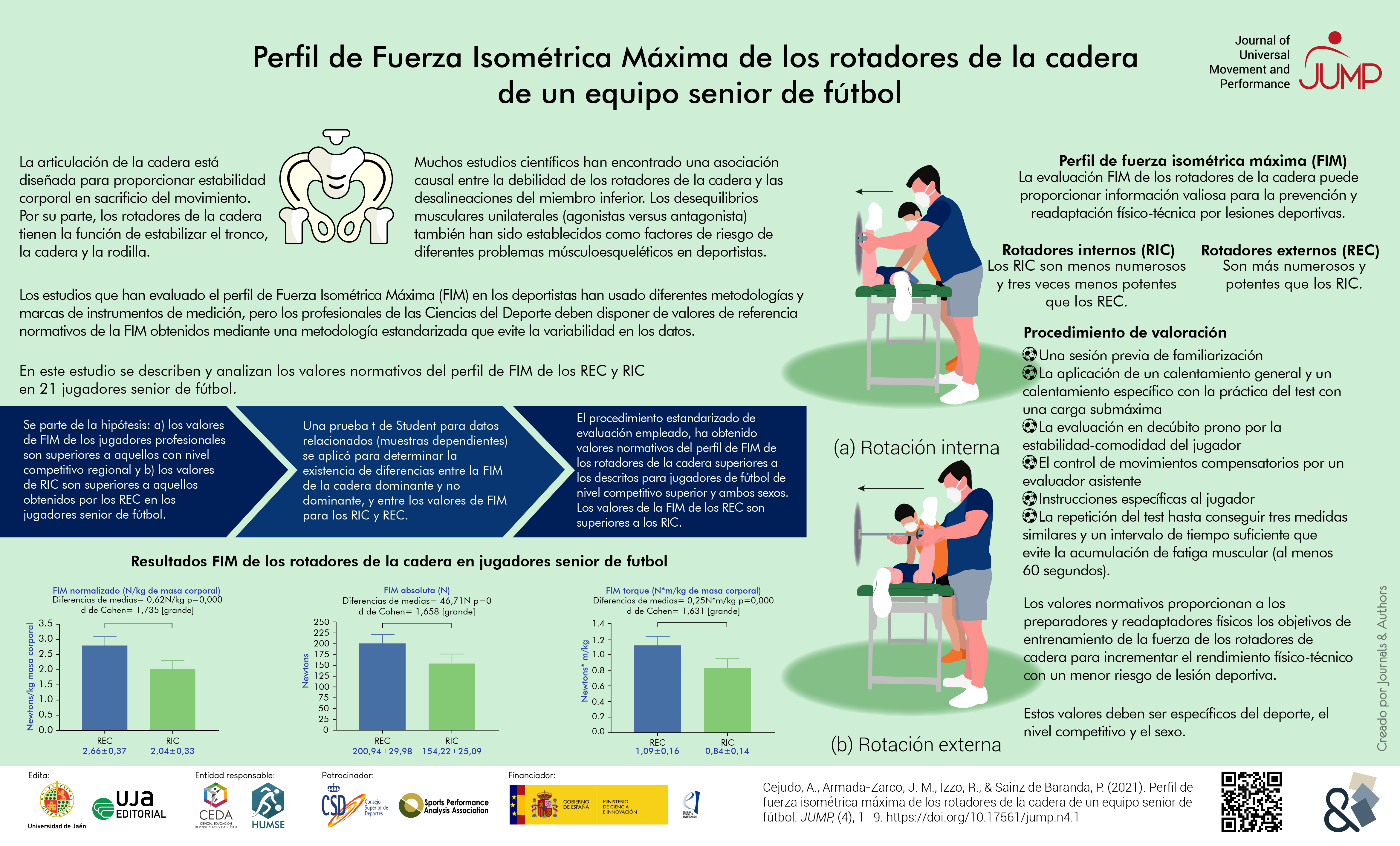
Hip rotator weakness and imbalances are associated with injuries in athletes. The aim of the present study was to describe the maximal isometric strength (MIS) profile of the internal (HIR) and external (HER) hip rotators in senior soccer players. An observational, descriptive, cross-sectional study was conducted in 21 senior soccer players that voluntarily participated in the present study. The MIS of HIR and HER were measured with the use of a manual Lafayette dynamometer. A Student's t-test for related data (dependent samples) was calculated to determine the existence of differences between the MIS values of the dominant and nondominant hip, and between the MIS values of the HIR and HER. These analyses were complemented with the effect size of all outcomes using Cohen's d statistic. The players showed MIS results of 200.94 ± 29.98 N, 2.66 ± 0.37 N/kg body mass and 1.09 ± 0.16 N*m/kg body mass in the REC; and 154.22 ± 25.09 N, 2.04 ± 0.33 N/kg body mass and 0.84 ± 0.14 N*m/kg body mass in the RIC. Comparison analysis of MIS means in the different units of measurement showed higher values in HER than in HIR (p = 0.000; Cohen's d > 1.631 [large]). In conclusion, a standardized assessment method has obtained normative values of the FIM profile of hip rotators higher than other soccer players of higher competitive level and both sexes. The FIM values of HER are higher than HIR.
References
Baldon, R., Furlan, L., & Serrão, F. (2012). Influence of the hip flexion angle on isokinetic hip rotator torque and acceleration time of the hip rotator muscles. Journal of Applied Biomechanics, 29(5), 593–599. https://doi.org/10.1123/jab.29.5.593
Brukner, P., Nealon, A., Morgan, C., & Burgess, D. (2014). Recurrent hamstring muscle injury: applying the limited evidence in the professional football setting with a seven-point programme. British Journal of Sports Medicineournal of Sports Medicine, 48(11), 929–938. https://doi.org/10.1136/bjsports-2012-091400
Cibulka, M., & Threlkeld-Watkins, J. (2005). Patellofemoral Pain and Asymmetrical Hip Rotation. Physical Therapy, 85(11), 1201–1207. https://doi.org/10.1093/PTJ/85.11.1201
Cibulka, M., Strube, M., Meier, D., Selsor, M., Wheatley, C., Wilson, N., & Irrgang, J. (2010). Symmetrical and asymmetrical hip rotation and its relationship to hip rotator muscle strength. Clinical Biomechanics, 25(1), 56–62. https://doi.org/https://doi.org/10.1016/j.clinbiomech.2009.09.006
Cichanowski, H., Schmitt, J., Johnson, R., Niemuth, P., Schmitt, J., Johnson, R., & Niemuth, E. (2007). Hip Strength in Collegiate Female Athletes with Patellofemoral Pain. Medicine & Science in Sports & Exercise, 39(8), 1227–1232. https://doi.org/10.1249/mss.0b013e3180601109
Clarkson, H. (2003). Proceso evaluativo musculoesquelético: amplitud del movimiento articular y test manual de fuerza muscular. Paidotribo.
De Ridder, R., Witvrouw, E., Dolphens, M., Roosen, P., & Van Ginckel, A. (2017). Hip Strength as an Intrinsic Risk Factor for Lateral Ankle Sprains in Youth Soccer Players. American Journal of Sports Medicine, 45(2), 410–416. https://doi.org/10.1177/0363546516672650
Desmyttere, G., Gaudet, S., & Begon, M. (2019). Test-retest reliability of a hip strength assessment system in varsity soccer players. Physical Therapy in Sport, 37, 138–143. https://doi.org/10.1016/J.PTSP.2019.03.013
Dierks, T., Manal, K., Hamill, J., & Davis, I. (2008). Proximal and Distal Influences on Hip and Knee Kinematics in Runners With Patellofemoral Pain During a Prolonged Run. | Journal of Orthopaedic & Sports Physical Therapy, 38(8), 448–456. https://doi.org/10.2519/jospt.2008.2490
Ellison, J., Rose, S., & Sahrmann, S. (1990). Patterns of hip rotation range of motion: a comparison between healthy subjects and patients with low back pain. Physical Therapy, 70(9), 537–541. https://doi.org/https://doi.org/10.1093/ptj/70.9.537
Faul, F., Erdfelder, E., Lang, A., & Buchner, A. (2007). G*Power 3: A flexible statistical power analysis program for the social, behavioral, and biomedical sciences. Behavior Research Methods, 39(2), 175–191. https://doi.org/10.3758/BF03193146
Hafiz, E. (2014). The relationship of femoral torsion and lower limb injury. University of Sydney.
Hannon, J., Wang-Price, S., & Garrison, J. (2019). Normalized hip and knee strength in two age groups of adolescent female soccer players. Journal of Strength and Conditioning Research, Epub ahead. https://doi.org/10.1519/JSC.0000000000003420
Hayen, A., Dennis, R., & Finch, C. (2007). Determining the intra-and inter-observer reliability of screening tools used in sports injury research. Journal of Science and Medicine in Sport, 10(4), 201–210.
Hides, J., & Oostenbroek, T. (2016). The effect of low back pain on trunk muscle size/function and hip strength in elite football (soccer) players. Journal of Sports Sciences, 34(24), 2303–2311. https://doi.org/10.1080/02640414.2016.1221526
Hopkins, W. (2004). How to interpret changes in an athletic performance test. Sport Science, 8, 1–7.
Hopkins, W., Marshall, S., Batterham, A., & Hanin, J. (2009). Progressive Statistics for Studies in Sports Medicine and Exercise Science. Medicine & Science in Sports & Exercise, 41(1), 3–12. https://doi.org/10.1249/MSS.0b013e31818cb278
Howard, J., Fazio, M., Mattacola, C., Uhl, T., & Jacobs, C. (2011). Structure, sex, and strength and knee and hip kinematics during landing. Journal of Athletic Training, 46(4), 376–385. https://doi.org/10.4085/1062-6050-46.4.376
Jackson, S., Cheng, M., Smith Jr, A., & Kolber, M. (2017). Intrarater reliability of hand held dynamometry in measuring lower extremity isometric strength using a portable stabilization device. Musculoskeletal Science and Practice, 27, 137–141. https://doi.org/10.1016/j.math.2016.07.010
Kapandji, A. (2007). Fisiología Articular III: Miembro Inferior. Medica Panamericana.
Lange Chamorro, C. (2017). Confiabilidad y validez de un nuevo dinamómetro electromecánico funcional en la evaluación de la fuerza isométrica máxima de los rotadores mediales y laterales de hombro. Influencia de la posición articular. Universidad de Granada.
Lees, A., Asai, T., Andersen, T., … H. N.-J. of sports, & 2010, U. (2010). The biomechanics of kicking in soccer: A review. Journal of Sports Sciences, 28(8), 805–817. https://doi.org/10.1080/02640414.2010.481305
Leporace, G., Tannure, M., & Zeitoune, G. (2018). Association between knee-to-hip flexion ratio during single-leg vertical landings, and strength and range of motion in professional soccer players. Sports Biomechanics, 19(3), 411–420. https://doi.org/10.1080/14763141.2018.1494207
Lindsay, D., Maitland, M., Lowe, R., & Kane, T. (1992). Comparison of isokinetic internal and external hip rotation torques using different testing positions. Journal of Orthopaedic and Sports Physical Therapy, 16(1), 43–50. https://doi.org/10.2519/JOSPT.1992.16.1.43
Magalhães, E., Silva, A., Sacramento, S., Martin, R., & Fukuda, T. (2013). Isometric strength ratios of the hip musculature in females with patellofemoral pain: a comparison to pain-free controls. The Journal of Strength & Conditioning Research, 27(8), 2165–2170. https://doi.org/10.1519/JSC.0b013e318279793d
Meylan, C., Cronin, J., & Nosaka, K. (2008). Isoinertial assessment of eccentric muscular strength. Strength & Conditioning Journal, 30(2), 56–64. https://doi.org/10.1519/SSC.0b013e31816a7037
Ocarino, J., Resende, R., Bittencourt, N., Correa, R., Mendonça, L., Reis, G., Souza, T., & Fonseca, S. (2021). Normative data for hip strength, flexibility and stiffness in male soccer athletes and effect of age and limb dominance. Physical Therapy in Sport, 47, 53–58. https://doi.org/10.1016/J.PTSP.2020.11.022
Palmer, M., & Epler, M. (2002). Fundamentos de Las Técnicas de Evaluación Musculoesquelética. Paidotribo.
Paul, D., & Nassis, G. (2015). Testing strength and power in soccer players: the application of conventional and traditional methods of assessment. The Journal of Strength & Conditioning Research, 29(6), 1748–1758. https://doi.org/10.1519/JSC.0000000000000807
Powers, C. (2010). The Influence of Abnormal Hip Mechanics on Knee Injury: A Biomechanical Perspective. Journal of Orthopaedic & Sports Physical Therapy, 40(2), 42–51. https://doi.org/10.2519/JOSPT.2010.3337
Romero-Franco, N., Jiménez-Reyes, P., & Montaño-Munuera, J. (2017). Validity and reliability of a low-cost digital dynamometer for measuring isometric strength of lower limb. Journal of Sports Sciences, 35(22), 2179–2184. https://doi.org/10.1080/02640414.2016.1260152
Siff, M., & Verkhoshansky, Y. (2004). Superentrenamiento (Segunda ed.). Paidotribo.
Sigward, S., Ota, S., & Powers, C. (2008). Predictors of frontal plane knee excursion during a drop land in young female soccer players. Journal of Orthopaedic & Sports Physical Therapy, 38(11), 661–667. https://doi.org/10.2519/jospt.2008.2695
Thorborg, K., Bandholm, T., Schick, M., Jensen, J., & Hölmich, P. (2013). Hip strength assessment using handheld dynamometry is subject to intertester bias when testers are of different sex and strength. Scandinavian Journal of Medicine & Science in Sports, 23(4), 487–493. https://doi.org/10.1111/J.1600-0838.2011.01405.X
Thorborg, K., Petersen, J., Magnusson, S., & Hölmich, P. (2010). Clinical assessment of hip strength using a hand-held dynamometer is reliable. Scandinavian Journal of Medicine and Science in Sports, 20(3), 493–501. https://doi.org/10.1111/J.1600-0838.2009.00958.X
Vannatta, C., & Kernozek, T. (2021). Normative measures of hip strength and relation to previous injury in collegiate cross-country runners. Journal of Athletic Training. https://doi.org/10.4085/721-20
Vega Cerda, E. (2018). Validez y fiabilidad de diferentes protocolos de evaluación de la fuerza isométrica en la musculatura abductora de cadera con el uso de un dinamómetro. Granada: Universidad de Granada. http://hdl.handle.net/10481/54437
Widler, K., Glatthorn, J., Bizzini, M., & Impellizzeri, F. (2009). Assessment of hip abductor muscle strength. A validity and reliability study. The Journal of Bone & Joint Surgery, 91(11), 2666–2672. https://doi.org/10.2106/JBJS.H.01119
Wilczyński, B., Wąż, P., & Zorena, K. (2021). Impact of Three Strengthening Exercises on Dynamic Knee Valgus and Balance with Poor Knee Control among Young Football Players: A Randomized Controlled Trial. Healthcare, 9(5), 558. https://doi.org/10.3390/HEALTHCARE9050558
Downloads
Published
Issue
Section
License
Copyright (c) 2021 Antonio Cejudo, José Manuel Armada-Zarco, Riccardo Izzo, Pilar Sainz de Baranda

This work is licensed under a Creative Commons Attribution 4.0 International License.