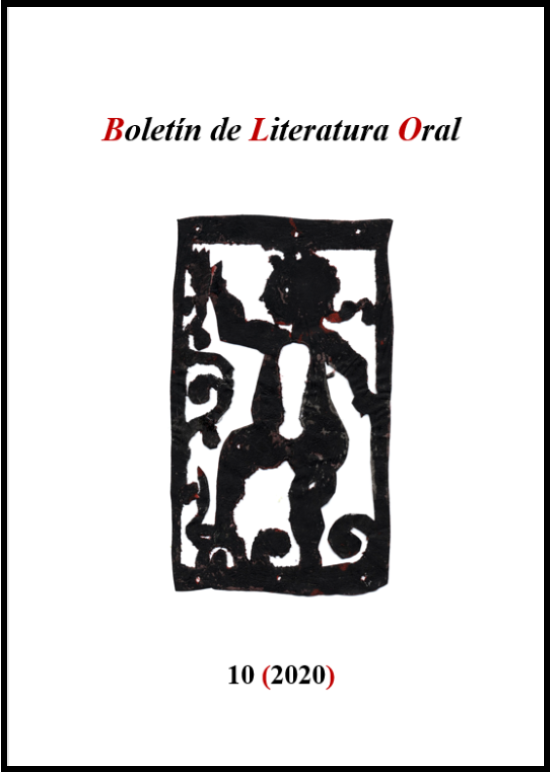
Sombrerón in the oral tradition of Chiapas
Keywords:
Oral Tradition, Mayan Culture, Hat, Indigenous PeoplesAbstract
With this work we have proposed to contribute to the literary heritage of oral tradition already recorded of the Mexican peoples and cultures of today with the publication of several stories and unpublished interviews conducted in 2019 in the region of the Altos de Chiapas around a character known as Sombrerón. The informants are speakers of the Tsotsil and Tzeltal languages (both from the Mayan family), in addition to Spanish. We have tried to limit as much as possible our margin of interpretation and to stick to the conclusions that can be drawn from the words of the narrators, as well as to respect as much as possible their mode of enunciation. We will introduce an ambivalent character who fulfils different functions that we could describe as "positive", such as being a protector of the mountain or a guardian of the seeds, but who can also pose enormous dangers for those who approach him. Our objective was to analyze the literary and cosmological imaginary that exists in different Chiapas cultural groups around the same figure of the oral tradition that goes beyond the limits of this region to highlight the permeable and itinerant potential of the oral tradition.
Downloads
References
BRADY, James E. y BONOR VILLAREJO, Juan Luis (1991): «Las cavernas en la geografía sagrada de los mayas», en Perspectivas antropológicas en el mundo maya, María Josefa Iglesias Ponce de León y Francesc Ligorred Perramon (coords.), Girona / Madrid, III Mesa Redonda de la Sociedad Española de Estudios Mayas, pp. 75-96. URL: <http://dialnet.unirioja.es/servlet/articulo?codigo=2775805>.
CHANDOMÍ, Patricia (2016): «Matrimonios forzados en Chiapas: cuando los Usos y Costumbres se imponen a la Constitución», LadoBe, 22 de mayo de 2016. URL: <https://ladobe.com.mx/2016/05/matrimonios-forzados-en-chiapas-cuando-los-usos-y-costumbres-se-imponen-a-la-constitucion/>.
CHEVALIER, Jean (1986): Diccionario de los símbolos, Barcelona, Herder.
CONSEJO NACIONAL PARA LA CULTURA Y LAS ARTES (2007): «El hombre que visitó el infierno», en Relatos tzeltales. Lo’il a’yej ta tzeltal kóp, Ciudad de México, Consejo Nacional para la Cultura y las artes / Dirección General de Culturas Populares, pp. 103-107.
EQUIPO DE PROMOTORES éTNICO-CULTURALES (1996): «Cómo surgió El Sombrerón», en Cuentos que parecen historia, historias que parecen leyenda, Ciudad de México, Praxis, pp. 72-73.
EQUIPO DE PROMOTORES éTNICO-CULTURALES (1996): «Cuento del Sombrerón», en Cuentos que parecen historia, historias que parecen leyenda, Ciudad de México, Praxis, 14-17.
FLORES ESTADA, Francisco (1998): «El Sombrerón», en Algunas leyendas coletas y de Chiapas, San Cristóbal de las Casas, Talleres de Editorial y Publicidad Flores, pp. 39-41.
FUENTES, R. J. (2005): «El Sombrerón de los Altos», en Cuentos chiapanecos de terror urbano. Relatos y leyendas, Tuxtla Gutiérrez, Ediciones y Sistemas Especiales, pp. 71-76.
HIGAREDA RANGEL, Yesica y Cardaillac, Louis (2011): «Una leyenda nahua de Santo Santiago», Revista de literaturas populares, 1, 2, pp. 59-67.
LA CHICA, María-Cruz (2016): «El Sombrerón. Una visión literaria del ‘otro’ en la tradición oral tojolabal», en Los personajes en formas narrativas de la literatura de tradición oral de México, Claudia Carranza Vera y Mercedes Zavala (eds.), San Luis Potosí, El Colegio de San Luis, pp. 383-408.
LA CHICA, María-Cruz (2017): Narrativa de tradición oral maya tojolabal, Madrid, Marcial Pons.
LA CHICA, María-Cruz (2018a) «Sombrerón y la mula: el viaje al otro mundo en un relato maya tojolabal», en 'Irás y no volverás'. El viaje en formas narrativas de la literatura tradicional de México, Claudia Verónica Carranza Vera, Nora Danira López Torres y Mercedes Zavala Gómez del Campo (eds.), San Luis Potosí, El Colegio de San Luis, pp. 345-376.
LA CHICA, María-Cruz (2018b): «Violencia contra la mujer indígena en la narrativa de tradición oral maya tojolabal», en Congreso Internacional de Estudios Culturales Interdisciplinares. Cultura e identidad en un mundo cambiante, Antonio Martín-Cabello, Almudena García-Manso y José Luis Anta Félez (coords.), Madrid, Universidad Rey Juan Carlos, pp. 229-237.
PINEDA DEL VALLE, César (1976): «De la Costa de Chiapas», en Cuentos y leyendas de la costa de Chiapas, Tuxtla Gutiérrez, UNACH, pp. 69-71.
RUZ, Mario H. (2002): «Credos que se alejan, religiosidades que se tocan. Los mayas contemporáneos» en Religión maya, Mercedes de la Garza Camino y Martha Ilia Nájera Coronado (eds.), Madrid, Trotta, pp. 321-364.
SEGURA ROMERO, Alma P. (2005): «Las cuevas. Espacio ritual en el México colonial. Siglo XVIII» en Memoria XVIII. Encuentro Nacional de Investigadores del Pensamiento Novohispano, San Luis Potosí, Universidad de San Luis Potosí, pp. 459-462. URL: <http://www.iifilologicas.unam.mx/pnovohispano/uploads/memoxviii/05_art_51.pdf>.
THOMPSON, John Eric S. (2007): Historia y religión de los mayas, Ciudad de México, Siglo XXI.
Published
Issue
Section
License
Authors who publish with this journal agree to the following terms:
- Authors retain copyright and grant the journal right of first publication with the work simultaneously licensed under a Creative Commons Attribution License that allows others to share the work with an acknowledgement of the work's authorship and initial publication in this journal.
- Authors are able to enter into separate, additional contractual arrangements for the non-exclusive distribution of the journal's published version of the work (e.g., post it to an institutional repository or publish it in a book), with an acknowledgement of its initial publication in this journal.
- Authors are permitted and encouraged to post their work online (e.g., in institutional repositories or on their website) prior to and during the submission process, as it can lead to productive exchanges, as well as earlier and greater citation of published work (See The Effect of Open Access).