
Making friendship
Ethnography and debates for a feminist anthropology of significant connections
DOI:
https://doi.org/10.17561/rae.v26.10527Keywords:
feminist , friendship, anthropologyAbstract
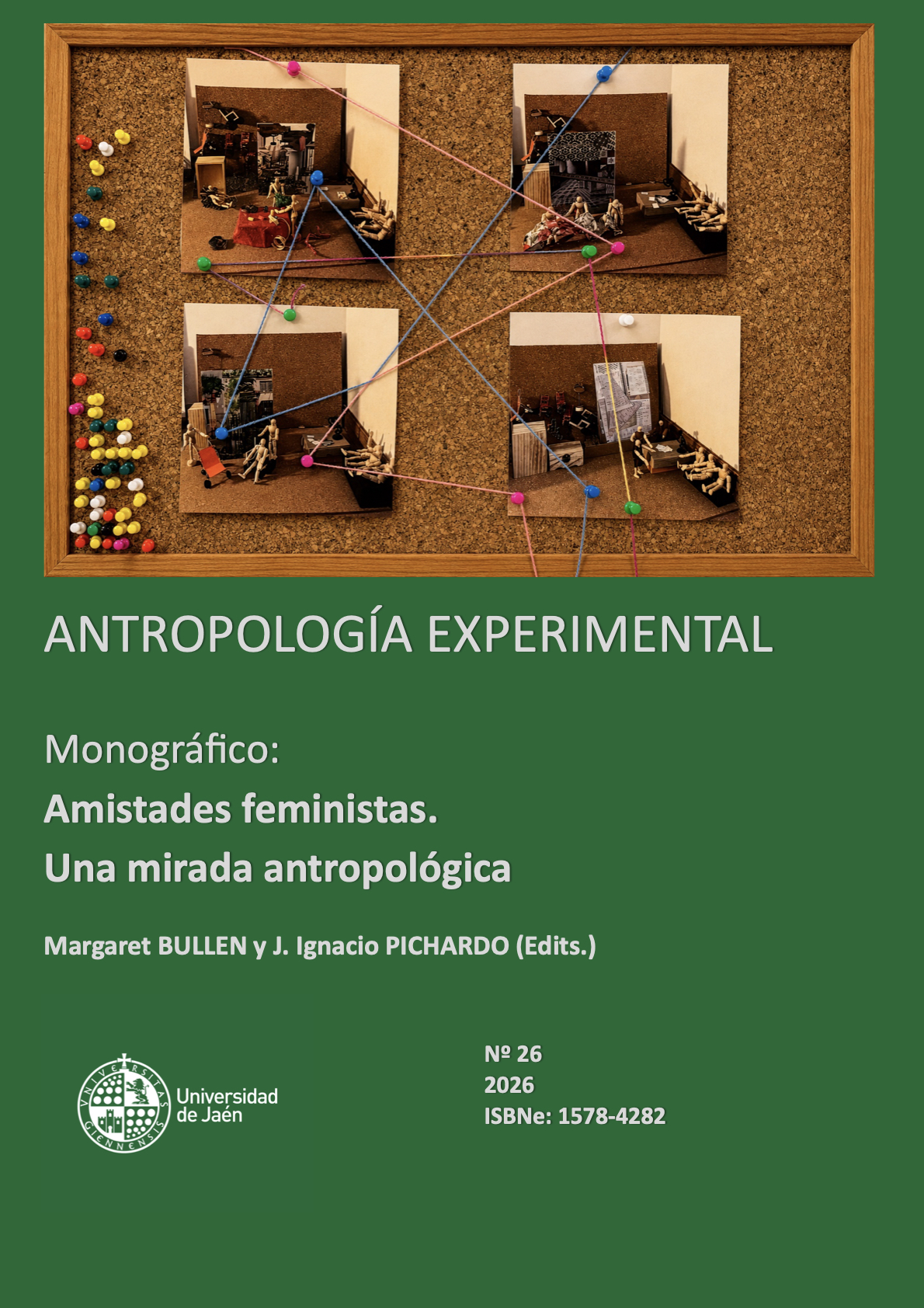
What is friendship for feminism? What is a feminist friendship? And how does feminist anthropology approach it? The articles in the monograph presented here address these issues from their many facets. Friendship is fashionable in feminism and in society: as a practice, to do, and as a theory, to think. Different ways of approaching coexistence, of configuring the family, of resignifying kinship. Different ways of creating links between social agents, more horizontal relationships, links that inspire and enable actions of transformation. Significant bonds not only because they are - mostly - chosen, but because they are the result of a political decision, an option for a type of relationship, a way of life that reflects and at the same time builds values of equality, horizontality and collectivity. From the feminist prism, the anthropological gaze detects and describes the new scenarios of friendship, where dissident and divergent forms emerge, subversive and resilient, pleasant and joyful, destined to weave networks of support, proposals for mutual care and enjoyment in new possibilities and life projects.
Downloads
References
Bell, Sandra y Coleman, Simon (eds.) (1999). The anthropology of friendship. Oxford, England: Berg.
Carsten, Janet (ed.) (2000). Cultures of relatedness: New approaches to the study of kinship. Cambridge, England: Cambridge University Press.
Desai, Amit y Killick, Evan (eds.) (2012). The ways of friendship: Anthropological perspectives. New York: Berghahn Books.
Illouz, Eva (2007). Intimidades congeladas: Las emociones en el capitalismo. Madrid: Katz.
Jamieson, Lynn (1998). Intimacy: Personal relationships in modern societies. Cambridge, England: Polity Press.
Puig de la Bellacasa, María (2017). Matters of care: Speculative ethics in more than human worlds. Minneapolis, MN: University of Minnesota Press.
Roseneil, Sasha (2004). Why we should care about friends: An argument for queering the care imaginary in social poli-cy. Social Policy and Society, 3(4), 409–419.
Smart, Carol (2007). Personal life: New directions in sociological thinking. Cambridge, England: Polity Press.
Weston, Kath (2003). Las familias que elegimos: Lesbianas, gays y parentesco. Barcelona: Bellaterra.
Zelizer, Viviana A. (2009). La negociación de la intimidad. Buenos Aires: Fondo de Cultura Económica.
Downloads
Published
Issue
Section
License
Copyright (c) 2026 J. Ignacio Pichardo, Margaret Bullen

This work is licensed under a Creative Commons Attribution 4.0 International License.
Responsabilidad de los autores: son responsables por las ideas y datos empíricos de los manuscritos, por la fidelidad de la información, por la corrección de las citas, por los derechos para publicar cualquier material incluido en el texto y por la presentación del manuscrito en el formato requerido por la Revista de Antropología Experimental. Un manuscrito enviado a la Revista de Antropología Experimental no debe estar publicado ni haber sido presentado en la misma forma a otro medio de publicación. Así, mismo, los autores reconocen que conocen y están de acuerdos con estas PAUTAS EDITORIALES Y FORMALES. La dirección de la Revista de Antropología Experimental está permanentemente abierta para aclarar cualquiera de los contenidos aquí citados u de cualquier otra índole que surjan en el proceso de publicación de los manuscritos.



