Bestiario pictórico: repensando los roles educativos desde la mirada A/r/tográfica
DOI:
https://doi.org/10.17561/rtc.extra10.9925Palabras clave:
Bestiario, dibujo, A/r/tográfia, personajeResumen
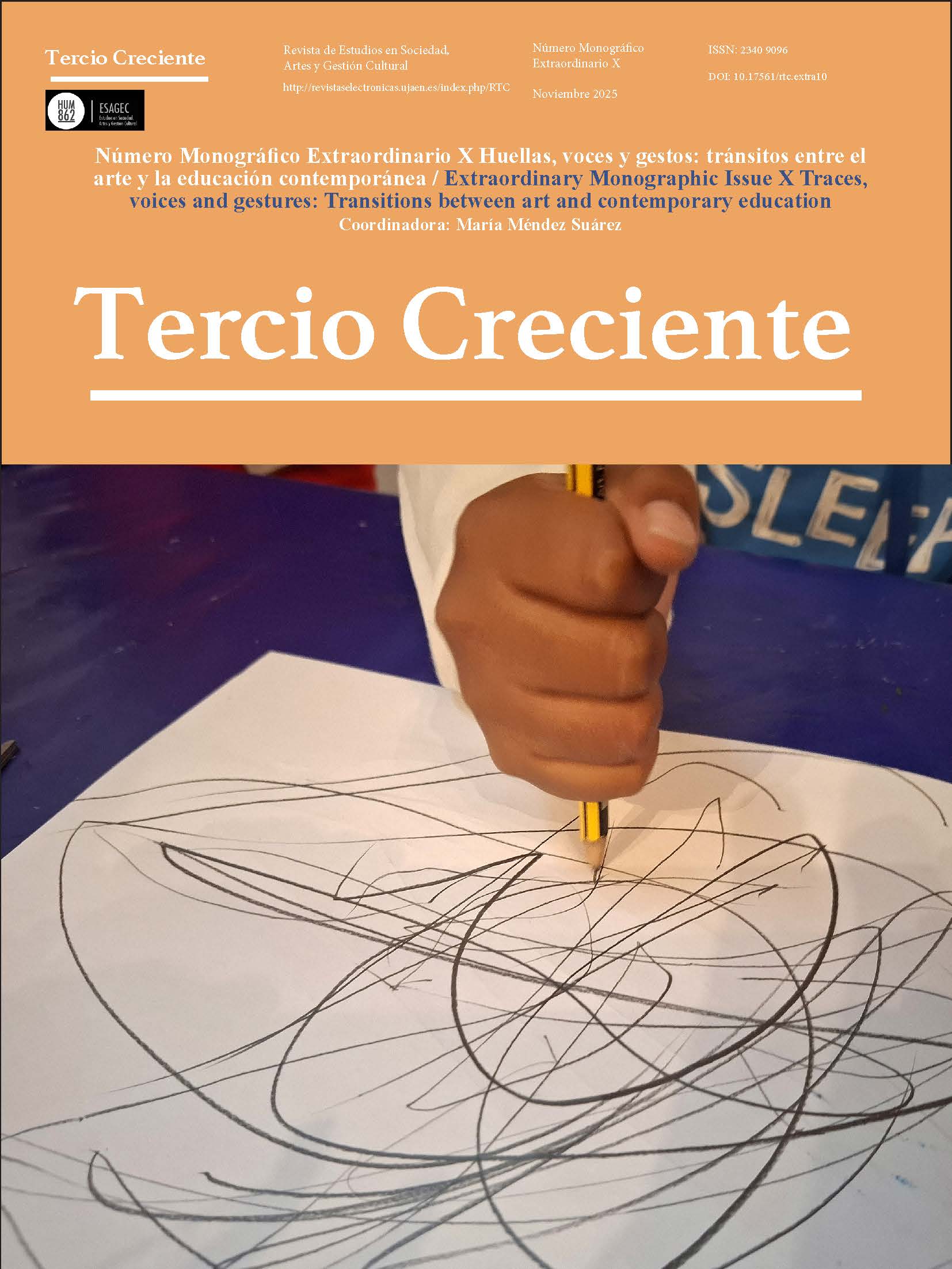
Este estudio utiliza la pintura generativa como método de experimentación visual y, dentro del marco metodológico de la A/r/tography, construye un registro visual crítico de roles educativos denominado Bestiario, que permite al estudio reconocer y repensar los roles en la educación. En el campo de la investigación en educación artística, la mayoría de los estudios se basan en el registro fotográfico y descuidan la evolución de la pintura, mientras que la pintura en sí misma posee una función generativa de crítica visual. La forma generativa de la pintura, como una vía metodológica de investigación, resalta la capacidad de la imagen para generar nuevo conocimiento y para criticar la sociedad. A través de la combinación de gestos corporales y las manchas aleatorias producidas por movimientos posturales, las manchas adquieren un nuevo significado educativo, permitiendo reconstruir y generar imágenes de roles inesperados. En el proceso de pensar mientras se pinta, el investigador explora los roles metafóricos de las imágenes, generando y construyendo modelos visuales metafóricos de roles educativos con características emocionales y corporales.
La metodología de investigación se basa en la A/r/tography y se desarrolla a partir de la reflexión mutua entre la práctica pictórica y el proceso investigativo. La pintura puede considerarse un método de entrenamiento del pensamiento que amplía la cognición. La generación final de Bestiario no solo funciona como registro de una obra artística, sino también como un resultado experimental de investigación en educación visual. Con la participación de estudiantes y otros participantes, también pueden generarse nuevos roles educativos, produciendo roles metafóricos con nuevas perspectivas críticas. Los resultados de la investigación amplían, a nivel teórico, la dimensión cognitiva de la pintura visual en el campo de la educación artística. A nivel metodológico, también han explorado la posibilidad de la pintura como una forma válida de investigación. En la práctica, también se ha establecido la viabilidad de construir y generar pensamiento crítico visual.
Aunque la metodología presenta grandes limitaciones en términos de participación social y posibilidades de difusión, la investigación basada en imágenes pictóricas y el método de crítica visual de la educación han logrado avances innovadores importantes. Por lo tanto, el estudio de los roles educativos visuales construidos en Bestiario responde a la problemática del desequilibrio mediático presente en el campo de la educación artística. Propone el valor de la pintura como herramienta para expandir la cognición y como instrumento de crítica visual, y proporciona una base teórica y un método práctico que pueden desarrollarse en futuras investigaciones educativas basadas en imágenes pictóricas.
Descargas
Referencias
1. Ordine, N. (2013). La utilidad de lo inútil. Barcelona: Acantilado.
2. Irwin, R. L., & de Cosson, A. (Eds.). (2004). A/r/tography: Rendering self through arts-based living inquiry. Vancouver, BC: Pacific Educational Press.
3. Roldán, J., & Marín Viadel, R. (2012). Metodologías artísticas de investigación en educación. Málaga: Ediciones Aljibe.
4. Barone, T., & Eisner, E. W. (2012). Arts based research. Thousand Oaks, CA: SAGE Publications. https://doi.org/10.4135/9781452230627
5. Eisner, E. W. (1998). El ojo ilustrado: indagación cualitativa y mejora de la práctica educativa. Madrid: Ediciones Morata.
6. Marín-Viadel, R., & Roldán, J. (2019). A/r/tografía e Investigación Educativa Basada en Artes Visuales en el panorama de las metodologías de investigación en Educación Artística. Arte, Individuo y Sociedad, 31(4), 881–895. https://doi.org/10.5209/aris.63409.
7. Sullivan, G. (2010). Art practice as research: Inquiry in visual arts (2nd ed.). Thousand Oaks, CA: SAGE Publications.
8. Mitchell, W. J. T. (1994). Picture theory: Essays on verbal and visual representation. Chicago: University of Chicago Press.
9. Berger, J. (2009). Ways of seeing. London: Penguin Books.
10. Méndez Suárez, M., & Arias-Camisón Coello, A. (2021). La educación de la mirada artística a través del cuerpo: Un ensayo visual neo-materialista. Afluir (Monográfico extraordinario III), 53–66. https://dx.doi.org/10.48260/ralf.extra3.58
11. Baker, S. (1993). Picturing the beast: Animals, identity, and representation. Urbana: University of Illinois Press.
Publicado
Número
Sección
Licencia
Derechos de autor 2025 Zhenyu Wang

Esta obra está bajo una licencia internacional Creative Commons Atribución 4.0.
Aquellos autores/as que tengan publicaciones con esta revista, aceptan los términos siguientes:
- Los autores/as conservarán sus derechos de autor y garantizarán a la revista el derecho de primera publicación de su obra, el cuál estará simultáneamente sujeto a la Licencia de reconocimiento de Creative Commons que permite a terceros compartir la obra siempre que se indique su autor y su primera publicación esta revista.
- Los autores/as podrán adoptar otros acuerdos de licencia no exclusiva de distribución de la versión de la obra publicada (p. ej.: depositarla en un archivo telemático institucional o publicarla en un volumen monográfico) siempre que se indique la publicación inicial en esta revista.
- Se permite y recomienda a los autores/as difundir su obra a través de Internet (p. ej.: en archivos telemáticos institucionales o en su página web) antes y durante el proceso de envío, lo cual puede producir intercambios interesantes y aumentar las citas de la obra publicada. (Véase El efecto del acceso abierto).
En caso de ser aceptados, los trabajos se publicarán bajo licencia Creative Commons.