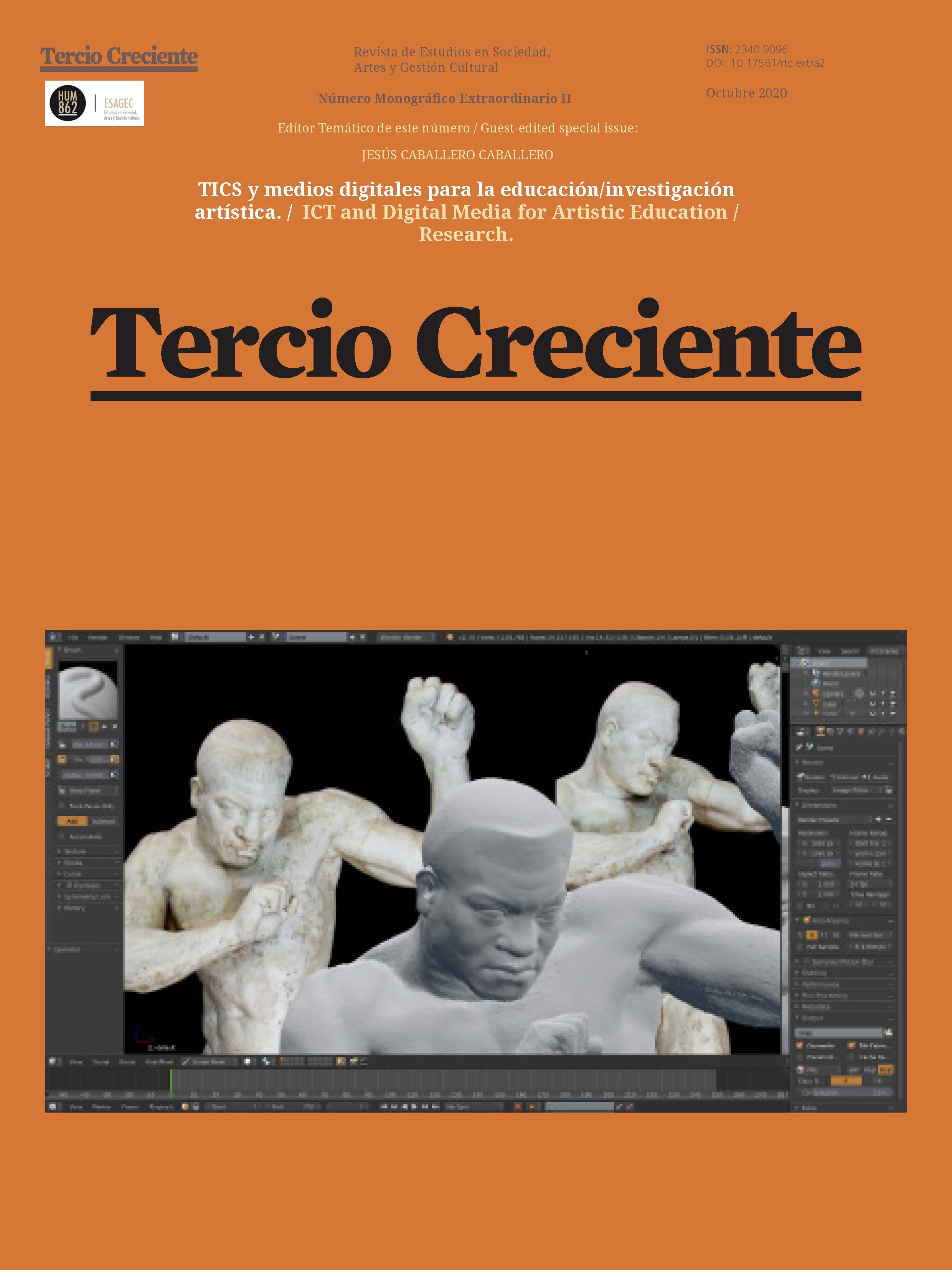
Educatión through the Clouds: an educational experience in lockdown
DOI:
https://doi.org/10.17561/rtc.extra2.5742Keywords:
Art education, online, education, divulgation, confinementAbstract
This study presents an educational experience with students from the IES Sol de Portocarrero (Almería) in the last stage of the Educación Secundaria Obligatoria (ESO), in the subject of Educación plástica, visual y audiovisual during the months of quarantine due to the COVID-19.
Throughout the months of lockdown, several activities have been carried out specifically designed for this situation, working on elements of the secondary school curriculum, using various digital tools supplied by the company Google. We have taken into account issues such as equal opportunities so that all students can carry them out, as well as the interaction between the activities, the sequencing between them, and the evaluation of these activities with different levels of execution.
This study presents each of the tools used, the activities carried out, the results obtained, and the evaluation of the students about this whole educational experience.
Downloads
References
Viñals Blanco, Ana; Cuenca Amigo, Jaime (2016) “El rol del docente en la era digital”. Revista interuniversitaria de Formación del Profesorado 30 (2). Universidad de Zaragoza. Recuperado de https://www.redalyc.org/jatsRepo/274/27447325008/html/index.html
Villota García, Stefanny Carolina; Zamora López, Gabriela Geraldine; Llanga Vargas, Edgar Francisco (2019) “Uso de Internet como base para el aprendizaje”. Revista Atlante: Cuadernos de Educación y Desarrollo. ISSN 1989-4155. Recuperado de https://www.eumed.net/rev/atlante/2019/05/internet-aprendizaje.html
Cabero Almenara, Julio; Córdoba Pérez, Margarita (2009) “Inclusión educativa: inclusión digital”. Revista Educación Inclusiva 2 (1). ISSN: 1130-0876. Recuperado de: https://revistaeducacioninclusiva.es/index.php/REI/article/view/27
Varsavsky, Julián (2020) “El viaje a la sociedad del cansancio digital”. [Ensayo]. Recuperado de http://repositorio.uasb.edu.ec/bitstream/10644/7153/1/03-EN-Varsavsky.pdf
D’Aloisio, Florencia (2014) “La secundaria como espacio-tiempo de sociabilidad: Aprendizajes para alivianar dificultades de vida y afrontar riesgos”. Cuadernos de Educación Año XII (12) ISSN 2344-9152. Recuperado de https://revistas.psi.unc.edu.ar/index.php/Cuadernos/article/view/9223
Canal de Youtube: unicoos https://www.youtube.com/user/davidcpv
Canal de YouTUbe: unProfesor https://www.youtube.com/user/unprofesorcom
García Jiménez, Antonio; Catalina García, Beatriz y Cruz López de Ayala, María (2016) “Adolescents and YouTube: Creation, Participaction and Consumption”. Prisma Social, número especial 1 ISSN 1989-3469. Recuperado de https://dialnet.unirioja.es/servlet/articulo?codigo=5602003
Pérez-Torres, Vanesa; Pastor-Ruiz, Yolanda; Abarrou-Ben-Boubaker, Sara (2018) “Los youtubers y la construcción de la identidad adolescente”. Recuperado de http://hdl.handle.net/10115/15249
Borba, Domingo y Avalos, Mariano (2019) “El uso responsable y seguro de internet. Aportes para la conformación de la ciudadanía digital”. Argentina. ISBN: 978-987-4434-87-6.
Downloads
Published
Issue
Section
License
Those authors who have publications with this magazine, accept the following terms:
The authors will retain their copyright and will guarantee to the journal the right of first publication of their work, which will be simultaneously subject to the Creative Commons Attribution License that allows third parties to share the work whenever their author is indicated and its first publication is this journal.
Authors may adopt other non-exclusive license agreements to distribute the version of the published work (eg to be deposited in an institutional telematic file or published in a monographic volume) provided the initial publication is indicated in this journal .
Authors are encouraged to disseminate their work via the Internet (eg in institutional telematic files or on their website) before and during the submission process, which can produce interesting exchanges and increase the number of citations of the published work..
In case of being accepted works will be published under Creative Commons license.