Virtual Skin: Arts-based Educational Research and Virtual Image
Virtual Skin: Arts-based Educational Research and Virtual Image
DOI:
https://doi.org/10.17561/rtc.extra2.5750Keywords:
virtual image, videomapping, visual artsAbstract
Summary
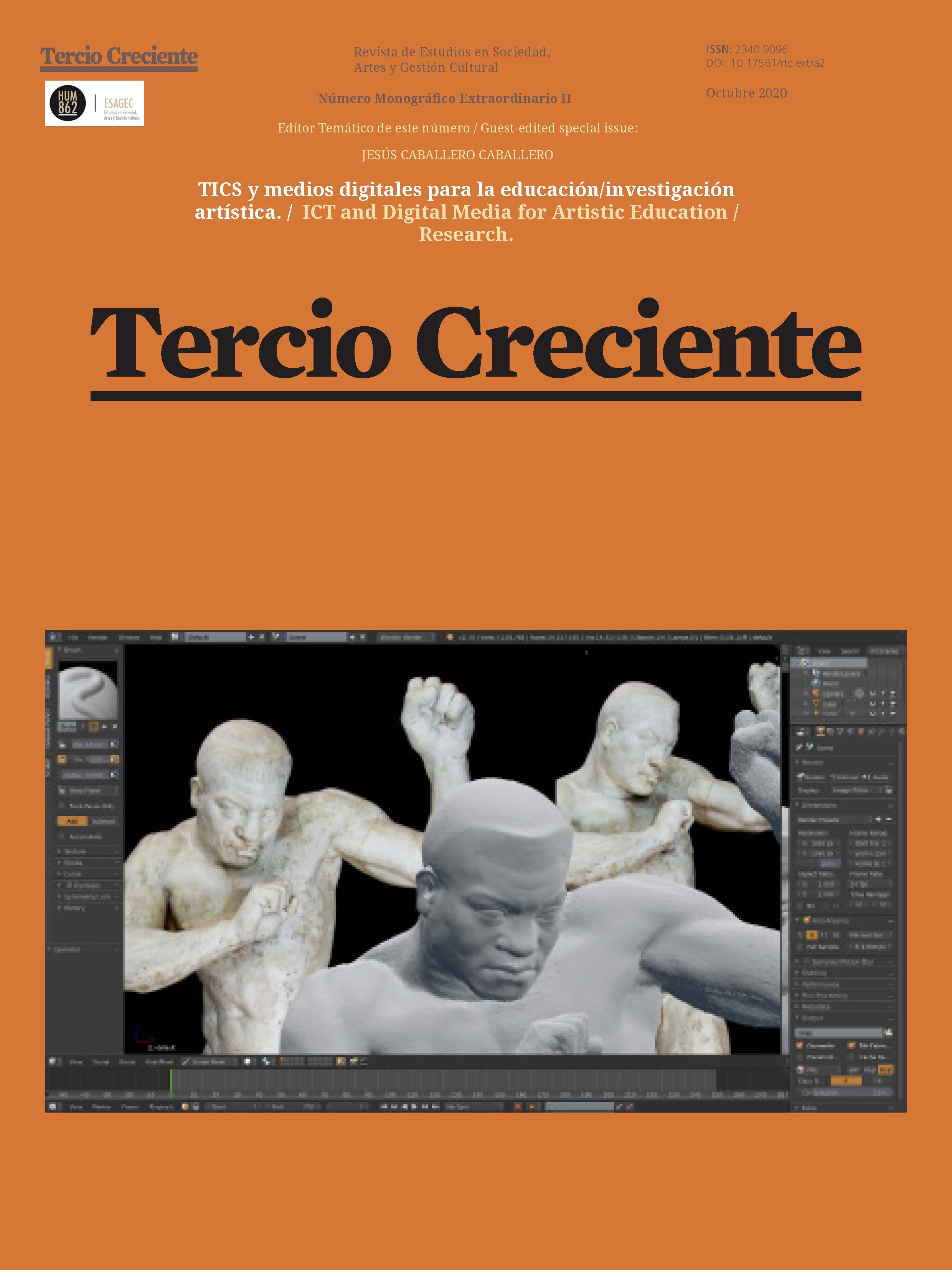
"Virtual Skin" is an educational workshop in Visual Arts that uses the virtual image from an a/r/tografic approach. We use video mapping on human skin to investigate the multiple creative, artistic and pedagogical possibilities that virtual environments have as spaces for image creation.
In every artistic activity there is a research purpose as long as the creation factor involved is taken into account (Muntané, M. D. C. G., Hernández, F. H., & López, H. J. P. (2006). Although such processes and research purposes need a scope of diffusion and conventional models of formulation and dissemination to allow critical activity and its validation by the academic community. Biggs, M. (2003).
In our creation workshop we have worked from the work of the photographer Daniel Oliver. His works are photographs of bodies with different forms of light projection. They are photographs that show volumes, shapes, anatomical contours combined with the multiple optical effects produced by light and the images it projects on the bodies. Thus, natural volumes are mixed with virtual skins, creating a sensation of depth on the skin and generating dialogues between the light that illuminates the scene and the light that comes from the projected images. The results of the artistic practice are shown in the form of photo essays or video creations.
Because of these games and combinations, in Oliver's work, the virtual image is a tool of enormous versatility in which the digital becomes virtual.
The creative use of the virtual image through ICTs that revolve around the technologies of storage, processing, retrieval and communication of information through different electronic and computer devices. Belloch, C. (2012) affordable in the classrooms of Artistic Education help in the construction of methodologies that allow through experimentation photography, video creation and use of digital platforms a fertile encounter of enormous aesthetic value. Innovative practices that develop a dialogue through light, spaces and the message as an end of the medium.
Downloads
References
• Belloch, C. (2012). Las Tecnologías de la Información y Comunicación en el aprendizaje. Departamento de Métodos de Investigación y Diagnóstico en Educación. Universidad de Valencia.
https://www.uv.es/bellochc/pedagogia/EVA1.pdf
• Biggs, M. (2003). The role of ‘the work’in research. PARIP.
• Deleuze, G. (1984). La imagen-movimiento. Barcelona: Paidós.
• Maldonado, Tomás (1999). Lo real y lo virtual. España: editorial Gedisa https://issuu.com/claudiadanielaarayarivera/docs/lo_real_y_lo_virtual___tomas_maldon
• Muntané, M. D. C. G., Hernández, F. H., & López, H. J. P. (2006). Bases para un debate sobre investigación artística. Ministerio de Educación.
• Marín-Viadel, R.; Roldán, J. (2019) A/r/tografía e Investigación Educativa Basada en Artes Visuales en el panorama de las metodologías de investigación en Educación Artística. Arte, Individuo y Sociedad 31(4), 881-895.
• Manovich, L. (2005). El lenguaje de los nuevos medios.
Downloads
Published
Issue
Section
License
Those authors who have publications with this magazine, accept the following terms:
The authors will retain their copyright and will guarantee to the journal the right of first publication of their work, which will be simultaneously subject to the Creative Commons Attribution License that allows third parties to share the work whenever their author is indicated and its first publication is this journal.
Authors may adopt other non-exclusive license agreements to distribute the version of the published work (eg to be deposited in an institutional telematic file or published in a monographic volume) provided the initial publication is indicated in this journal .
Authors are encouraged to disseminate their work via the Internet (eg in institutional telematic files or on their website) before and during the submission process, which can produce interesting exchanges and increase the number of citations of the published work..
In case of being accepted works will be published under Creative Commons license.