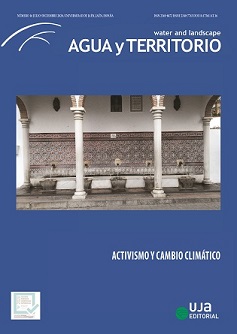
Il ruolo dell'attivismo socio-ambientale di base nella nuova ondata del movimento per il clima (2018-2020)
DOI:
https://doi.org/10.17561/at.16.5109Parole chiave:
activismo local socioambiental, activismo urbano, movimientos climáticosAbstract
Dal 2018, la nuova ondata del movimento per il clima rappresenta una nuova tappa dell'attivismo ambientale grazie anche alla partecipazione di attori locali che possono raggrupparsi sotto l'ombrello di esperienze di attivismo socio-ambientale di base. L'obiettivo principale di questo articolo è quello di evidenziare il ruolo di questo tipo di attivismo all'interno della nuova ondata del movimento per il clima. Nell'articolo presentiamo tre elementi che caratterizzano l'attivismo socio-ambientale e che consideriamo decisivi per lo sviluppo di strategie di fronte all'emergenza climatica: la presenza di attaccamenti al luogo locale e globale, la prioritizzazione dei valori altruistici e biosferici, e il carattere prefigurativo di queste pratiche. Nell'analisi confronteremo i risultati del progetto internazionale Protest for a Future: Composition, Mobilization and Motives of the Participants in Fridays For Future Climate Protests (2018-2020) con i risultati di diverse esperienze di attivismo socio-ambientale nel contesto urbano.
Downloads
Riferimenti bibliografici
Almeida, P., Stearns, L. B. 1998: “Political Opportunities and Local Grassroots Environmental Movements: The Case of Minamata”, Social. Problems, 45 (1), 37-60. https://doi.org/10.2307/3097142
Andrews, K., & Edwards, B. 2005: “The Organizational Structure of Local Environmentalism”, Mobilization, 10 (2), 213-234. https://doi.org/10.17813/maiq.10.2.028028u600744073
Aragón Durand, F. 2015: “La gestión del riesgo de inundaciones y los desafíos de la adaptación urbana al cambio climático: discursos y respuestas institucionales”, en Cruz Núñez, X., Delgado Ramos, G. C. y Oswald Spring, U. (coords.): México ante la urgencia climática: ciencia, política y sociedad. Ciudad de México (México), CEIICH, CRIM, PINCC, UNAM, 139-162.
Aureli, A. et al. 2016: Agua, megaciudades y cambio climático. Retrato de 15 ciudades emblemáticas del mundo. París (Francia), Organización de las Naciones Unidas para la Educación, la Ciencia y la Cultura.
Bedall, P. & Görg, C. 2014: “Antagonistic Standpoints. The climate justice coalition viewed in light of a theory of societal relationships with nature”, in Dietz, M. & Garrelts, H. (eds.): Routledge Handbook of The Climate Change Movement. New York (USA), Routledge, 44-65.
Biehl, J. 2015: Ecology or Catastrophe: The Life of Murray Bookchin. Oxford, Oxford University Press.
Brulle, R. J. 2000: Agency, Democracy, and Nature. Cambridge, MA (USA), MIT Press. https://doi.org/10.7551/mitpress/1158.001.0001
Bruno, K., Karliner, J. & Brotsky, C. 1999: Greenhouse Gangsters vs. Climate Justice, Transnational Resource and Action Center. Disponible en línea: www.corpwatch.org/downloads/greenhousegangsters. Pdf
Cable, S. & Benson, M. 1993: “Acting Locally: Environmental Injustice and the Emergence of Grass-roots Environmental Organizations”, Social Problems, 40 (4), 464-477. https://doi.org/10.2307/3096862
Čapek, S. M. 1993: “The ‘Environmental Justice’ Frame: A Conceptual Discussion and an Application”, Social Problems, 40 (1), 5-24. https://www.jstor.org/stable/3097023?seq=1. https://doi.org/10.1525/sp.1993.40.1.03x0069q
Carmichael, J. T., Jenkins, J. C. & Brulle, R. J. 2012: “Building Environmentalism: The Founding of Environmental Movement Organizations in the United States, 1900-2000”, The Sociological Quarterly, 53 (3), 422-453. https://doi.org/10.1111/j.1533-8525.2012.01242.x
Chatterton, P., Featherstone, D. & Routledge, P. 2012: “Articulating Climate Justice in Copenhagen: Antagonism, the Commons, and Solidarity”, Antipode, 45 (3), 602-620. https://doi.org/10.1111/j.1467-8330.2012.01025.x
Curiel Ballesteros, A., Garibay Chávez, M. G., Ramos de Robles, S. L., Ramírez Ojeda, G., Amaya Acuña, F. G. y Ruiz Corral, J. A. 2015: El clima cambiante. Conocimientos para la adaptación en Jalisco. Guadalajara (México). Universidad de Guadalajara, Centro Universitario de Ciencias Biológicas y Agropecuarias.
Davenport, L. 2017: Emotional Resiliency in the Era of Climate Change. Londres (UK), Jessica Kingsley Publishers.
De Moor, J., Uba, K., Wahlström, M, Wennerhag, M. & De Vydt, M. (cords.). 2020: Protest for a future II: Composition, mobilization and motives of the participants in Fridays For Future climate protests on 20-27 September, 2019, in 19 cities around the world. Göteborg (Suecia), Swedish Research Council for Sustainable Development. https://doi.org/10.17605/OSF.IO/ASRUW
Della Porta, D. 2004: Comitati di cittadini e democrazia urbana. Soveria Mannelli (Italia), Rubbettino Editore.
Della Porta, D. (ed.) 2007: The Global Justice Movement: Cross-National and Transnational Perspectives. London (UK), Routledge.
Della Porta, D. e Andretta, M. 2001: “Movimenti sociali e rappresentanza: i comitati spontanei dei cittadini a Firenze”, Rassegna Italiana di Sociologia, 1, 41-76. https://doi.org/10.1423/2558
Della Porta, D. & Parks, L. 2014: “Framing Processes in the Climate Movement: from Climate Change to Climate Justice”, en Dietz, M. & Garrelts, H. (eds.): Routledge Handbook of the Climate Change Movement. New York (USA), Routledge, 19-30.
Devine-Wright, P. 2014: “Dynamics of Place Attachment in a Climate Changed World”, en Manzo, L C. & Devine-Wright, P. (eds.): Place Attachment. Advances in Theory, Methods and Applications. Oxon-New York, Routledge, 165-177.
Devine-Wright, P. & Batel, S. 2017: “My neighbourhood, my country or my planet? The influence of multiple place attachments and climate change concern on social acceptance of energy infrastructure”, Global Environmental Change, 47, 110-120. https://doi.org/10.1016/j.gloenvcha.2017.08.003
Devine-Wright, P., Price, J. & Leviston, Z. 2015: “My country or my planet? Exploring the influence of multiple place attachments and ideological beliefs upon climate change attitudes and opinions”, Global Environmental Change, 30, 68-79. https://doi.org/10.1016/j.gloenvcha.2014.10.012
Dietz, M. & Garrelts, H. 2014: Routledge Handbook of the Climate Change Movement. New York (USA), Routledge. https://doi.org/10.4324/9780203773536
Feitelson, E. 1991: “Sharing the globe: the role of attachment to place”, Global Environmental Change, 1 (5), 396-406. https://doi.org/10.1016/0959-3780(91)90005-E
Gravante, T. 2015: “Interconnections between anarchist practices and grassroots struggles”, Interface: a Journal for and about Social Movements, 7 (1), 247-255.
Gravante, T. 2019a: “Prácticas emergentes de activismo alimentario en la Ciudad de México”, Iberoforum, Revista de Ciencias Sociales, 14 (28), 105-125.
Gravante, T. 2019b: “Prácticas y redes de autonomía alimentaria en la Ciudad de México: un acercamiento etnográfico”, Interdisciplina, 7 (19), 163-179. http://dx.doi.org/10.22201/ceiich.24485705e.2019.19.70292
Grin, J., Rotmanns, J. & Schot, J. 2010: Transitions to Sustainable Development. New Directons in the Study of Long Term Transformative Change. New York (USA), Routledge. https://doi.org/10.4324/9780203856598
Hadden, J. 2015: Networks in Contention: The Divisive Politics of Climate Change. Cambridge (UK), Cambridge University Press.
Helm, S. V., Pollitt, A., Barnett, M. A. Curran, M. A. & Craig, Z. R. 2018: “Differentiating environmental concern in the context of psychological adaption to climate change”, Global Environmental Change, 48, 158-167. https://doi.org/10.1016/j.gloenvcha.2017.11.012
IPCC 2007: Contribution of Working Group I to the Fourth Assessment Report of the Intergovernmental Panel on Climate Change. Solomon. Cambridge/New York (UK/USA), Cambridge University Press.
IPCC 2012: Managing the Risks of Extreme Events and Disasters to Advance Climate Change Adaptation. A Special Report of Working Groups I and II of the Intergovernmental Panel on Climate Change. Cambridge/New York (UK/USA), Cambridge University Press.
IPCC 2018a: Global Warming of 1.5°C. Special Report. Geneva. Geneva (Switzerland), World Meteorological Organization.
IPCC 2018b: What the IPCC Special Report On Global Warming Of 1.5°C Means For Cities. Geneva, (Switzerland), World Meteorological Organization.
Klein, N. 2014: This Changes Everything: Capitalism vs the Climate. New York (USA), Simon & Schuster.
Leff, E. 1996: “Ambiente y democracia: los nuevos actores del ambientalismo en el medio rural mexicano”, en De Grammont, H. C. y Tejera Gaona, H. (coords.): La sociedad rural mexicana frente al nuevo milenio. Ciudad de México (México), UAM, UNAM, Plaza y Valdés Editores, vol. IV, 35-63.
Leff, E. 2019: Ecología Política. De la deconstrucción del capital a la territorialización de la vida. Ciudad de México (México), Siglo XXI.
Low, S. M. & Altman, I. 1992: Place Attachment. Boston (USA), Springer. https://doi.org/10.1007/978-1-4684-8753-4
Lucatello, S. 2011: “Las dimensiones de justicia y equidad en el cambio climático: ¿esperando a Godot?”, en Lucatello, S. y Rodríguez Velázquez, D. (coords.): Las dimensiones sociales del cambio climático: un panorama desde México. ¿Cambio social o crisis ambiental? Ciudad de México (México), Instituto Mora y UNAM.
Moreno Sánchez, A. R. y Urbina Soria, J. 2008: Impactos sociales del cambio climático en México. Ciudad de México (México), INE/SEMARNAT/PNUD. http://d2ouvy59p0dg6k.cloudfront.net/downloads/impactos_sociales_cc.pdf
Norgaard, K. M. 2011: Living in Denial. Climate Change, Emotions, and Everyday Life. Cambridge (USA), MA, The MIT Press. https://doi.org/10.7551/mitpress/9780262015448.001.0001
OECD 2010: Cities and Climate Change. París (Francia), OECD Publishing. https://doi.org/10.1787/9789264091375-en.
Perlaviciute, G., Steg, L., Contzen, N., Roeser, S. & Huijts, N. 2018: “Emotional Responses to Energy Projects: Insights for Responsible Decision Making in a Sustainable Energy Transition”, Sustainability, 10 (7), 2526-2538. https://doi.org/10.3390/su10072526
Pleyers, G. 2010: Alter-Globalization. Becoming Actors in the Global Age. Cambridge (USA), Polity Press.
Poma, A. 2014: “Emociones y cambio cultural en dos experiencias de conflictos contra obras hidráulicas en España y México”, Agua y Territorio, 4, 96-106. https://doi.org/10.17561/at.v1i4.2167
Poma, A. 2017: Defendiendo territorio y dignidad. Emociones y cambio cultural en luchas contra represas en España y México. Campina Grande, Paraíba, Brasil y Sevilla: EDUEPB, Red WATERLAT-GOBACIT, Escuela de Estudios Hispano-Americanos-CSIC. https://doi.org/10.2307/j.ctvjk2wdg
Poma, A. 2018: “El papel de las emociones en la respuesta al cambio climático”, Interdisciplina, 6 (15), 191-214. http://dx.doi.org/10.22201/ceiich.24485705e.2018.15.63843
Poma, A. 2019: “Cambio climático y activismo ambiental: el papel de los apegos al lugar”, Tla-Melaua, Revista de Ciencias Sociales, 12 (46), 212-237. http://www.apps.buap.mx/ojs3/index.php/tlamelaua/article/view/573/pdf
Poma, A. & Gravante, T. 2016: “Environmental Self-organized Activism: Emotion, Organization and Collective Identity in Mexico”, International Journal of Sociology and Social Policy, 36 (9/10), 647-661. http://dx.doi.org/10.1108/IJSSP-11-2015-0128
Poma, A. y Gravante, T. 2018: “Emociones, identidad colectiva y estrategias en los conflictos socioambientales”, Andamios. Revista de Investigación Social, 15 (36), 287-309. https://doi.org/10.29092/uacm.v15i36.611
Poma, A. y Gravante, T. 2020: “La nueva ola de activismo climático en México. Un primer diagnóstico”, en Poma, A. y Gravante T. (coords.): Generando Con-Ciencia sobre el cambio climático. México, Instituto de Investigaciones Sociales-UNAM (en prensa).
Rising Tide North America 2010: The Climate Movement is Dead: Long Live the Climate Movement. www.risingtidenorthamerica.org. Consulta realizada el 28 de noviembre de 2019.
Rosas Pérez, I., Carranza Ortiz, G., Nava Cruz, Y. y Larqué Saavedra, A. 2006: “La percepción sobre la conservación de la cobertura vegetal”, en Urbina Soria, J. y Martínez Fernández, J. (comps.): Más allá del cambio climático. Las dimensiones psicosociales del cambio ambiental global. Ciudad de México (México), SEMARNAT, INE, UNAM, 123-140.
Sánchez Rodríguez, R. (editor) 2013: Respuestas urbanas al cambio climático en América Latina. Santiago de Chile (Chile), CEPAL, Naciones Unidas.
Schlosberg, D. 1999: “Networks and Mobile Arrangements: Organisational Innovation in the US Environmental Justice Movement”, Environmental Politics, 8 (1), 122-148. https://doi.org/10.1080/09644019908414441
Schlosberg, D. 2004: “Reconceiving Environmental Justice: Global Movements and Political Theories”, Environmental Politics, 13 (3), 517-540. https://doi.org/10.1080/0964401042000229025
Steg, L. 2016: “Values, Norms, and Intrinsic Motivation to Act Proenvironmentally”, Annual Review of Environment and Resources, 41, 277-292. https://doi.org/10.1146/annurev-environ-110615-085947
Taylor, D. E. 2000: “The Rise of the Environmental Justice Paradigm: Injustice Framing and the Social Construction of Environmental Discourses”, American Behavioral Scientist, 43 (4), 508-580. http://dx.doi.org/10.1177/0002764200043004003
UN-Habitat. 2011: Cities and Climate Change. Global Report on Human Settlements 2011. London/Washington DC (USA), Earthscan. https://doi.org/10.4324/9781849776936
Velasco Rodríguez, G., Becerra Delgado, M. L., Vázquez Ramírez, I., Skwierinski Durán, A., Haro González, M. E. y Ortega Ramírez, M. 2014: Programa de Acción Climática de la Ciudad de México 2014-2020. Ciudad de México (México), Centro Mario Molina para Estudios Estratégicos sobre Energía y Medio Ambiente, A. C.
Velázquez Quesada, S. I. y Martínez Ortega, M. 2010: “Conflictos sociales y cambio climático en México”, en M. J. Cárdenas (Comp.): México ante el cambio climático. Evidencias, impactos, vulnerabilidad y adaptación. Ciudad de México (México), Greenpeace, 40-42.
Wahlström, M., Kocyba, P. De Vydt, M. & de Moor, J. 2019: Protest for a future: Composition, mobilization and motives of the participants in Fridays For Future climate protests on 15 March, 2019 in 13 European cities. Göteborg (Suecia), Swedish Research Council for Sustainable Development. https://doi.org/10.17605/OSF.IO/XCNZH
Yates, L. 2014: “Rethinking Prefiguration: Alternatives, Micropolitics and Goals in Social Movements”, Social Movement Studies, 14 (1), 1-21. https://doi.org/10.1080/14742837.2013.870883
Pubblicato
Fascicolo
Sezione
Licenza
© Universidad de Jaén-Seminario Permanente Agua, territorio y medio ambiente-CSIC.
Gli originali pubblicati nelle edizioni cartacee ed elettroniche di questa rivista sono di proprietà dell'Università di Jaén e del Seminario Permanente Agua, territorio y medio ambiente (CSIC), nonché delle Università che pubblicano monografie specifiche in America Latina o in Europa. L'origine deve essere citata in ogni riproduzione parziale o totale.
Se non diversamente indicato, tutti i contenuti dell'edizione elettronica sono distribuiti con licenza "Creative Commons Attribution 4.0 Spain" (CC-by). Potete consultare da qui la versione informativa e il testo legale della licenza. Questa circostanza deve essere espressamente dichiarata in questo modo quando necessario.