Developing a postdigital approach in the Art Education classroom
DOI:
https://doi.org/10.17561/rtc.21.6664Keywords:
Art Education, Postmodern Curriculum, COVID-19, Critical Pedagogy, PostdigitalAbstract
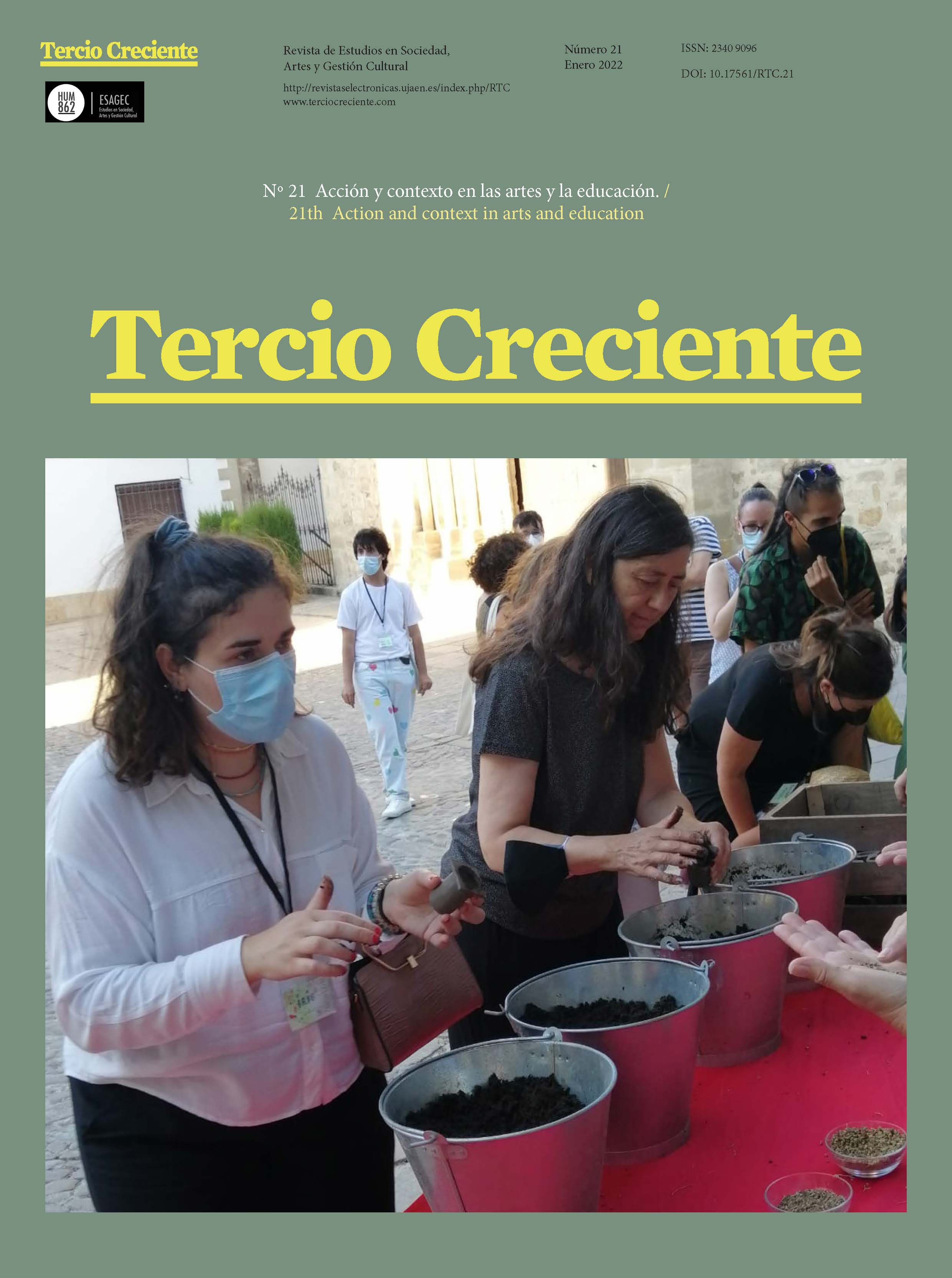
The period of sanitary crisis produced by COVID-19 has revealed fissures in social and economic terms, with educational practice being one of the main agents affected. This unprecedented crisis has led to a reflection on the part of educators who must ask themselves what/who they are educating for and how to do so from a pedagogical point of view. Thus, a substantial remodelling of the educational system implies recognising our immediate context, a hybrid and mediatised space where the analogue and the digital merge: a postdigital context. From a philosophical perspective, the postdigital establishes a critical look towards technology, media and communication networks, and therefore, it is susceptible to be implemented in the art education classroom in response to the postmodern curriculum that demands a critical pedagogy and a questioning of the established. This text presents a reflection from a post-digital, educational and artistic point of view through an action carried out with Primary Education students during the 2020/2021 academic year, an academic year marked by digital technology, the reconfiguration of teaching and a massive consumption of audiovisual culture. The results of the proposed practice lead to an understanding of the arts as a vehicle for social criticism and transformation of the collective imaginary. In this way, a series of artistic actions were generated through collective experimentation and intercreation, involving a public that receives the work and gives it meaning.Downloads
References
Aparici, Roberto, Escaño, Carlos, y García-Marín, David (2018). Espectáculo y mercado pedagógico en el capitalismo informacional. In La otra educación. Pedagogías críticas para el siglo XXI. (p. 321). UNED - Universidad Nacional de Educación a Distancia.
Arañó, Juan Carlos (2003). La investigación en educación artística, entre la utopía y la irrealidad. Educación Artística: Revista de Investigación (EARI), 1, 24.
Barbosa, Ana Mae (2012). 1a Bienal de Educación Artística “Geografía de un vínculo.” El Arte/Educación Que Necesitamos, 25–33.
Barragán, José María (2005). Educación artística: perspectivas críticas y práctica educativa. En Investigación en educación artística: temas, métodos y técnicas de indagación sobre el aprendizaje y la enseñanza de las artes y culturas visuales (pp. 43–81). Universidad de Granada.
Castells, Manuel (2001). La galaxia Internet. Areté.
Castells, Manuel (2009). Creatividad, innovación y cultura digital. Un mapa de sus interacciones. TELOS (Cuadernos de Comunicación e Innovación), 75, 1–6.
Chalmers, F. Graeme (2003). Arte, educación y diversidad cultural. Paidós.
Cramer, Florian (2015). What is ‘post-digital’? In Postdigital Aesthetics: Art, Computation and Design (pp. 12–26). Palgrave Macmillan. https://doi.org/10.1057/9781137437204_2
Desai, Dipti (2017). Artistic activism in dangerous times: Teaching and learning against the grain. Visual Inquiry: Learning and Teaching Art, 6(2), 135–145. https://doi.org/10.1386/vi.6.2.135_2
Dewey, John (2008). El arte como experiencia. Paidós.
Efland, Arthur D., Freedman, Kerry, y Stuhr, Patricia (2003). La educación en el arte posmoderno. Paidós Ibérica.
Eisner, Elliot W. (2002). Qué enseñan las artes y en qué se nota. En El arte y la creación de la mente (pp. 97–123). Paidós.
Escaño, Carlos (2010). Hacia una educación artística 4.0. Arte, Individuo y Sociedad, 22(1), 135–144.
Escaño, Carlos (2017). Cultura, remezcla y sostenibilidad. La perversión de la sostenibilidad cultural o las mentiras neoliberales sobre la cultura en la sociedad-red. Iberoamérica Social: Revista-Red de Estudios Sociales, VII, 31–33.
Escaño, Carlos (2021). Educación para un mundo postdigital. In R. Aparici & J. Martínez-Pérez (Eds.), El algoritmo de la incertidumbre (pp. 99–107). Gedisa.
Giroux, Henry (2015). Cuando las escuelas se convierten en zonas muertas de la imaginación: manifiesto de la pedagogía crítica. Revista de Educación, 8, 11–26. https://fh.mdp.edu.ar/revistas/index.php/r_educ/article/view/1331
Giroux, Henry, y McLaren, Peter (1998). Sociedad, cultura y educación. Miño y Dávilo Editores.
Greene, Maxine (2005). Liberar la imaginación. Ensayos sobre educación, arte y cambio social. Graó.
Huerta, Ricard (2020). Educación artística más allá del coronavirus: diálogo con Estitxu Aberasturi, Carlos Escaño y Carmen María Belmonte. EARI Educación Artística Revista de Investigación, 11, 207–222. https://doi.org/10.7203/eari.11.17868
Jandrić, Petar (2017). Learning in the Age of Digital Reason. Sense Publisher. https://doi.org/10.1007/978-94-6351-077-6
Jandrić, Petar (2019). The Postdigital Challenge of Critical Media Literacy. The International Journal of Critical Media Literacy, 1(1), 26–37. https://doi.org/10.1163/25900110-00101002
Jandrić, Petar, Knox, Jeremy, Besley, Tina, Ryberg, Thomas, Suoranta, Juha, & Hayes, Sarah (2018). Postdigital science and education. Educational Philosophy and Theory, 50(10), 893–899. https://doi.org/10.1080/00131857.2018.1454000
Jandrić, Petar, Ryberg, Thomas, Knox, Jeremy, Lacković, Nataša, Hayes, Sarah, Suoranta, Juha, Smith, Mark, Steketee, Anne, Peters, Michael, McLaren, Peter, Ford, Derek R., Asher, Gordon, McGregor, Callum, Stewart, Georgina, Williamson, Ben, & Gibbons, Andrew (2019). Postdigital Dialogue. Postdigital Science and Education, 1(1), 163–189.
https://doi.org/10.1007/s42438-018-0011-x
Maeso-Broncano, Ana (2019). (Per)forming ourselves. Relaciones entre educación –artística– para el desarrollo, feminismos y performance. In Lo que no se ve no existe. Artes, imagen y educación para el desarrollo. (pp. 93–109). UNED - Universidad Nacional de Educación a Distancia.
Mesias-Lema, José María (2019). Educación artística sensible. Cartografía contemporánea para arteducadores. Graó.
Mesías-Lema, José María (2017). Art teacher training: A photo essay. International Journal of Education Through Art, 13(3), 395–404. https://doi.org/10.1386/eta.13.3.395_1
Mirzoeff, Nicholas (2016). Cómo ver el mundo. Una nueva introducción a la cultura visual. Paidós.
Osuna-Acedo, Sara, Frau-Meigs, Divina, y Marta Lazo, Carmen (2018). Educación mediática y formación del profesorado. Educomunicación más allá de la alfabetización digital. Revista Interuniversitaria de Formación Del Profesorado, 91(91), 29–42.
Prada, Juan Martín (2012). Prácticas artísticas e Internet en la época de las redes sociales. Ediciones Akal.
Read, Herbert (1969). Función de las artes en la sociedad contemporánea. In Arte y alienación. Proyección.
Vattimo, Gianni (1990). Posmodernidad: .una sociedad transparente? En En torno a la
posmodernidad (pp. 9-21).Anthropos.
Zafra, Remedios (1999). El instante invisible del net. Aleph. Net Art. Net Critique, 2–5. http://www.remedioszafra.net/textos.html
Zafra, Remedios (2015). Educación y cultura-red: potencias y contradicciones para una transformación necesaria. Profesorado: Revista de Curriculum y Formación Del Profesorado, 19(2), 11–24.
Downloads
Published
Issue
Section
License
Copyright (c) 2021 Julia Mañero Contreras

This work is licensed under a Creative Commons Attribution 4.0 International License.
Those authors who have publications with this magazine, accept the following terms:
The authors will retain their copyright and will guarantee to the journal the right of first publication of their work, which will be simultaneously subject to the Creative Commons Attribution License that allows third parties to share the work whenever their author is indicated and its first publication is this journal.
Authors may adopt other non-exclusive license agreements to distribute the version of the published work (eg to be deposited in an institutional telematic file or published in a monographic volume) provided the initial publication is indicated in this journal .
Authors are encouraged to disseminate their work via the Internet (eg in institutional telematic files or on their website) before and during the submission process, which can produce interesting exchanges and increase the number of citations of the published work..
In case of being accepted works will be published under Creative Commons license.