From caos to creation at Dana: Doodling art for pre-service teachers emotional-educational sustainability
DOI:
https://doi.org/10.17561/rtc.extra10.9992Keywords:
Art Education, Teacher Training, Emotional Wellbeing, Doodling Art, LifeComp, DanaAbstract
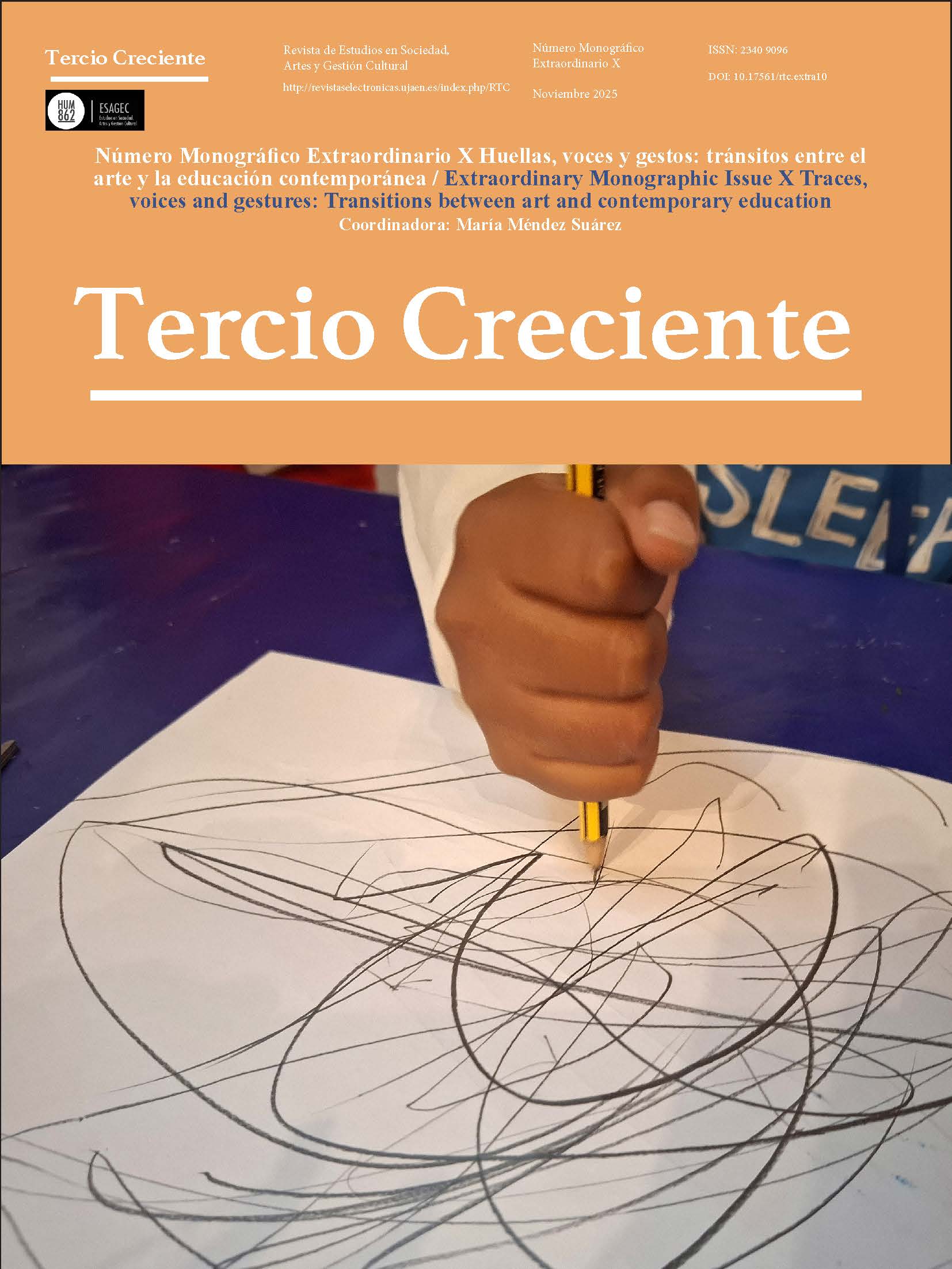
This article presents research in arts education developed after the DANA climate catastrophe in the Valencian Community (2024), which focuses on the use of doodling art as a psycho-pedagogical tool for future teachers. The intervention was carried out with 66 students from the Primary Education Degree programme at the University of Valencia, integrating the art of doodling as a means of emotional expression, reflection and self-regulation in a crisis context. The study uses the European LifeComp framework on personal, social and learning key competences, broken down into nine competences. Using a qualitative approach, the students' graphic and narrative works were analysed to investigate whether the teaching proposal promotes these competences and revealed a significant impact on competences such as communication, self-regulation and flexibility. The results show that doodling art promotes emotional management, critical thinking and autonomous learning, positioning itself as an accessible, therapeutic and replicable technique in educational contexts. Experience shows that art can help to bring order to chaos, offering future teachers tools to deal with traumatic situations from a pedagogically and emotionally sustainable perspective.
Downloads
References
Curl, K. (2008). Assessing stress reduction as a function of artistic creation and cognitive focus. Art Therapy: Journal of the American Art Therapy Association, 25(4), 164–169. https://doi.org/10.1080/07421656.2008.10129550
Cope, B., and Kalaltzis, M. (2018). Nuevo Aprendizaje. Elementos de una ciencia de la educación. Octaedro.
Cope, B., y Kalantzis, M. (2020). Making Sense: Reference, Agency, and Structure in a Grammar of Multimodal Meaning. Cambridge University Press. https://doi.org/10.1590/1678-460X202238256749
Deci, E. L., & Ryan, R. M. (1985). Intrinsic motivation and self-determination in human behavior. Plenum Press. http://dx.doi.org/10.1007/978-1-4899-2271-7
Drake, J.E., 2021. How Drawing to Distract Improves mood in Children. Frontiers in Psychology, vol.12, pp.622927. ISSN1664-1078. https://doi.org/10.3389/fpsyg.2021.622927
Haring, K. (en Loyer, S. (Ed.)). (2023). Keith Haring: Art Is for Everybody. Del Monico Books https://delmonicobooks.com/book/keith-haring-art-is-for-everybody/
Isis, P., Bokoch, R., Fowler, G., & Hass-Cohen, N. (2023). Efficacy of a Single Session Mindfulness-based Art Therapy Doodle Intervention. Art Therapy, 41(1), 11–20. https://doi.org/10.1080/07421656.2023.2192168
Kaimal, G., Ayaz, H., Herres, J., Dieterich-Hartwell, R., Makwana, B., Kaiser, D. H., & Nasser, J. A. (2017). Functional near-infrared spectroscopy assessment of reward perception based on visual self-expression: Coloring, doodling, and free drawing. The Arts in Psychotherapy, 55, 85–92. https://doi.org/10.1016/j.aip.2017.05.004
Kaimal, G., Ray, K., & Muniz, J. (2016). Reduction of cortisol levels and participants' responses following art making. Art Therapy, 33(2), 74 80. https://doi.org/10.1080/07421656.2016.1166832
Kern, R. (2000). Literacy and language teaching. Oxford University Press.
Kucer, S. B. (2014). Dimensions of literacy: A conceptual base for teaching reading and writing in school settings (4a ed.). Routledge.
Martínez Díez, N. y López Fernández Cao, M., & (2004). Arteterapia y Educación.Comunidad de Madrid. Consellería de Educación. Dirección General de Promoción Educativa.
Pinelo Páez, C. M. (2019). Una experiencia a/r/tográfica en educación artística inspirada en pintura oriental "sumi-e": Las metáforas de la tinta y la indagación sobre la conciencia plena. Revista de Educación Artística, (14), 75–95. https://doi.org/10.5209/arte.62569
Posadas de Julián, P., Verdejo Lucas, C., de Rueda Villén, B., Haro-Soler, M. d. M., Gijón-Puerta, J., Cámara Aguilera, E., & García de Quesada, M. (2024). From Life-Skills Research and Training to Sustainability: A Case Study from a Spanish University. Challenges, 15(3), 35. https://doi.org/10.3390/challe15030035
Sala, A., Punie, Y., Garkov, V., y Cabrera Giraldez, M. (2020). LifeComp: The European framework for personal, social and learning to learn key competence. Publications Office of the European Union. https://doi.org/10.2760/302967
Schott, G. D. (2011). The art of medicine: Doodling and the default network of the brain. The Lancet, 378(9797), 1133-1134. https://doi.org/10.1016/S0140-6736(11)61496-7
Wallace, N., 2020. Thinking while drawing and drawing to think: Exploring ‘reflective doodling’ as a critical reflective practice in design for transitions. DRS2020: Synergy [en línea]. S.l.: s.n., [consulta: 10 mayo 2025]. https://doi.org/10.21606/drs.2020.187
Wu.J.,2024. Colorful Conversations: Enhancing Communication in Non speaking Toddlers Through Art Therapy. Expressive Therapies Capstone Theses [en línea], https://digitalcommons.lesley.edu/expressive_theses/882
Downloads
Published
Issue
Section
License
Copyright (c) 2025 Nuria Sánchez-León, Matilde Portalés-Raga, Verónica Juárez-Ramos

This work is licensed under a Creative Commons Attribution 4.0 International License.
Those authors who have publications with this magazine, accept the following terms:
The authors will retain their copyright and will guarantee to the journal the right of first publication of their work, which will be simultaneously subject to the Creative Commons Attribution License that allows third parties to share the work whenever their author is indicated and its first publication is this journal.
Authors may adopt other non-exclusive license agreements to distribute the version of the published work (eg to be deposited in an institutional telematic file or published in a monographic volume) provided the initial publication is indicated in this journal .
Authors are encouraged to disseminate their work via the Internet (eg in institutional telematic files or on their website) before and during the submission process, which can produce interesting exchanges and increase the number of citations of the published work..
In case of being accepted works will be published under Creative Commons license.